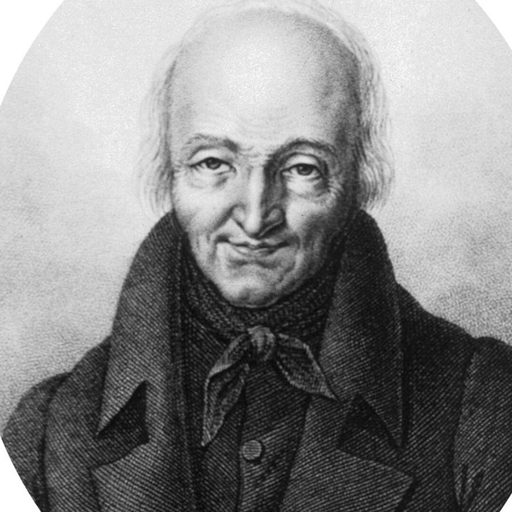
Haüy was a priest when he came to mineralogy, and he drew a whole science from it: in January 1781 a paper on garnets served him to show that the visible form of a crystal depends on its inner arrangement. Imprisoned under the Revolution as a non-juring priest, he owed his release to Geoffroy Saint-Hilaire. He then worked on weights and measures, and the decilitre owes him its definition.
The story
Born at Saint-Just-en-Chaussée on 28 February 1743, a priest, René-Just Haüy came to mineralogy through Daubenton — and founded an entire science there. Alfred Lacroix would sum it up: “No science has ever been so completely the work of one man.”
On 10 January 1781 his paper on garnets was read to the Académie des sciences: he had just discovered the law of crystallisation — that the outward form of a crystal follows from its internal structure.
The Revolution imprisoned him as a refractory priest; he was freed thanks to Geoffroy Saint-Hilaire. As secretary of the Commission on weights and measures he worked with Lavoisier — the decilitre owes him its definition.
First curator of the collections of the École des mines in 1795, author of the Traité de minéralogie (1801), honorary canon of Notre-Dame in 1802 by decision of Bonaparte, he held the chair of mineralogy at the Muséum until his death.
He died on 3 June 1822 and rests in Division 60, on Chemin Gosselin, second row, in the same grave as his brother Valentin (1745-1822), founder of the first school for the blind in the world, who died the same year.
The grave
A family tomb beneath the heading “FAMILLES HAUY-VUILLEMOT-ROUGERON”, whose two main inscriptions bring together the brothers and their two callings: “Valentin HAUY, premier instituteur des aveugles, 1745-1822” — first teacher of the blind — and “Abbé René-Just HAUY, savant minéralogiste, 1743-1822” — learned mineralogist. They died the same year. Two formulas of a few words, for the first school for the blind in the world and for the founding of crystallography.
On site, do not miss
A single stone for two sciences: “Valentin HAUY, premier instituteur des aveugles, 1745-1822” — first teacher of the blind — and “Abbé René-Just HAUY, savant minéralogiste, 1743-1822” — learned mineralogist. The brothers died the same year.
Visitors' questions
Where is René-Just Haüy's grave?
In Division 60, chemin Gosselin, second row — and it is the same one as his brother's. The stone reads “FAMILLES HAUY-VUILLEMOT-ROUGERON”, then the two brothers, both dead in 1822 — the mineralogist and the teacher of the blind.
Valentin HaüyWhat did René-Just Haüy found?
Crystallography. His paper of 1781 on garnets established that the outward form of a crystal follows from its internal structure. Alfred Lacroix summed it up: “No science has ever owed so much to a single man.”
Michel ChaslesDo the two Haüy brothers rest together?
They do, in the same grave, and they died in the same year, 1822: René-Just the mineralogist and Valentin, “premier instituteur des aveugles”, the first teacher of the blind, founder of the school that would produce Louis Braille. They were born two years apart, at Saint-Just-en-Chaussée.
Georges CuvierWas Haüy imprisoned during the Revolution?
He was, as a non-juring priest — he refused the oath to the constitution. He was released thanks to the intervention of the naturalist Geoffroy Saint-Hilaire, and shortly afterwards became secretary of the Commission on Weights and Measures.
Étienne Geoffroy Saint-HilaireAudio guide to Père Lachaise: the best unusual guided tour!
Discover the secrets of the most astonishing tombs
the audio guidefrom€6.99