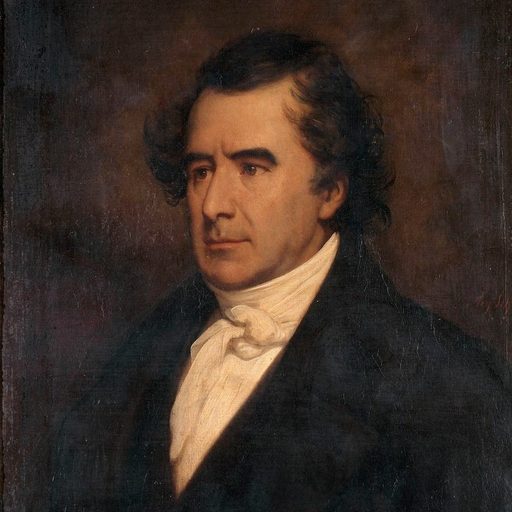
Sent to measure the arc of the meridian in Spain, he was imprisoned as a spy before completing his mission. Director of the Observatory, he signed as Minister of the Navy, in 1848, the decree abolishing slavery in the colonies. After 1851 he refused the oath, and the regime did not dare to dismiss him.
The story
Dominique François Arago was born on 26 February 1786 at Estagel, in the Pyrénées-Orientales. Admitted to Polytechnique, he was sent from 1806 to 1809 to measure the arc of the meridian in Spain — a mission he completed after being imprisoned by the Spanish, who took him for a spy.
His work on the polarisation of light, on magnetism and on electricity gave him a European authority. In 1830 he was appointed director of the Paris Observatory, a post he kept until his death, and he made his public lectures a Paris event.
A republican, he entered politics without leaving science behind. In 1848, a member of the provisional government and minister of the Navy and the Colonies, he signed the decree that abolished slavery in the French colonies.
After the coup of 1851 he refused to swear the oath to Louis-Napoléon Bonaparte. The regime did not dare remove a scientist of that standing: he was left the Observatory without the signature being required.
He died in Paris on 2 October 1853. His monument in Division 4 received a bronze bust by David d'Angers five years later. His son Emmanuel, a lawyer and politician who died in 1896, lies with him.
The grave
An imposing neoclassical monument, designed by the architect Félix Duban. The bronze bust that crowns it is by David d'Angers and was set in place in 1858, five years after the scientist's death — the sculptor, who also rests in Père-Lachaise, portrayed a good many of the great men of the century. The grave also shelters Emmanuel Arago (1812-1896), the scientist's son, a lawyer and politician of the Third Republic.
On site, do not miss
The bust by David d'Angers and Duban's architecture, then, lower on the stone, the name of the son, Emmanuel Arago, who died forty-three years after his father.
Visitors' questions
Where is François Arago's grave?
In Division 4 of Père-Lachaise. Félix Duban's neoclassical monument, topped with a bust by David d'Angers, is easy to spot from the path.
Abbé SicardWhat did François Arago do in 1848?
As a member of the provisional government and Minister of the Navy and the Colonies, he signed the decree abolishing slavery in the French colonies. It stands as the single most important political act of a life otherwise spent at the Paris Observatory.
Adolphe AlphandWhat was his scientific work?
Measuring the arc of the terrestrial meridian in Spain, from 1806 to 1809, followed by research into the polarisation of light, magnetism and electricity. He ran the Paris Observatory from 1830 onward and gave public lectures there that drew large audiences.
Jean-Louis BaudelocqueWhy did he refuse to swear the oath?
A committed republican, he refused, after the 1851 coup, to swear loyalty to Louis-Napoléon Bonaparte. The regime preferred to leave him at the Observatory without his signature: his scientific reputation protected him.
Claude BernardAudio guide to Père Lachaise: the best unusual guided tour!
Discover the secrets of the most astonishing tombs
the audio guidefrom€6.99