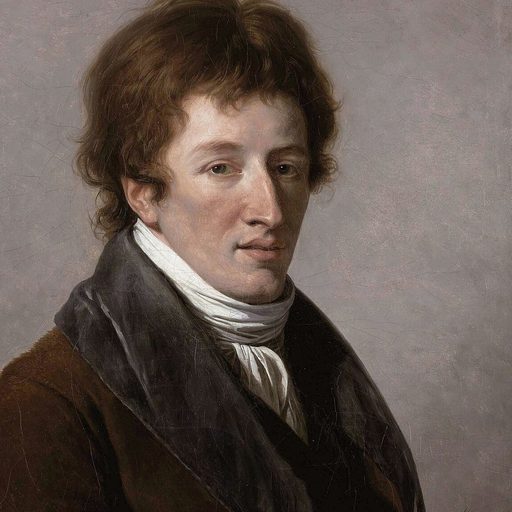
He established that a single tooth is enough to reconstruct an animal and demonstrated in his “Recherches sur les ossements fossiles” that whole species had vanished, an idea almost unthinkable to his contemporaries. The upkeep of his grave falls to the Consistory of the Reformed Church, by a bequest in his will.
The story
Jean Léopold Nicolas Frédéric Cuvier, known as Georges, was born at Montbéliard on 23 August 1769, into a Protestant family then subject to the Duke of Württemberg. In 1795 he entered the Muséum d'histoire naturelle as a deputy in the teaching of comparative anatomy.
Professor at the Collège de France in 1799, holder of the chair of comparative anatomy in 1802, he set out the theory of the subordination of organs: the shape of one bone governs that of the whole skeleton, and a single tooth is enough to rebuild an animal. That is the method that founds palaeontology.
His “Recherches sur les ossements fossiles des quadrupèdes” proved that whole species had vanished — an idea all but unthinkable to his contemporaries, who held the creation to be intact. From it he drew a history of the Earth made of one catastrophe after another.
He fought Lamarck and Geoffroy Saint-Hilaire hard, judging their early evolutionism to rest on no proof at all. History settled the argument in his opponents' favour; it took nothing away from the method he left behind.
A baron, a peer of France, a grand officer of the Legion of Honour in 1826, he died in Paris on 13 May 1832 and lies in Division 8. His brother Frédéric, a naturalist and keeper of the Muséum's menagerie, had his own heart laid there; Frédéric's son Frédéric Georges, deputy governor of the Bank of France, followed them in. Cuvier himself had outlived all four of his children.
The grave
A plain stone, whose inscription fits in one sentence of civil status: “Georges Cuvier, born at Montbéliard on 23 August 1769, died in Paris on 13 May 1832”. No title of baron, no peerage, no Légion d'honneur, not the slightest fossil. The peculiarity lies elsewhere: the plot is maintained by the Consistory of the Reformed Church, under a bequest in the scientist's will that the President of the Republic had to approve. His brother Frédéric Cuvier (1772-1838), director of the Ménagerie, has only his heart there — one more heart-tomb in Père-Lachaise; his son Frédéric Georges, who died in 1893, rests there whole.
On site, do not miss
An inscription reduced to the bare civil status — name, Montbéliard, Paris, two dates — on the grave of the man who invented palaeontology.
Visitors' questions
Where is Georges Cuvier's grave?
In Division 8, Chemin du Coq, sixth row, in the lower, older part of the cemetery — the division of Xavier Bichat, of Chemin Chénier and of Guillotin's grave. The stone is plain.
Xavier BichatWhat did Georges Cuvier discover?
That whole species had died out — an idea almost unthinkable in his day — and that the shape of one bone dictates that of the entire skeleton, so that a single tooth is enough to reconstruct an animal. That method is the foundation of palaeontology.
Antoine-Louis BaryeWho maintains his grave?
The Consistory of the Reformed Church, under a bequest in the scientist's will that the President of the Republic had to approve. Cuvier came from a Protestant family of Montbéliard, then a possession of the Duke of Württemberg.
Camille CorotWho rests with him in Division 8?
His brother Frédéric, a naturalist and director of the Muséum's menagerie, of whom only the heart was laid there, and his son Frédéric Georges, councillor of state and deputy governor of the Banque de France, who died in 1893.
Joseph-Ignace GuillotinAudio guide to Père Lachaise: the best unusual guided tour!
Discover the secrets of the most astonishing tombs
the audio guidefrom€6.99