Visiting Père-Lachaise
with an audio guide
The most famous cemetery in the world is explored slowly, the way one listens to a secret. It is a haven of calm and an open-air museum where time seems to hang still.
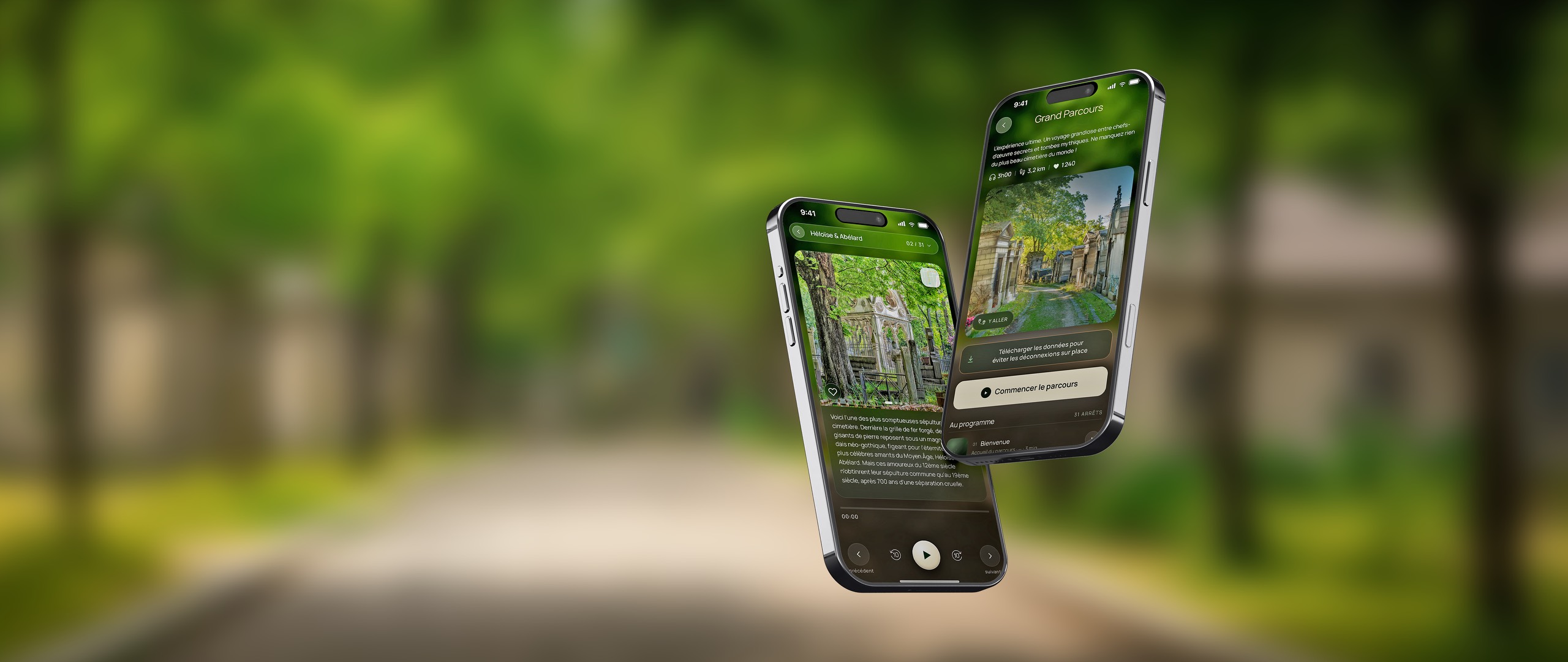
The audio guide is the ideal companion for reading this vast labyrinth without getting lost: it steers you towards the graves you must not miss and brings back to life, in your ear, the extraordinary fates of those who lie here.
An open-air museum
Beneath its tree-lined avenues lie more than seventy thousand graves: some monumental, others movingly plain. Nature has quietly reclaimed the ground, wrapping marble and granite in romantic ivy as the seasons turn. You come upon weeping angels, stained glass worn by time, neo-Gothic chapels and surreal shapes.
Here you do not walk between stones: you walk through two centuries of memory, beauty and grief, where the silence itself seems charged with an enduring poetry.
A cemetery nobody wanted
The hill belonged to the Jesuits, who grew vines and orchards on it. Louis XIV, taken with the serenity of the place, had a house built there called “Mont-Louis” and gave the use of it to his confessor, Father François d'Aix de La Chaise. Parisians fell into the habit of saying they were going “to Father La Chaise's”, and the name stuck to the ground itself.
The estate was bought in 1803 by Prefect Nicolas Frochot, who entrusted its layout to the architect Brongniart. The cemetery opened its gates on 21 May 1804 under the official name of the “Eastern Cemetery” — which nobody would ever use.
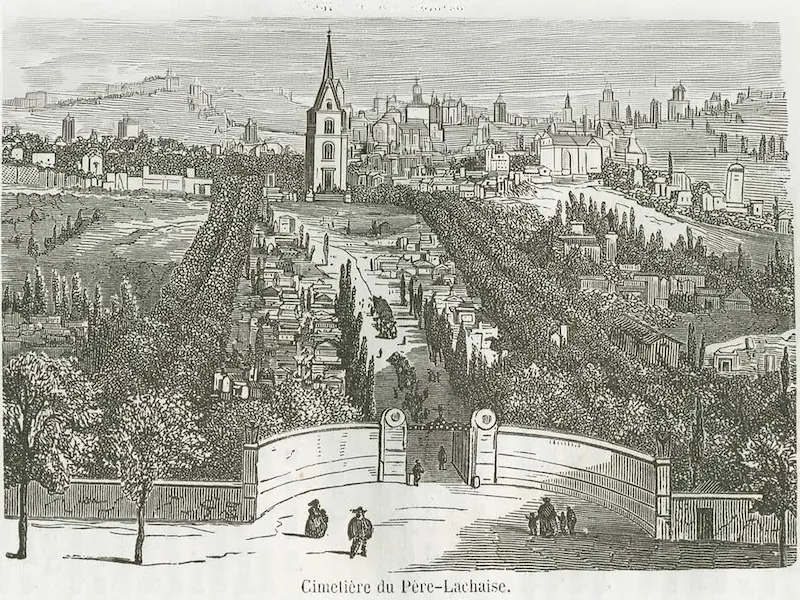
And it drew nobody. Too far from the centre, too rustic: Parisians were wary of this hill planted at the city's edge. The first burial, on 1 June 1804, was that of a five-year-old girl, Adélaïde Paillard de Villeneuve, daughter of a bell-ringer from the faubourg Saint-Antoine; her grave vanished long ago.
The authorities then hit on a stroke of marketing genius, long before the term existed. In 1817, the remains of Molière and Jean de La Fontaine were moved there with great ceremony, followed by those of the eternal lovers Héloïse and Abelard. The gamble paid off: within a few years the shunned cemetery had become the most coveted address in Paris.
Even today, resting here is a privilege: you must have died in Paris or have lived there — and plots are scarce and expensive.
Graves that became legends
Père-Lachaise is first of all an open-air pantheon, where artists, writers and figures from all over the world lie sleeping. Behind every carved name hides a story — and that is precisely what the audio guide whispers in your ear, step after step.
One useful bearing before you set off: the oldest and lowest divisions, near the boulevard de Ménilmontant gate, hold Héloïse and Abelard (Division 7), Chopin (Division 11), Molière and La Fontaine (Division 25). The great twentieth-century names — Oscar Wilde (Division 89), Victor Noir (Division 92), Édith Piaf (Division 97) — lie much higher up, in the eastern part. Knowing this changes everything: you pick one slope instead of zigzagging.
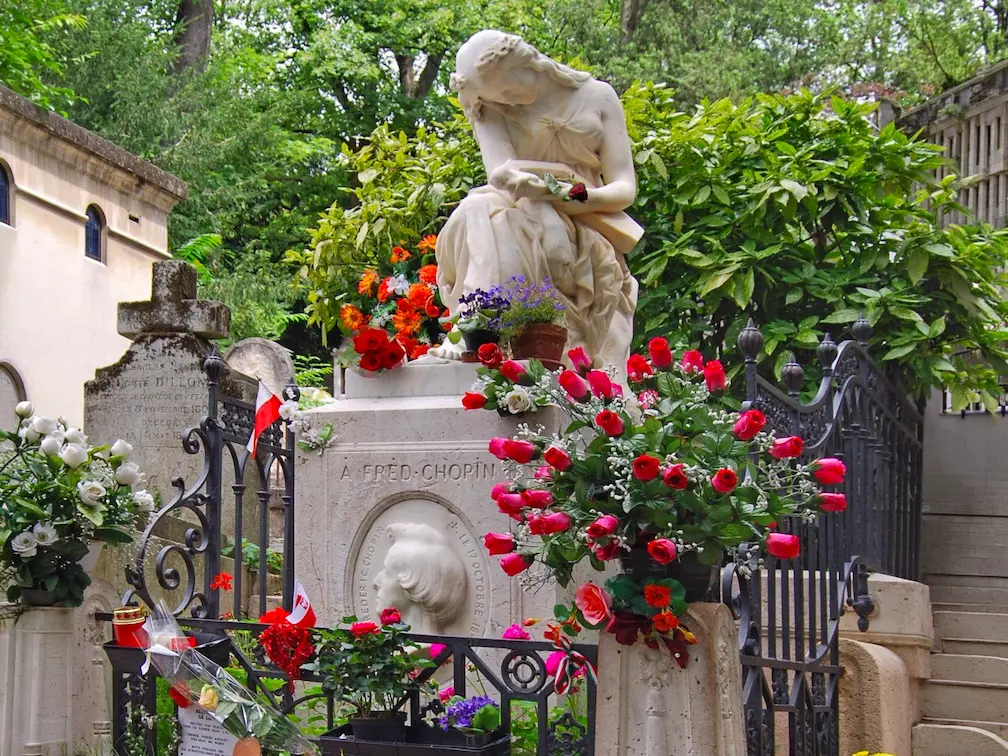
Frédéric Chopin · Division 11
His body is here, but his heart is in Warsaw.
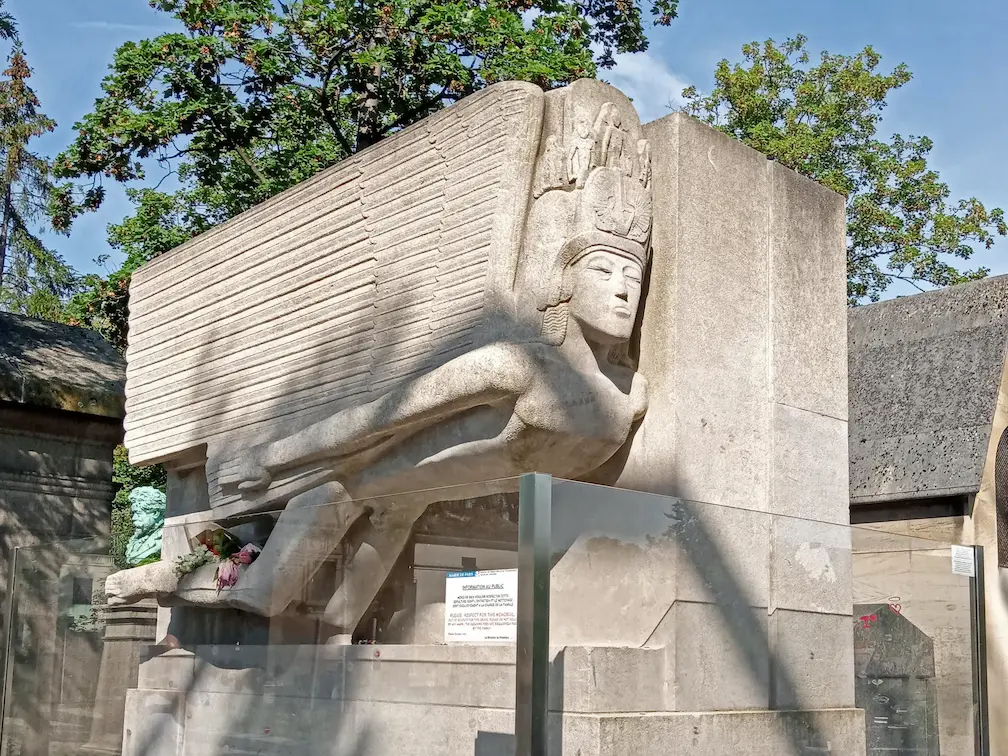
Oscar Wilde · Division 89
Wilde's sphinx was covered with the kisses of his admirers.
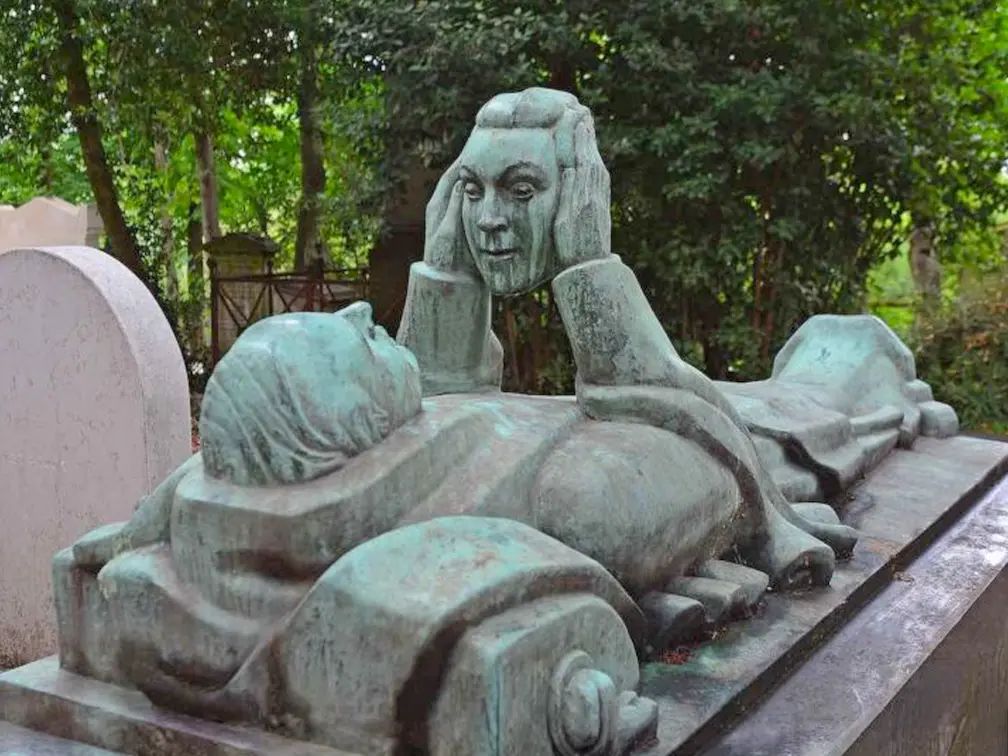
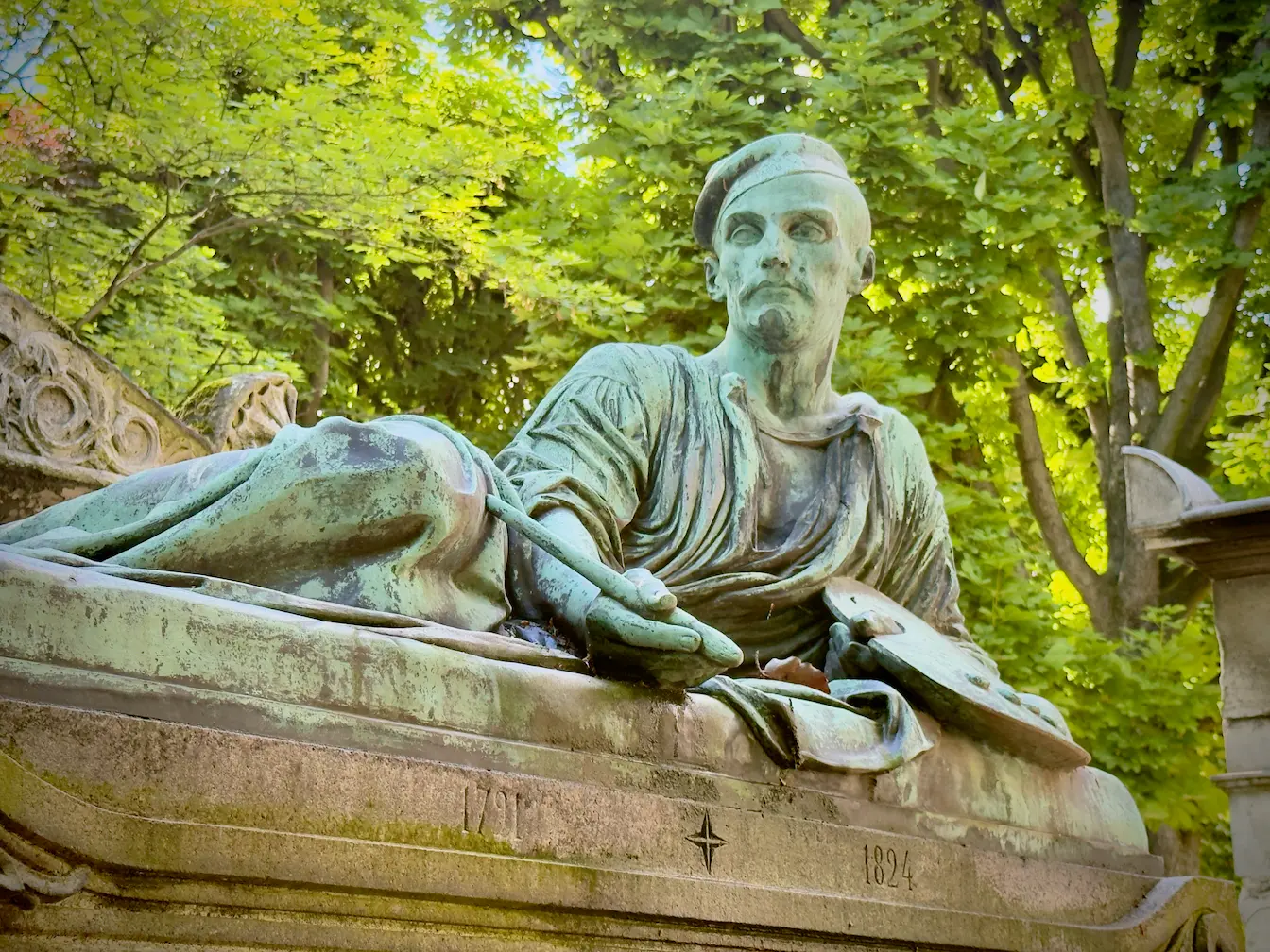
Fernand Arbelot · Division 11
The effigy that gazes for ever at the face it loved.
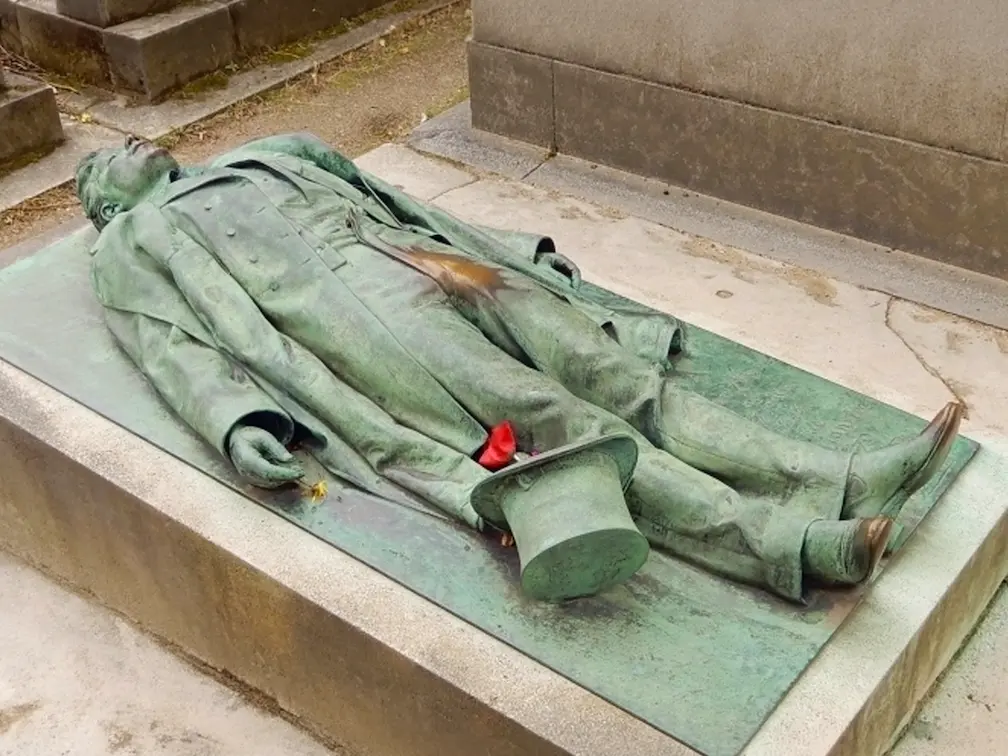
Victor Noir · Division 92
The bronze effigy, the object of many a superstition.
The questions visitors ask
Which famous graves should you see at Père-Lachaise?
The most visited graves are those of Jim Morrison (Division 6), Héloïse and Abelard (Division 7), Frédéric Chopin (Division 11), Molière and Jean de La Fontaine (Division 25), Allan Kardec (Division 44), Honoré de Balzac (Division 48), Marcel Proust (Division 85), Oscar Wilde (Division 89), Victor Noir (Division 92) and Édith Piaf (Division 97).
The audio guide leads you from one to the next and tells you their absorbing stories.
How much time should you allow for the visit?
Allow 45 minutes for a quick trail of the essential graves, and two to three hours for the full circuit. Across 44 hectares and 97 divisions, seeing everything at once makes no sense.
Nothing obliges you to see it all in one go: explore the cemetery in a single visit or come back several times — your trail stays available whenever you want it.
What is a “division” at Père-Lachaise?
A division is one of the 97 numbered sectors into which the cemetery is divided. It is the unit of address used by the administration, and the only reliable way to locate a grave: you do not say “near the main avenue”, you say “Division 11”.
Their numbering follows the history of the cemetery's expansion, not its geography: the low divisions are the oldest and the closest to the main gate, while the high ones lie on the heights to the east.
The interactive map of the cemetery shows them all, with the graves they hold.
Which gate should you start from?
Through themain gate on boulevard de Ménilmontant, facing rue de la Roquette: this is where the audio guide's trails begin, and it is also the closest point to the historic divisions.
The nearest metro station to that gate is Philippe Auguste (line 2). Père-Lachaise (lines 2 and 3) and Gambetta (line 3) serve the other entrances, higher up in the cemetery.
Can you still be buried at Père-Lachaise?
Yes, but it has become rare. You must have died in Paris or been resident there, and the plots available are few and costly.
The cemetery has been in use since 1804 and has never stopped taking burials: it is not a fixed monument but a place where families come to mourn every day. That is also why people speak softly here.
Why is Père-Lachaise the most visited cemetery in the world?
Because it brings together three things that almost never occur together: an exceptional concentration of world-famous figures, from Chopin to Jim Morrison; a 44-hectare landscaped park designed for walking; and two centuries offunerary art that make it one of the finest open-air sculpture museums in Paris.
Admission is free all year round, which completes its standing as a destination in its own right.
Should you book a tour with a human guide, or is the audio guide enough?
Both have their merits, depending on what you are after. A group guided tour offers live exchange and stories told on the spot, but imposes a fixed time and the group's pace, at a price generally around €15 to €25 a head for two hours.
The audio guide answers the same need — finding your way through the maze of 97 divisions, understanding what you are looking at, missing none of the essential graves — at your own pace, at the hour you choose, alone or in company, for less money and with no advance booking.
Is there a risk of getting lost at Père-Lachaise without a guide?
The cemetery has 97 divisions across 44 hectares, with avenues that do not always follow an obvious logic — finding your own way can indeed baffle first-time visitors.
A paper map is enough to avoid most wrong turns; the audio guide goes further by giving the route from one grave to the next and announcing your arrival at each one, which makes a solo visit as untroubled as an accompanied one.
Breathtaking funerary art
Beyond the famous names, Père-Lachaise is one of the finest sculpture museums in Paris. Recumbent effigies, sphinxes, mausoleums and remarkable statues compose a setting like no other, which light and season are forever transforming.
Almost everything here means something. The nineteenth century had a vocabulary of stone that we have forgotten, and which can still be read on the graves:
The broken column speaks of a life cut short. The inverted torch, of a flame put out. The winged hourglass, of time slipping away. A wreath of everlasting flowers promises remembrance that does not fade; carved ivy stands for attachment that outlives death; the serpent biting its own tail, for eternity beginning again. Two clasped hands seal a fidelity — and from their position you can often tell which of the two outlived the other.
Once you know this, you never look at the avenues the same way: every monument becomes a sentence. That is precisely what the audio guide gives back to you — not dates, but the reading of a language.
Every avenue holds a surprise for anyone who takes the time to look up.