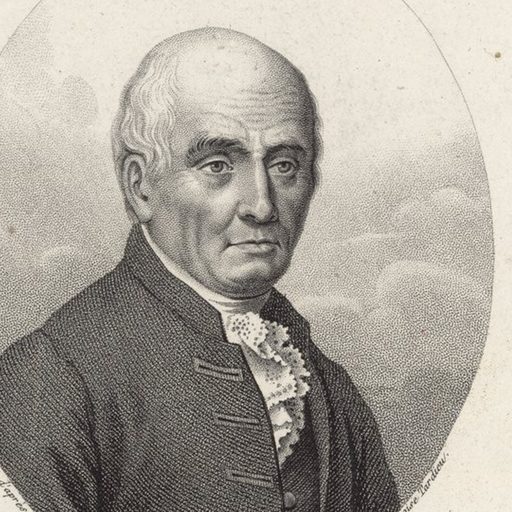
Michel Adanson spent six years in Senegal, brought back thirty thousand specimens and was the first to describe the baobab. His classification, which he wanted to be natural, contradicted Linnaeus's system, and the Académie des sciences passed him over several times for that reason, despite the quality of his work. He devoted his last years to an unfinished encyclopaedia. It is the cemetery that names him, through one of its paths.
The story
In Senegal, from 1748 to 1754, Michel Adanson collected thirty thousand specimens of animals and plants and gave the first description of the baobab. Back in Paris, in his “Familles des plantes” of 1763, he argued for a natural classification founded on every character of a plant at once — against the system of Linnaeus, which kept only one, the sexual organs. Elected to the Academy of Sciences in 1759, he never carried his method: his century preferred Linnaeus.
He spent his last years writing an encyclopaedia in twenty-seven volumes; the Academy advised him to publish only what was new in it, he refused to cut it up, and the work never appeared. The abolition of the academies in 1793 took away his pension: when the Institute called him among its founding members, he was too poor to present himself. He died in Paris on 3 August 1806.
His grave is in Division 23, on the chemin Adanson — the path carries his name. The stone itself carries nothing: no name, no dates, no calling. He had asked for one ornament only, a garland made of flowers from the fifty-eight plant families he had distinguished. It is the cemetery that names him, not his grave.
The grave
A grave without any inscription: no name, no dates, no profession. The botanist who described the baobab and brought back thirty thousand specimens from Senegal is named only by the cemetery itself — the chemin Adanson, which runs along his grave, was named in his honour. Several paths in the cemetery carry the name of a dead man they run past; this is the only one where the path names the man his own stone leaves anonymous.
On site, do not miss
The chemin Adanson runs along his grave — it is the path that names the botanist, since the stone itself bears no inscription: no name, no dates, no profession.
Visitors' questions
Where is Michel Adanson's grave?
In Division 23, on chemin Adanson, second row: the cemetery path bears his name. It is the only landmark, for the grave carries no inscription at all — no name, no dates, no profession.
René LaliqueWhat did he bring back from Senegal?
Thirty thousand specimens, after a stay of six years, from 1748 to 1754. It was there that he described the baobab, the tree to which his name remains attached in botanical nomenclature. A cemetery path bears his name.
Georges CuvierWhy did he oppose Linnaeus?
Because he championed a “natural classification” against the Swedish naturalist's system. The stance cost him dearly: the Academy of Sciences turned him down several times, despite his genius.
Étienne Geoffroy Saint-HilaireWhat did he write at the end of his life?
An encyclopaedia in twenty-seven volumes, to which he devoted his final years and which never appeared: the Academy advised him to publish only what was new in it, and he refused to cut it up. He died in Paris on 3 August 1806. A cemetery path bears his name.
René-Just HaüyAudio guide to Père Lachaise: the best unusual guided tour!
Discover the secrets of the most astonishing tombs
the audio guidefrom€6.99