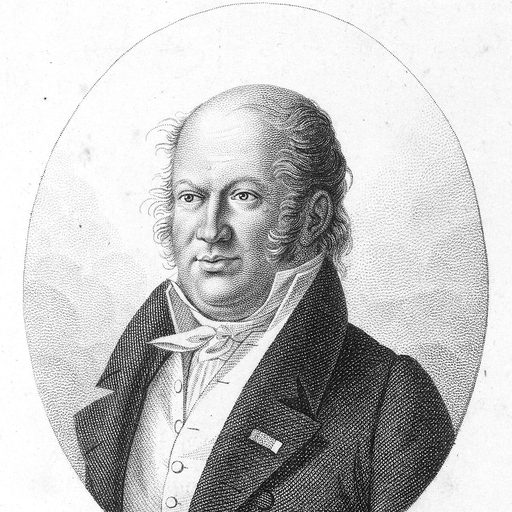
Étienne Geoffroy Saint-Hilaire held that all vertebrates obey a single plan of construction, of which each species would be only a variant: the idea opened the road to transformism, four decades before Darwin. Cuvier held exactly the opposite. Their confrontation of 1830, before the Académie des sciences, gripped people far beyond the scientists. Goethe judged it more important than the revolution of the same summer.
The story
Étienne Geoffroy Saint-Hilaire was born at Étampes in 1772. A professor at the Muséum national d'histoire naturelle, he left with Bonaparte's Egyptian expedition from 1798 to 1801 and brought back a very large zoological collection.
His thesis was the unity of plan: all vertebrates are built on one and the same scheme, of which the forms are only variations. The idea opened the road to transformism, forty years before Darwin.
Cuvier, once his collaborator, held the opposite: every species is fixed, and function commands form. The two men fought it out before the Academy of Sciences in 1830, and the debate spilled far beyond learned circles.
Goethe, following the affair from Weimar, wrote that it seemed to him more important than the July Revolution going on at the same moment: whether species change engaged more, to his mind, than a change of king.
He died on 19 June 1844 and lies in Division 19. Cuvier, his opponent, is in Division 8 — both sides of the argument in the same cemetery. His headstone carries a birth date that matches none of the reference works.
The grave
A bronze medallion signed David d'Angers and dated 1831, on a monument by the architect Isabelle — the same as for the tomb of David d'Angers himself, in Division 39. The portrait was thus made thirteen years before the naturalist's death. The inscription gives the name, the place of birth and the date of death, but the engraved date of birth, “13 June 1772”, does not agree with the 15 April given by the reference works: two months apart, unresolved.
On site, do not miss
The medallion by David d'Angers, dated 1831 — thirteen years before the scientist's death — and the engraved date of birth, “13 June 1772”.
Visitors' questions
Where is Geoffroy Saint-Hilaire's grave?
In Division 19, chemin du Dragon, first row, in the old part of the cemetery — not far from Jane Avril's stele. A bronze medallion by David d'Angers, dated 1831, adorns the monument by the architect Isabelle.
Jane AvrilWhat was his debate with Cuvier?
A public quarrel before the Academy of Sciences in 1830: Geoffroy Saint-Hilaire held that all vertebrates are built on a single plan, Cuvier that every species is fixed. Goethe judged the affair more important than the July Revolution.
Georges CuvierWhat is the unity of plan?
The idea that all vertebrate animals are built on one and the same blueprint, of which their forms are merely variations. It opened the way to evolutionary thinking forty years before Darwin — and it was precisely what Cuvier would not grant him.
Antoine-Louis BaryeIs there a mistake on his grave?
Yes, by two months: the stele has him born on 13 June 1772, whereas Étienne Geoffroy Saint-Hilaire was born on 15 April, at Étampes. His record as a deputy at the National Assembly and the Archives de France agree on 15 April; the stone alone says June.
Guillaume DupuytrenAudio guide to Père Lachaise: the best unusual guided tour!
Discover the secrets of the most astonishing tombs
the audio guidefrom€6.99