 Iconic
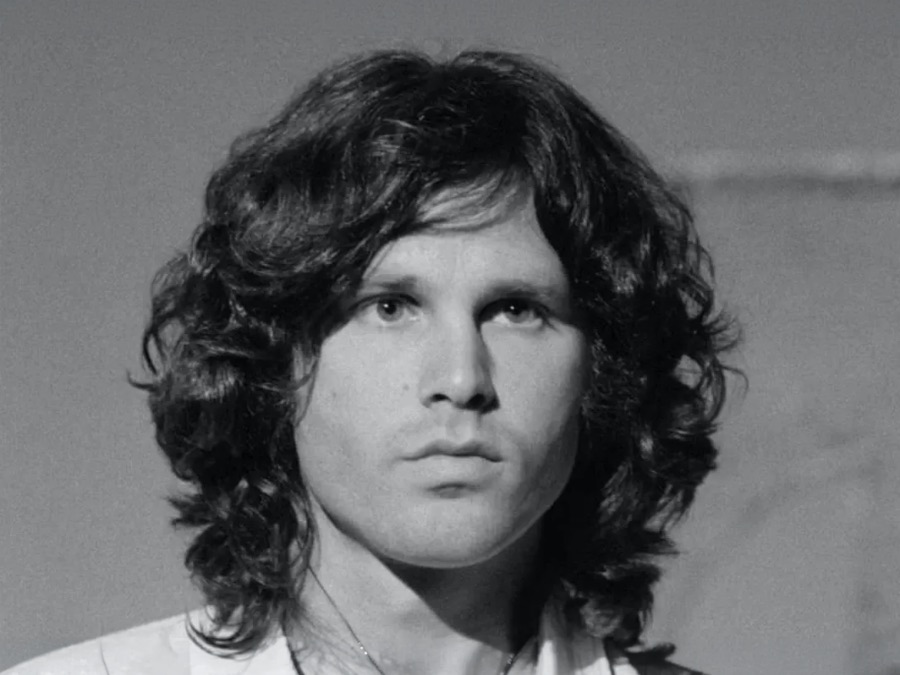
Jim Morrison
Division 6
0:40
Close your eyes a moment: you are already there.
Iconic

 Moving
 Curiosities
Install the app, choose your trail, and let it guide you.
“I knew about Morrison, but I discovered so many other stories. You never look at the cemetery the same way again.”

“Perfect for our visit: we walked, and it told the stories by itself. My children loved it.”

“The best way to visit Père-Lachaise. It is like having a private guide in your ear.”

Admission to Père-Lachaise cemetery is free and open to all, every day of the year. No ticket, no booking.
What you buy from us is the storytelling: the audio guide that gives a voice to the graves you walk past. The place itself is not for sale.
All trails are the same price: €6.99. Downloading the app is free.
It is a one-off purchase, with no subscription and nothing to renew: the trail is yours, you can listen as often as you like, come back in six months and pick up where you left off.
No. Père-Lachaise is not a museum: there is no ticket desk, no queue, no time slot to book. You push open the gates and walk in.
One piece of advice: download your trail data over wifi before you set out, so that you need no signal once you are there.
Allow 45 minutes for a quick trail around the most famous graves, and two to three hours for the full circuit.
The cemetery covers 44 hectares and holds more than 70,000 graves: seeing it all in one visit makes no sense. Better to follow one thread, stop, listen — and come back. The audio guide pauses when you do.
In an hour from the main gate on boulevard de Ménilmontant, you can reach the graves ofHéloïse and Abelard (Division 7), Frédéric Chopin (Division 11) and Molière and Jean de La Fontaine (Division 25), all in the lower and oldest part of the cemetery.
It is also the finest historical shortcut the place offers: these are precisely the three graves the authorities had brought here in 1817 to persuade Parisians to be buried at Père-Lachaise.
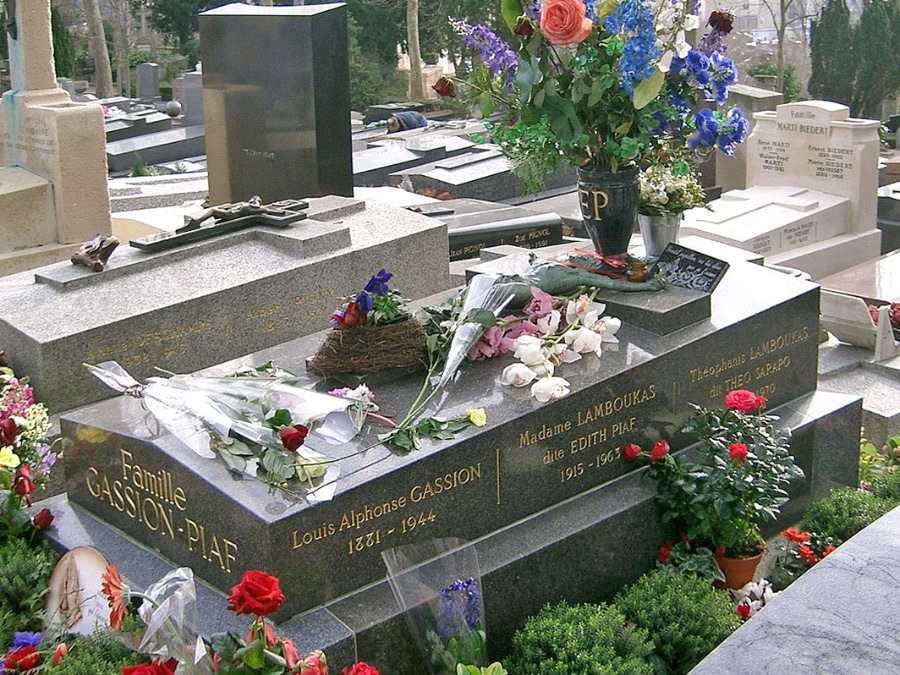
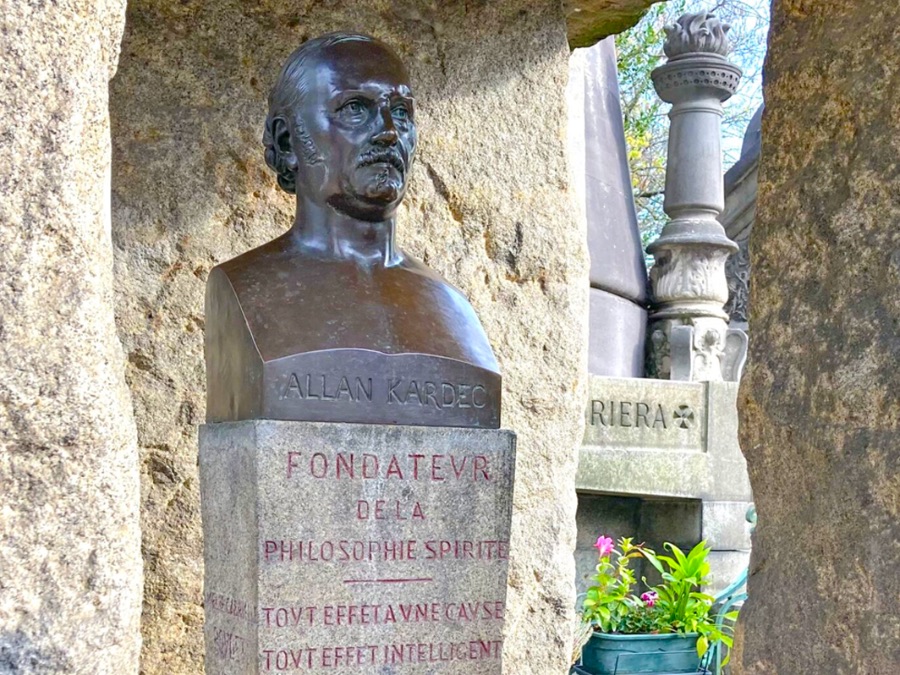
The most visited graves are those of Jim Morrison (Division 6), Héloïse and Abelard (Division 7), Frédéric Chopin (Division 11), Fernand Arbelot (Division 11), Molière and Jean de La Fontaine (Division 25), Allan Kardec (Division 44), Honoré de Balzac (Division 48), Oscar Wilde (Division 89), Victor Noir (Division 92) and Édith Piaf (Division 97).
The audio guide leads you from one to the next without your having to search: the story begins as you reach the stone.
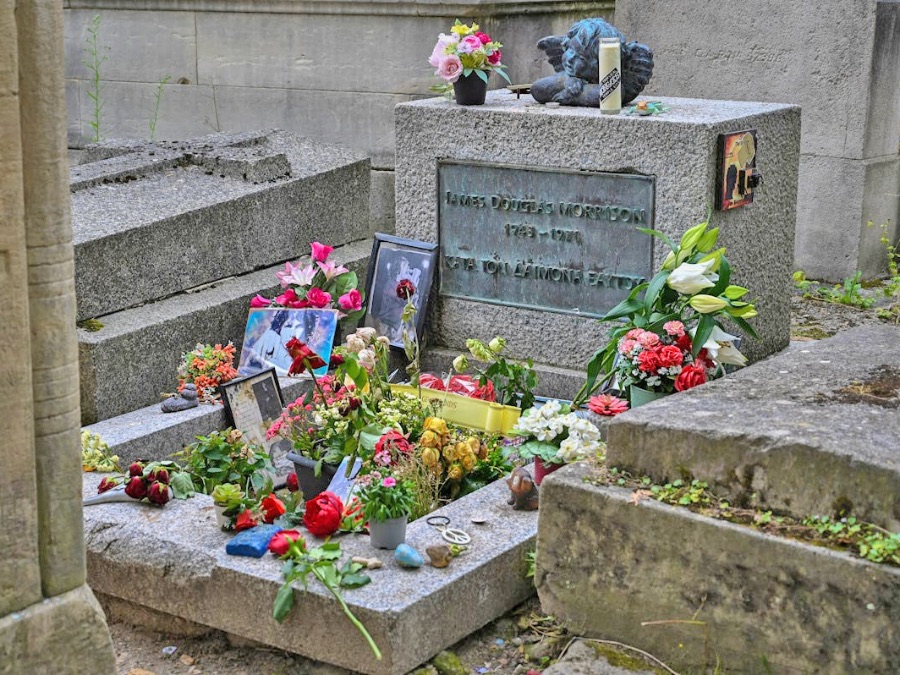
Jim Morrison's grave lies in Division 6 of Père-Lachaise, a few minutes from the main gate.
It is one of the most unassuming in the cemetery — a plain slab, long unmarked, now ringed by a low wall. Many visitors walk past without noticing it; the audio trail warns you as you draw near.
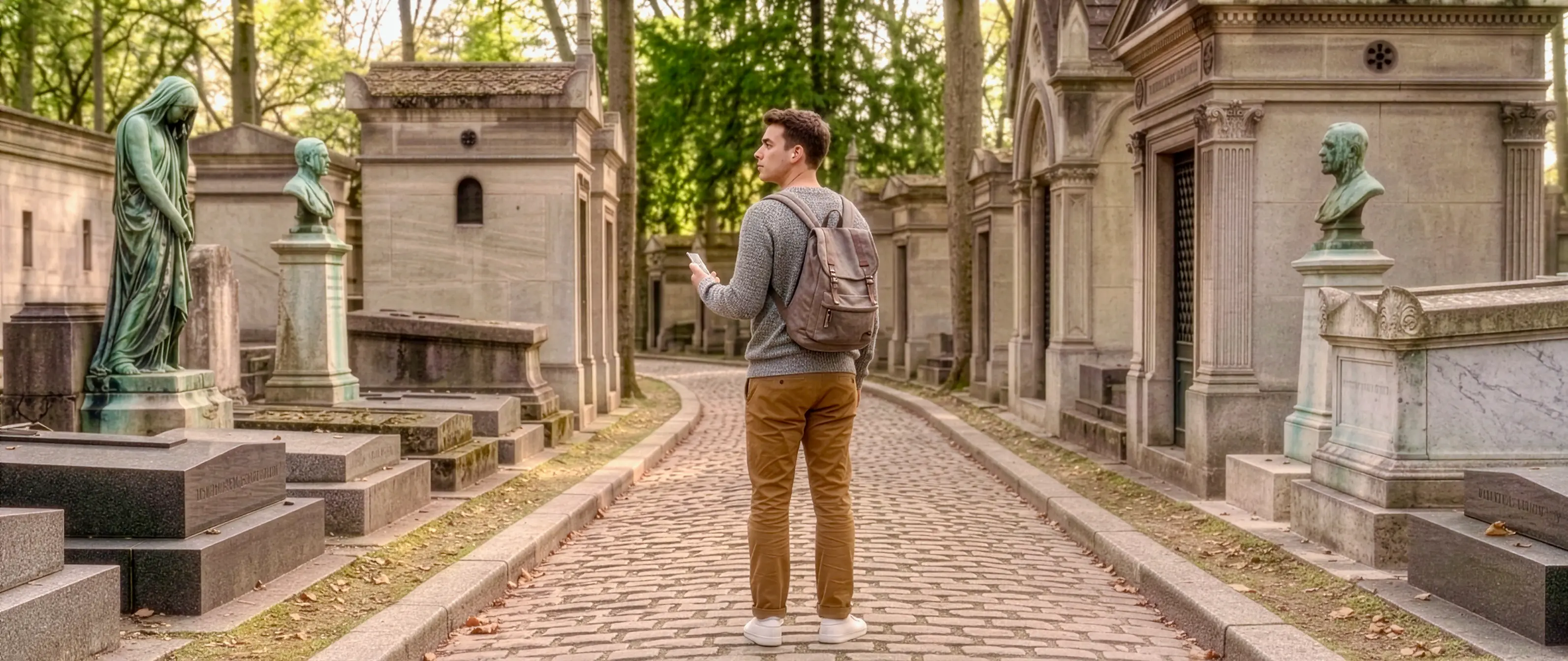
Père-Lachaise is a labyrinth of 44 hectares: its avenues are not laid out on a grid, the ground rises and falls, and the division numbers do not always follow in an obvious order.
The app shows your position on a map that works offline and guides you from grave to grave. That is the most tangible difference from a paper map: you keep your head up, looking at the sculpture instead of hunting for your way.
A group tour follows a set time, a set pace and a set route, and generally costs between €15 and €25 a head. The audio guide starts at €6.99 and lets you set off when you like, stop as long as you like, and come back another day.
The real difference is not the price but the silence. Père-Lachaise is a place of remembrance, where people speak softly. Hearing a story in your headphones, alone before a stone, is not the same as a commentary delivered to thirty people.
Yes — and it is arguably the truest way to discover it. The cemetery is yours to walk freely, on foot, at your own pace, throughout opening hours.
The one thing missing, if you come with nothing, is the story: without it you pass beautiful monuments whose history you never learn. That is precisely the gap the audio guide fills, without imposing anyone's company on you.
The cemetery is named after Father François d'Aix de La Chaise, a Jesuit and confessor to Louis XIV for more than thirty years, who occupied a house on this hill called “Mont-Louis”.
Parisians fell into the habit of saying they were going “to Father La Chaise's”, and the usage stuck: when the place became the “Eastern Cemetery” in 1804, nobody ever called it that. The irony is complete — Father La Chaise, who died in 1709, is not buried there: he lies in the Marais, in the church of Saint-Paul-Saint-Louis.
Père-Lachaise opened its gates on 21 May 1804. The estate had been bought in 1803 by Prefect Nicolas Frochot, who entrusted its layout to the architect Brongniart.
Its early years were a failure: Parisians thought it too far out, too rustic. So the authorities had the remains of Molière and La Fontaine moved there, then those of Héloïse and Abelard, to draw the middle classes — one of the first public-relations operations in the history of Paris. It worked.
The first burial took place on 1 June 1804 : that ofAdélaïde Marie Antoinette Paillard de Villeneuve, a five-year-old girl, daughter of a bell-ringer from the faubourg Saint-Antoine.
She was given a temporary plot at the top of what is now the 60th division. Her grave vanished long ago: of the most visited cemetery in the world, the very first grave survives only in the register.
Mid-March to October: 8am–6pm Monday to Friday, 8.30am–6pm on Saturday, 9am–6pm on Sunday and public holidays. From November to mid-March, closing moves forward to 5.30pm, with the same opening times.
The last visitors are admitted no later than 15 minutes before closing. In winter the light goes quickly: arriving two hours before closing is more comfortable than rushing.
The cemetery is in the 20th arrondissement of Paris. Its main gate opens onto boulevard de Ménilmontant, facing rue de la Roquette.
By metro: Philippe Auguste (line 2) is the closest to that gate; Père-Lachaise (lines 2 and 3) and Gambetta (line 3) serve the other entrances. By bus: lines 61 and 69. The audio guide's trails all begin at the main gate.
The cemetery is largely accessible to visitors with reduced mobility, and the main gate on boulevard de Ménilmontant takes both pedestrians and vehicles.
Some sectors remain difficult, however: the ground is hilly and several old avenues are cobbled and uneven. The lower divisions, near the main gate — where Chopin, Molière and La Fontaine lie — are the easiest going.
No. The cemetery's rules forbid bringing dogs, even on a lead. Feeding the animals is also forbidden.
Bicycles and scooters are likewise banned, even wheeled by hand, as are jogging, alcohol and picnics: Père-Lachaise remains above all a place of remembrance.
Photography is not forbidden by the cemetery's rules, and the light there is magnificent — especially late in the day, when it rakes across the sculpture.
One caveat of common sense: families come here to mourn every day. Photograph the monuments and the avenues; step quietly aside from a ceremony or from someone visiting a grave.
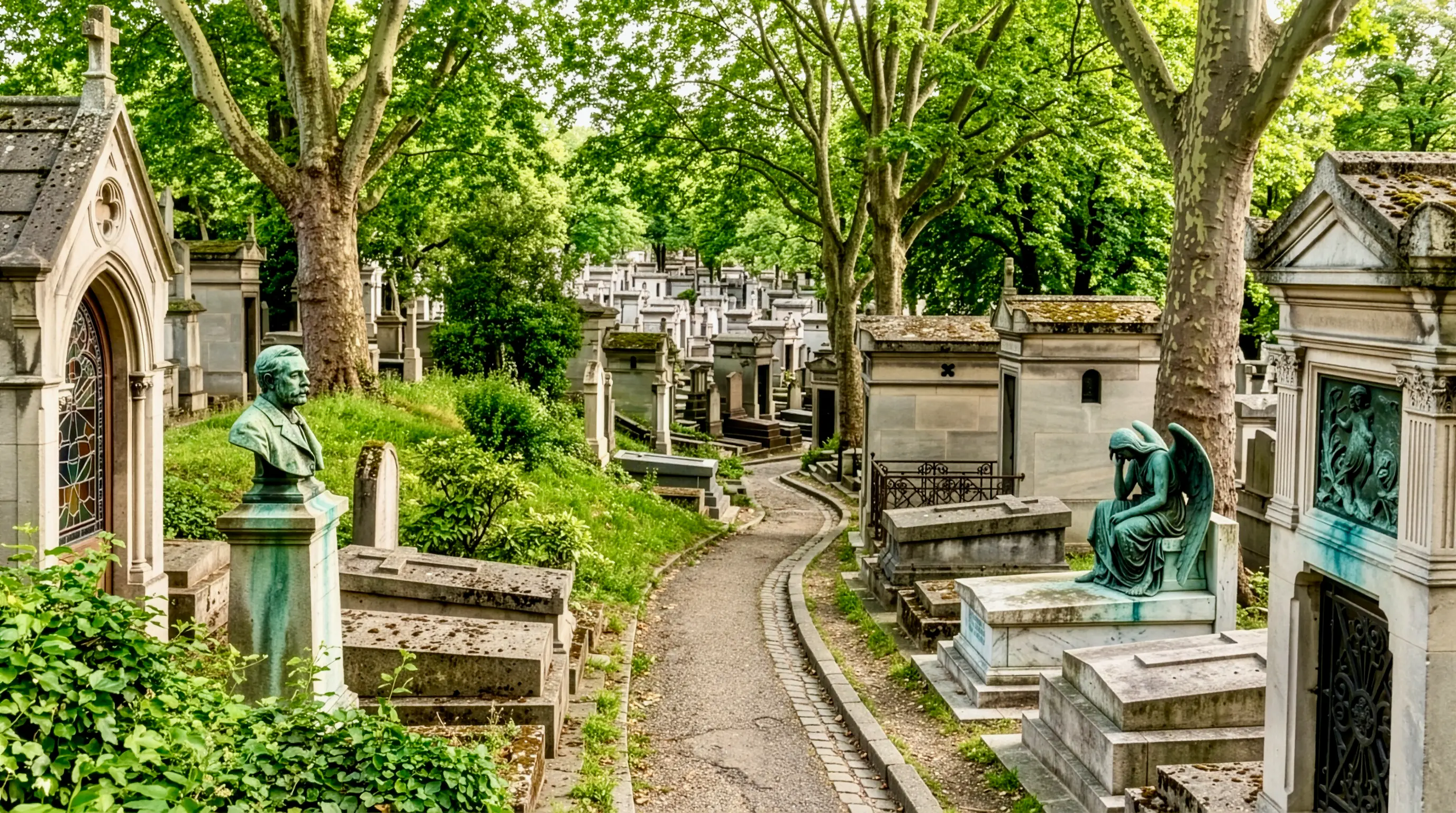
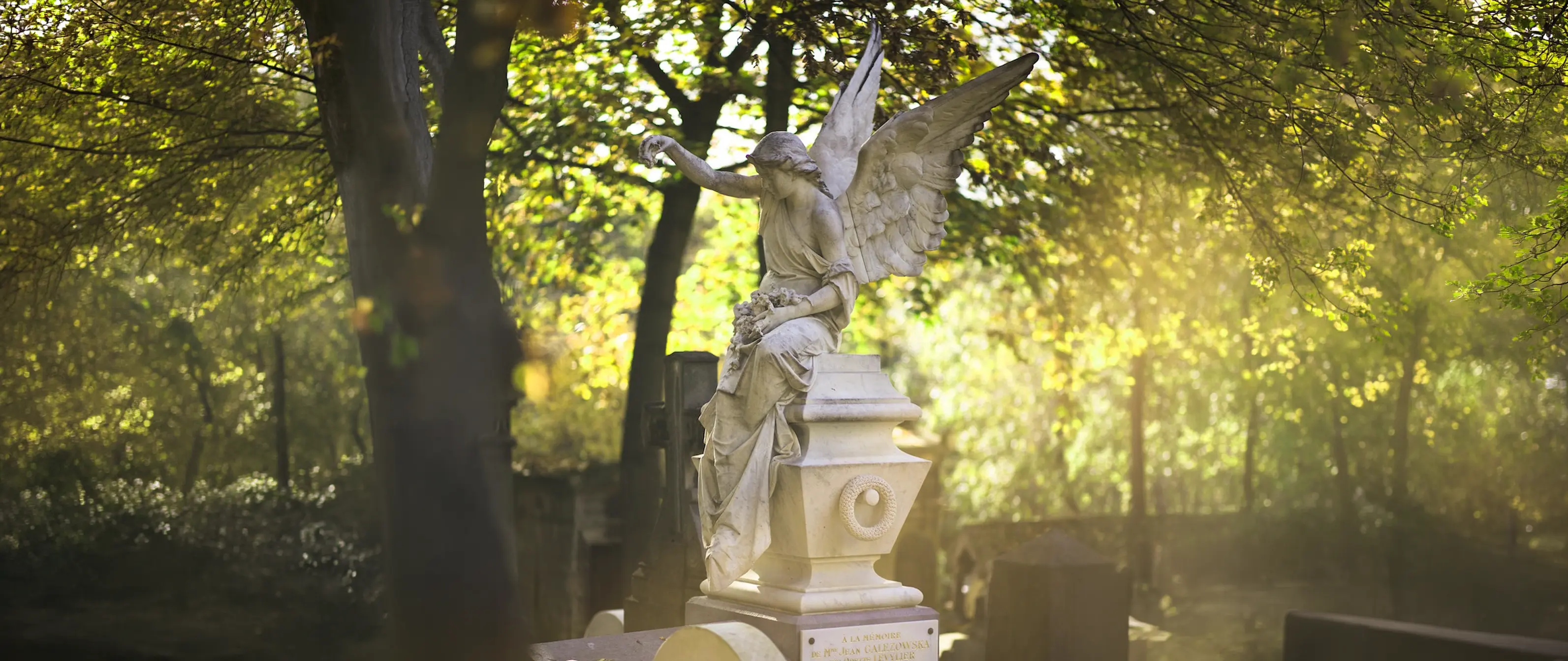
Yes, and it is often a pleasant surprise. Père-Lachaise is as much a landscaped park as a necropolis: tree-lined avenues, sphinxes, angels, cats crossing the path.
Two precautions: the ground is uneven, so good shoes beat a flimsy pushchair; and one hour of trail is better than three. Listening to a story together, one earphone each, works remarkably well with a child.
Des headphones — the listening experience is nothing like the same without them — a well-charged phone, and good shoes: the ground is often cobbled and slippery in wet weather.
Add, according to the season, a water bottle, a folding umbrella, a hat. And a power bank if your phone's battery is weak: two hours of mapping and audio playback take their toll.
Downloading the app is free. Access to the trails is then bought, from €6.99, on this site or directly in the app.
After buying on the site, you receive a code to enter in the app, which unlocks your trail immediately.
An internet connection is not needed on site: you simply download the trail data over wifi beforehand, at home.
The map and the stories then work entirely offline — useful in the avenues where the signal is unreliable.
If you bought the tour from a partner (Tiqets, Fnac and so on), enter your code or activation link in the app to unlock your trail.
The app is currently available in French. Other languages are being added.