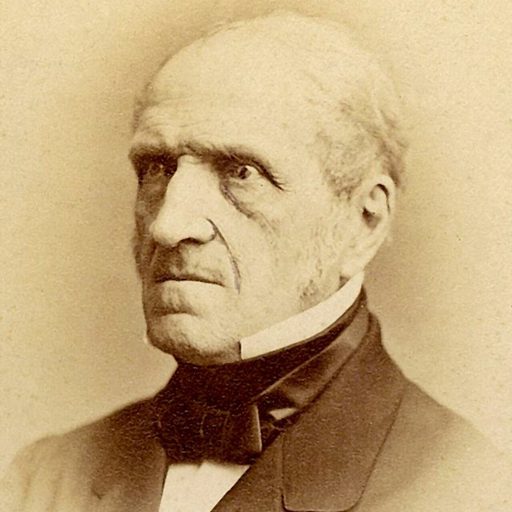
Chasles worked on projective geometry and left the classroom a word still in daily use: homothety. A chair was created for him at the Sorbonne in 1846. At the end of his life, a forger sold him, over several years, thousands of fake letters — by Pascal, by Caesar, by Cleopatra — which he certified as genuine, in perfect good faith, before the Académie. The trial that followed caused a scandal across Europe.
The story
Born at Épernon on 15 November 1793, admitted to the École Polytechnique in 1812 and teaching there by 1841, Michel Chasles was given in 1846 the chair of higher geometry created for him at the Sorbonne.
He worked on projective geometry and the cross-ratio, and left the language of mathematics a word still used in every classroom: homothety. The Académie des sciences elected him in 1851.
Late in his life the forger Vrain-Lucas sold him, year after year, thousands of forged autograph letters — from Pascal, from Caesar, from Cleopatra — which Chasles authenticated in good faith before the Académie. The trial of 1870 was a European scandal.
He died in Paris on 18 December 1880, aged eighty-seven. His tomb lists the foreign academies that had elected him — London, Dublin, Saint Petersburg, Brussels, Rome, Berlin, Turin, Naples, Copenhagen, Stockholm, Bologna, Milan — then gives up naming them all and cuts “etc.” into the stone.
On 29 March 1881 his body was exhumed and moved to the family grave at Chartres. What stands in Division 17, on the Avenue des Acacias, second row, is therefore a cenotaph.
The grave
A cenotaph, since 29 March 1881: the mathematician's body was exhumed three months after the funeral and transferred to the family tomb in Chartres. What remains is the inscription, one of the longest in Père-Lachaise, which lists his titles and twelve academies — “membre de la société royale de Londres et de la société royale d'Irlande, membre des académies des sciences de St Pétersbourg, de Bruxelles et de Rome, de Berlin, de Turin, de Naples, de Copenhague, de Stockholm, de Bologne, de Milan, etc.” — member of the Royal Society of London and the Royal Irish Academy, of the academies of sciences of Saint Petersburg, Brussels, Rome, Berlin, Turin, Naples, Copenhagen, Stockholm, Bologna, Milan and so on — and ends with an age: eighty-seven.
On site, do not miss
Read the inscription in full: twelve academies, two commanderships, an age — eighty-seven. Then remember that the body left the premises on 29 March 1881 for Chartres: this is a cenotaph.
Visitors' questions
Where is Michel Chasles's grave?
In Division 17, avenue des Acacias, second row — but it is a cenotaph: his body was exhumed on 29 March 1881, three months after the burial, and moved to the family tomb in Chartres. Only the inscription remained.
Auguste ComteWhat does mathematics owe to Michel Chasles?
Projective geometry, the cross-ratio, and a word every French schoolchild uses: homothétie, the scaling of a figure that English classrooms call an enlargement. The Sorbonne created a chair of higher geometry for him in 1846, which he held for thirty-four years.
Gaspard MongeWhat swindle caught out Michel Chasles?
The forger Vrain-Lucas sold him thousands of fake autograph letters — Pascal, Caesar, Cleopatra — which the mathematician authenticated in good faith before the Academy of Sciences. The trial of 1870 was a scandal across the whole of Europe.
Georges CuvierWhat does the inscription on his cenotaph say?
It lists twelve academies: London, Dublin, St Petersburg, Brussels, Rome, Berlin, Turin, Naples, Copenhagen, Stockholm, Bologna, Milan — then gives up naming them all and cuts “etc.” into the stone. It is one of the longest epitaphs in the cemetery — and the body is no longer beneath it.
Jean-Nicolas-Pierre HachetteAudio guide to Père Lachaise: the best unusual guided tour!
Discover the secrets of the most astonishing tombs
the audio guidefrom€6.99