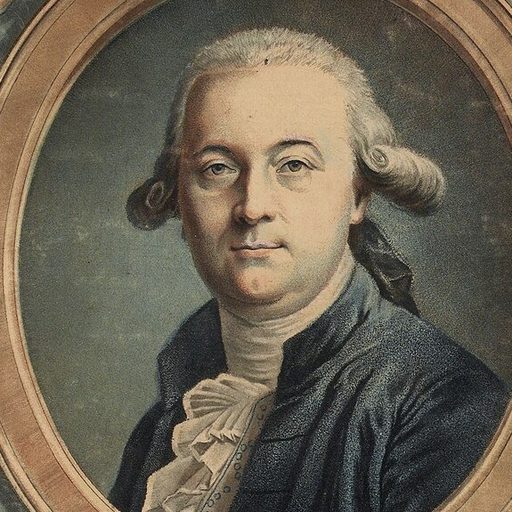
A fairground show where people laughed at blind men in costume decided his life. In 1784, he founded the first school for blind children and invented a raised typeface, from which Louis Braille would draw his alphabet. His brother René Just, founder of crystallography, died the same year as he did.
The story
Valentin Haüy was born at Saint-Just-en-Chaussée on 13 November 1745. An interpreter by trade, he was appalled by a fairground show in which the crowd was made to laugh at blind men in costume, and decided to answer it with teaching.
In 1785 he founded the Institution for Blind Children — the first school in the world for blind pupils. The principle was simple and new: they would learn to read.
For that he invented a raised typography, embossed Latin letters that the fingers could follow, and worked with the Royal Printing House to produce the first tactile books in history. The system was cumbersome, but it proved that reading was possible — Louis Braille, a pupil of that school, would draw his alphabet of dots from it thirty years later.
Tsar Alexander I invited him to found a similar institution at St Petersburg, which he did before returning to France.
He died in Paris on 19 March 1822 and lies in division 60 with his brother, the Abbé René Just Haüy, who died the same year — the founder of modern crystallography and the author of the “Treatise on Mineralogy”.
The grave
One stone for two brothers who died the same year, and whose epitaphs answer each other: “Valentin Haüy, first teacher of the blind, 1745-1822” and “Abbé René-Just Haüy, learned mineralogist, 1743-1822”. A few words each, one formula per life. The first founded in 1784 the world's first school for blind children, the second crystallography: few graves in the cemetery see two disciplines born on the same slab.
On site, do not miss
The two inscriptions side by side: “first teacher of the blind” and “learned mineralogist” — two brothers, two disciplines.
Visitors' questions
Where is Valentin Haüy's grave?
In Division 60, chemin Gosselin, second row, in the upper part of the cemetery. He rests there with his brother, Abbé René Just Haüy, who died in the same year: the two inscriptions follow one another.
Abbé SicardDid he invent writing for the blind?
He invented the first: a raised typography, embossed Latin letters that the fingers trace. The system was cumbersome, but it proved that reading was possible — Louis Braille, a pupil at his school, drew his alphabet of dots from it.
Claude ChappeWhen did he found his school?
In 1784: the Institution for Blind Youth was the first school in the world intended for blind children. Tsar Alexander I later invited him to found a similar one in Saint Petersburg.
François-Vincent RaspailWho was his brother?
Abbé René Just Haüy, founder of modern crystallography, professor at the Muséum and author of the “Traité de minéralogie” of 1801. The two brothers died in the same year, 1822, and rest together.
Georges CuvierAudio guide to Père Lachaise: the best unusual guided tour!
Discover the secrets of the most astonishing tombs
the audio guidefrom€6.99