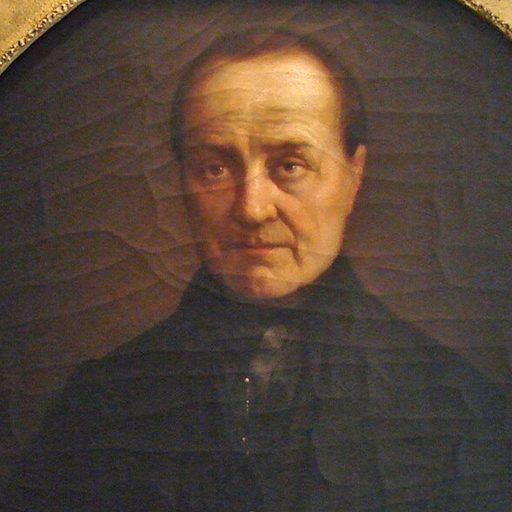
Admitted fourth to the École polytechnique at sixteen, he founded sociology as a science in his “Cours de philosophie positive”, then, after the death of Clotilde de Vaux, a Religion of Humanity whose catechism he wrote in 1852. His motto gave the Brazilian flag its “Ordem e Progresso”.
The story
Auguste Comte was born at Montpellier in 1798, into a lower-middle-class Catholic family, and entered Polytechnique at sixteen, fourth in his year. From 1817 to 1824 he was secretary to the Comte de Saint-Simon, before a final break.
The first volume of his “Cours de philosophie positive” appeared in 1830; the sixth and last in 1842. In it he set out the law of the three stages and founded sociology as a science. A tutor at Polytechnique, he lived on the little his teaching brought in.
Meeting Clotilde de Vaux, in 1845, changed his thinking as much as his life. She died the following year; Comte made a cult of her and the patroness of a religion of Humanity, for which he wrote the “Catéchisme positiviste” in 1852.
The “Système de politique positive”, in four volumes from 1851 to 1854, completes that passage from scholar to prophet. The motto he set over the door of his doctrine — ‘L'amour pour principe et l'ordre pour base, le progrès pour but’, love for a principle, order for a base, progress for an end — stands today on his grave.
He died inconsolable on 5 September 1857. In Brazil positivism remains a living religion: it was its faithful who gave, in 1985, the bronze statue in Division 17, and it is from Comte that the ‘Ordem e Progresso’ on the Brazilian flag comes.
The grave
A large bronze statue entitled “Maternité”, the work of the Brazilian sculptor Henrique Batista Da Silva Oliveira, cast in Rio de Janeiro by the Zani foundry and put up in 1985 — the plot itself having been given by the Alvaro Da Silva family. The tall pedestal bears a medallion in which Comte faces Clotilde de Vaux, and two bas-reliefs devoted to his mother, Rosalie Boyer, and to his servant Sophie Bliaux-Thomas: these are the “three angels” named in the inscription. One reads there the motto of positivism, “love as principle and order as basis, progress as goal”, and this sentence: “the living are always and increasingly governed of necessity by the dead”.
On site, do not miss
The medallion on the pedestal, where Comte and Clotilde de Vaux face each other, and the phrase engraved beneath: “Auguste Comte and his three angels”.
Visitors' questions
Where is Auguste Comte's grave?
In Division 17, Chemin de la Bédoyère, fifth row. A large bronze statue crowns it, on a tall pedestal adorned with a medallion of the philosopher and Clotilde de Vaux, and two bas-reliefs.
Clotilde de VauxWhy a statue donated by Brazil?
Because positivism remained a living religion there, the country's second. Brazilian positivists donated this statue by the sculptor Henrique Batista Da Silva Oliveira, cast in Rio de Janeiro, in 1985.
General AndranikWho was Clotilde de Vaux to him?
The woman he met in 1845, who died the following year, and whom he made the patron saint of his Religion of Humanity. Her medallion sits on the pedestal beside his own, and her grave is also at Père-Lachaise.
Marie d'AgoultWhat is the connection with the Brazilian flag?
Its motto, “Ordem e Progresso”, comes straight from Comte's formula engraved on his grave: “l'amour pour principe et l'ordre pour base, le progrès pour but” — love as principle, order as basis, progress as goal. Positivism was the doctrine of the founders of the Brazilian Republic.
Miguel Ángel AsturiasAudio guide to Père Lachaise: the best unusual guided tour!
Discover the secrets of the most astonishing tombs
the audio guidefrom€6.99