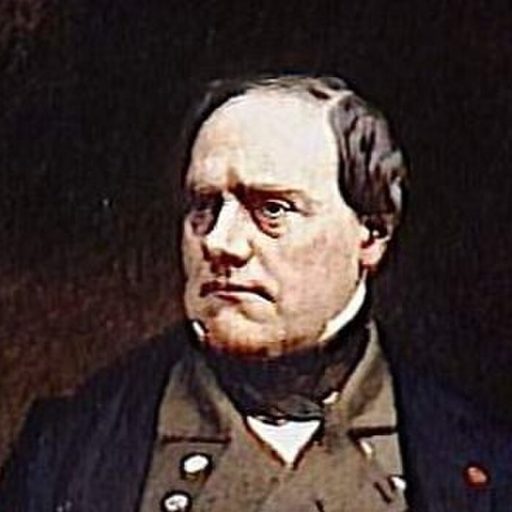
His big cats got him excluded from the Salon for thirteen years, after the jury rejected his entries in 1837: he opened his own foundry and lived off the editions of his bronzes. The bust that bore his portrait was stolen in 2006; all that remains is the word he claimed for himself, “statuary”.
The story
Antoine Louis Barye was born in Paris on 24 September 1795. At thirteen he was apprenticed to a master engraver and learned metal, chasing, the goldsmith's precision: the technical footing of everything that followed.
He trained above all at the Jardin des Plantes, watching live animals, and studied their anatomy in the treatises of Cuvier and Lacépède — both naturalists lie at Père-Lachaise, as he does. He showed at the Salon from 1827 and took a second-class medal in 1831 for “Tiger Devouring a Gavial”.
The Duc d'Orléans took him up from 1834; then came “Theseus Fighting the Minotaur” and “The Centaur”. But in 1837 the Salon jury rejected his entries and shut its door on him: thirteen years passed before he could exhibit again.
He held on through the editions. He opened his own foundry, went bankrupt in 1848 and handed his models to the industrialist Émile Martin, who published them until 1857: his bronzes made their way into middle-class interiors while the Salon ignored him. The World's Fair of 1855 gave him a first prize for “Jaguar Devouring a Hare”; he entered the Académie des beaux-arts in 1868.
He died in Paris on 25 June 1875 and lies in Division 49. The bronze bust by the sculptor Moulin that once stood on his grave was stolen in 2006; his wife Amélie Antoinette, who died in 1888, lies with him.
The grave
The grave has lost its portrait: the bronze bust by the sculptor Moulin that topped it was stolen in 2006, like Bizet's the same year in Division 68. Only the inscriptions remain: “A.L. Barye” on the front, then “Antoine Louis Barye, statuary, member of the Institut, born on 25 September 1796, died on 25 June 1875”, and his wife, née Amélie Antoinette Houdart, who died on 6 February 1888. The word “statuary” is the one he claimed for himself, against the Salon jury that had long filed him among the animal sculptors.
On site, do not miss
The empty spot where the bronze bust stood, stolen in 2006, on the grave of the most widely published sculptor of the century.
Visitors' questions
Where is Antoine-Louis Barye's grave?
In Division 49, Avenue Eugène-Delacroix, second row. The marble recumbent effigy of Hélène Andrianoff lies in the same alley, one row further up: the two can be seen in a single stop.
Hélène AndrianoffWhy was Barye turned away by the Salon?
Because animal sculpture was regarded as a lesser genre. The jury rejected his entries in 1837 and kept its doors shut to him for thirteen years, until the Exposition Universelle of 1855 restored his standing.
Ferdinand BarbedienneWhere can his works be seen?
In most major museums, since his bronzes were cast in series and at every scale by the Barbedienne foundry. His monumental commissions for the State include a Napoleon III as a Roman emperor, made between 1860 and 1865.
Georges CuvierWhere did he learn to sculpt animals?
At the Jardin des Plantes, watching the living animals, and in the anatomy treatises of Cuvier and Lacépède. His command of metal, however, came from an apprenticeship with a master engraver begun at the age of thirteen.
Eugène DelacroixAudio guide to Père Lachaise: the best unusual guided tour!
Discover the secrets of the most astonishing tombs
the audio guidefrom€6.99