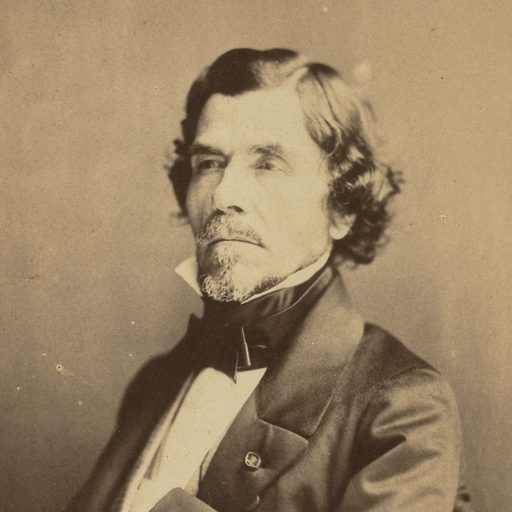
His will forbade any bust, any statue and any religious emblem: his executors had nothing but his name engraved. His tomb, in Volvic lava stone, copies that of Scipio on the Via Appia. He died on 13 August 1863, worn out by twenty years spent on scaffolding.
The story
At the Salon of 1822, Dante et Virgile aux Enfers imposed a painter of twenty-four. Two years later the State bought Scènes des massacres de Scio for six thousand francs. The Three Glorious Days of 1830 gave him La Liberté guidant le peuple.
The journey to Morocco, in 1832, settled the rest. He came back with notebooks that would feed thirty years of orientalism, and with a conviction: colour can do without drawing to say movement.
From 1840 to 1861 he covered the ceilings of the Louvre, the Palais-Bourbon and the museum at Versailles with paintings. Those years on scaffolding wrecked his health. He died on 13 August 1863, watched over by his housekeeper Jenny Le Guillou, who lies in Division 49 herself.
His will is precise: no bust, no statue, no religious emblem. He wanted a tomb in the antique manner. His executors gave the design to the architect Denis Darcy, who took the form of the tomb of Scipio, found on the Via Appia — a model whose original now stands in the Vatican Museum.
The result is one of the most austere tombs in the cemetery, and the avenue that leads to it carries his name. His apartment in the rue de Furstenberg is a museum today.
The grave
A tomb in the antique style designed by the architect Denis Darcy, cut from Volvic lava stone — a dark, matt material, without veins or lustre. It copies the form of the tomb of Scipio, on the Via Appia, which Delacroix knew from the copy kept at the Vatican. In accordance with his will, no bust, no statue, no religious emblem: a single word is engraved, “EUGENE DELACROIX”.
On site, do not miss
Look at the material rather than the form: this lava stone does not catch the light, which is why the tomb looks darker than everything around it. Then look for an ornament — there is none, and that was his testamentary wish.
Visitors' questions
Why is Delacroix's grave so plain?
By the terms of his will: he had explicitly forbidden any bust, any statue, and any religious emblem. His executors entrusted the tomb's design to the architect Denis Darcy, who borrowed the form of the tomb of Scipio.
Camille CorotWhere is Eugène Delacroix's grave?
In Division 49, in the central, upper part of the cemetery, not far from Balzac's.
Honoré DaumierWhen did Delacroix die?
On 13 August 1863, in his studio on Place de Furstenberg. He left behind a journal, thousands of drawings, and a revolution in painting that would open the way for the Impressionists.
David d'AngersWhat other painters' graves are worth seeing at Père-Lachaise?
Théodore Géricault rests in Division 12, beneath a recumbent effigy holding a palette and a bas-relief of The Raft of the Medusa, and Amedeo Modigliani in Division 96, beside Jeanne Hébuterne.
Dominique Vivant DenonAudio guide to Père Lachaise: the best unusual guided tour!
Discover the secrets of the most astonishing tombs
the audio guidefrom€6.99