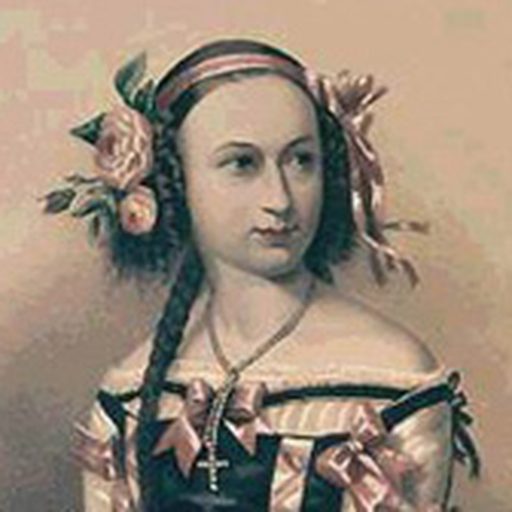
Theatrical France tore her to pieces — “a lightness without grace or taste” — and advised this pupil of Taglioni to go back to Saint Petersburg; Gautier called her “not unworthy of that brilliant school”. Dead at around thirty-five, she has for inscription only her name and the date of 26 October 1857.
The story
Hélène Andrianoff was born in Saint Petersburg around 1822. A pupil of La Scala and then of Marie Taglioni, she belonged to that Russian school Europe was beginning to watch, and she came to Paris to seek, in her own words, “the verdict of Paris on her dancing”.
The verdict was divided. The paper La France théâtrale put her to the sword — “she was never pretty”, “a lightness without grace or taste” — and advised “the Taglioni of the North” to take the road back to Saint Petersburg. Théophile Gautier, more measured, found her “fair, with eyes as blue as a daughter of the north”, and “not unworthy of that brilliant school”.
She died in Paris on 26 October 1857, at around thirty-five, after a few Paris seasons of which the press remembered the faults rather than the parts.
Four years later, in 1861, a marble recumbent figure was laid on her grave. It is signed Antonio Rossetti, a sculptor who left several monuments at Père-Lachaise, and it shows a young woman lying on a plinth ringed with dolphins, beneath a lit Roman lamp.
That imbalance is the whole interest of Division 49, on the avenue Eugène-Delacroix: a sumptuous grave for a dancer nobody quotes any more, and not one line cut in the stone to say who she was.
The grave
The monument is a marble recumbent effigy signed Antonio Rossetti and dated 1861: a young woman lying down, on a pedestal surrounded by dolphins, topped by a lit Roman lamp. The disproportion between the work and the inscription is striking: “Hélène Andrianoff, died on 26 October 1857”, seven words, with no year of birth and no mention of dance. The reference works have her born around 1822 in Saint Petersburg, which the stone does not confirm — it says nothing of her life, only the day it stopped.
On site, do not miss
The marble effigy and the details of its pedestal: the dolphins that surround it, and the lit Roman lamp set on top.
Visitors' questions
Where is Hélène Andrianoff's grave?
In Division 49, Avenue Eugène-Delacroix, first row, in the central part of the cemetery. The white marble effigy, a young woman lying at rest, marks it out at first glance: it is one of the most photographed Romantic monuments at Père-Lachaise.
Georges MélièsWho was Hélène Andrianoff?
A ballerina born in Saint Petersburg around 1822, a pupil of La Scala and of Marie Taglioni, who came to dance in Paris. The Parisian critics gave her a cold reception; Théophile Gautier was one of the few to judge her worthy of the Russian school.
Yves Montand and Simone SignoretWho sculpted her effigy?
Antonio Rossetti (1819-1870), who signed and dated it 1861, four years after the dancer's death. The sculptor left several funerary monuments at Père-Lachaise; this one is considered one of the finest Romantic effigies in the cemetery.
Eric AdjaniWhat does her gravestone say?
“Hélène Andrianoff, died 26 October 1857” — and nothing more. No year of birth, no profession, no epitaph: the stone stays silent about the dancer beneath it, even as the monument itself is sumptuous.
Jehanne d'AlcyAudio guide to Père Lachaise: the best unusual guided tour!
Discover the secrets of the most astonishing tombs
the audio guidefrom€6.99