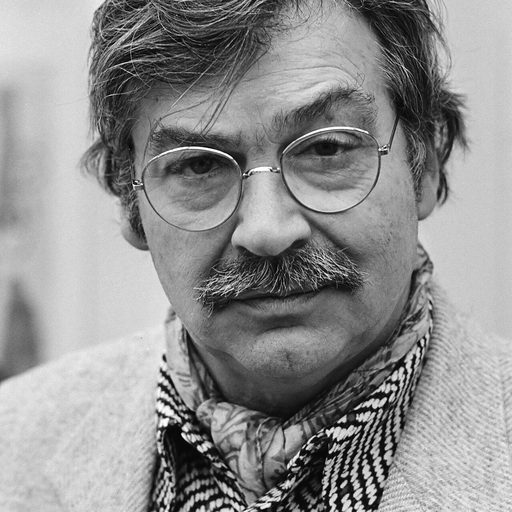
Karel Appel studied fine art in Amsterdam under the German occupation. In 1948, in a Paris café near Notre-Dame, he drafted with Dotremont and Jorn the manifesto of CoBrA, named after the three cities of its signatories: they demanded a spontaneous painting, on the side of children's drawing, against an abstraction they found cold. Venice crowned him in 1954. He painted a mural in a shanty town in Lima.
The story
Karel Appel was born in Amsterdam in 1921 and had his first painting lessons from an uncle in 1936. He was at the Amsterdam academy of fine arts from 1940 to 1943, under German occupation, and made friends there with Corneille van Beverloo.
On 16 July 1948 he co-founded the Dutch Experimental Group. That same year in Paris, with Christian Dotremont and Asger Jorn, he wrote the CoBrA manifesto in a café near Notre-Dame — Copenhagen, Brussels, Amsterdam. The movement wanted a spontaneous painting, close to children's drawing and to art brut, against cold abstraction.
The Colette Allendy gallery was showing him in Paris as early as 1949; a prize at the Venice Biennale set the seal on him in 1954. He then widened his materials: first works on wood and polyester in 1961, monumental aluminium sculptures in the United States in 1971.
In 1976 he painted a mural in a shanty town in Lima, with the people who lived there. The gesture sums up a constant ambition: to get painting out of the museum without taking its violence away.
He died in Zurich on 3 May 2006, at eighty-five, of a long-standing heart condition; he was still painting, seated. His widow had him buried at Père-Lachaise on 16 May, in strict privacy, in Division 22, under a maple. A tribute ceremony was held on 17 June at the Concertgebouw in Amsterdam.
On site, do not miss
The maple above the stone, and the brevity of the inscription: “Karel Appel, 1921-2006”, nothing more for a painter of that stature.
Visitors' questions
Where is Karel Appel's grave?
In Division 22, Chemin de la Citerne, second row, beneath a maple tree. Gustave Doré's grave lies in the same division, three rows further on, so both can be seen on the same stop.
Jeanne HébuterneWhat was the CoBrA movement?
A movement founded in 1948 by Karel Appel, Christian Dotremont and Asger Jorn, its name compressed from Copenhagen, Brussels and Amsterdam. It championed a spontaneous style of painting, close to a child's drawing, against the cold abstraction of the post-war years.
James PradierWhy is a Dutch painter buried in Paris?
Because his life as an artist unfolded from Paris, where CoBrA was founded in 1948 and where he exhibited as early as 1949. His widow chose Père-Lachaise for his burial, held on 16 May 2006 in strict privacy.
Charles-François DaubignyWhen did Karel Appel die?
On 3 May 2006 in Zurich, at eighty-five, from a long-standing heart condition. He was still painting, seated, up to the end. A memorial ceremony followed on 17 June at Amsterdam's Concertgebouw.
Charles CrozatierAudio guide to Père Lachaise: the best unusual guided tour!
Discover the secrets of the most astonishing tombs
the audio guidefrom€6.99