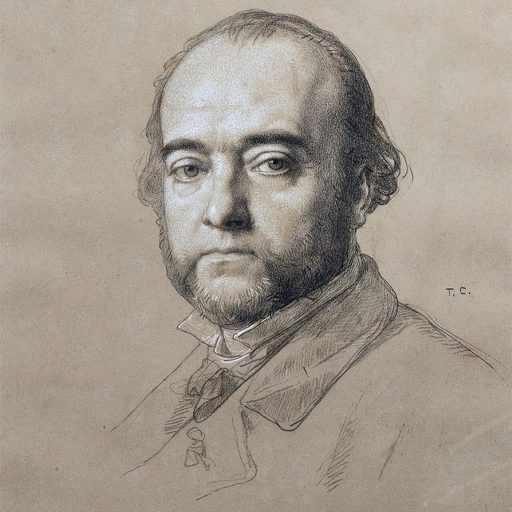
Barbedienne was selling wallpaper when he met, in 1838, a mechanic who knew how to reduce a statue to any scale. His firm, founded the following year, reproduced in bronze the great sculptures of Europe's museums: the unique commissioned object became a published edition. He signed contracts with Barye and Frémiet, and furnished the drawing rooms of the Second Empire.
The story
The son of a poor Norman farmer, born in 1810, Barbedienne began in the wallpaper trade. Everything changed in 1838, when he went into partnership with the engineer Achille Collas, who had invented a process for reproducing statues in bronze at any scale.
The Barbedienne house was founded in 1838, with the engineer Achille Collas. Its principle: reproduce the great statues of Europe's museums at every size, and sell them. Bronze stopped being a one-off commission and became a published edition.
He signed publishing contracts with living sculptors — Barye, Frémiet, Mène — and put on the market a repertoire of antique and allegorical figures that the middle classes of the Second Empire set in their drawing rooms. Bronzes stamped with his name still come up regularly at auction.
He died in 1892, childless. His nephew Gustave Leblanc-Barbedienne took over the house, which would later sign a great many war memorials across France.
The monument in Division 53 was cast by that same house in 1894: the founder portrayed by his own workshops, two years after his death. Nowhere else in the cemetery does a tomb fold back on itself so completely.
The grave
A tall square pillar of Vosges stone, topped by a bronze bust signed Henri Chapu. On either side, two life-size statues by Alfred Boucher: Art, helmeted with a chimera, and Industry, armed with a hammer — the founder's two activities, placed side by side without hierarchy. At the foot of the pillar, a naked seated child holds an upturned torch whose flame flickers. The bronzes bear the Leblanc-Barbedienne mark and the date 1894: they were cast by the deceased's own firm, two years after his death. The inscription, for its part, is limited to “F. Barbedienne 1810-1892”.
On site, do not miss
The two bronzes flanking the pillar — Art helmeted with a chimera, Industry with her hammer — then, at the bottom, the naked child whose upturned torch is going out.
Visitors' questions
Where is Ferdinand Barbedienne's grave?
In Division 53, Chemin de Mont-Louis, first row, at the heart of the cemetery. The monument is recognisable by its two life-size bronze statues, flanking a tall pillar of Vosges stone topped with a bust.
Antoine-Louis BaryeWho sculpted his monument?
The bronze bust is by Henri Chapu, who also created the monument of Marie d'Agoult. The two statues, Art and Industry, are by Alfred Boucher, and the child holding an inverted torch stands at the foot of the pillar.
Paul BaudryWho was Ferdinand Barbedienne?
The greatest art founder of the nineteenth century. His firm, established in 1838 with the engineer Achille Collas, reproduced in bronze the statues held in Europe's museums and published editions of living sculptors such as Barye: it was he who brought sculpture into the middle-class home.
Jean-Adolphe BeauceWho cast the bronzes on his grave?
His own firm, by then Leblanc-Barbedienne under the direction of his nephew Gustave, who cast them in 1894, two years after his death. The founder is thus commemorated by bronzes that came out of his own workshops.
Octave de BéhagueAudio guide to Père Lachaise: the best unusual guided tour!
Discover the secrets of the most astonishing tombs
the audio guidefrom€6.99