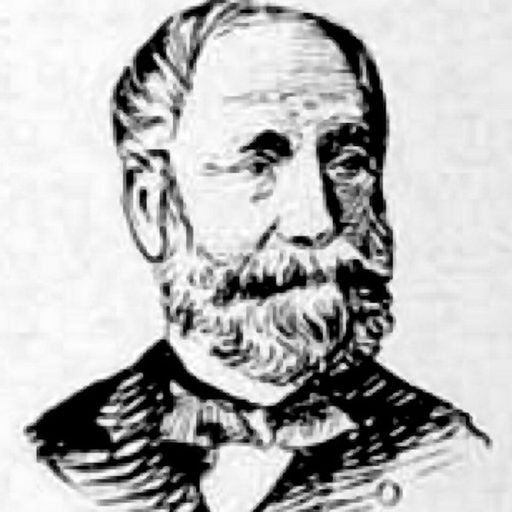
Théodore Ballu, Grand Prix de Rome in 1840, restored the Tour Saint-Jacques and raised for Saint-Germain-l'Auxerrois a belfry whose iron frame vanishes entirely beneath the stone. Then put in charge of all the City's churches, he built the Trinité, Saint-Ambroise and Saint-Joseph. In 1873 he won the competition opened to rebuild the Hôtel de Ville, which the Commune had left in ashes.
The story
Born in Paris on 8 June 1817, Ballu entered the École royale des beaux-arts in 1835, in the studio of Louis Hippolyte Lebas. Grand Prix de Rome in 1840 with a design for a palace for the Chamber of Peers, he held a place at the Villa Medici from 1841 to 1845 and worked there on Pompeii and on the Erechtheion in Athens.
In 1853 he became chief architect of Sainte-Clotilde, restored the Tour Saint-Jacques from 1854 to 1858, then raised the belfry of Saint-Germain-l'Auxerrois — an iron structure hidden entirely under its stone.
Chief architect for the City of Paris's places of worship in 1860, he built the church of La Trinité from 1861 to 1867, Saint-Ambroise from 1863 to 1869, Saint-Joseph from 1866 to 1875, and the church of Saint-Denis at Argenteuil. He entered the Académie des beaux-arts in 1872.
In 1873, with Édouard Deperthes, he won the competition to rebuild the Hôtel de Ville, burnt during the Commune, and ran the site until his death. In 1874 he succeeded Viollet-le-Duc, who had resigned, as inspector general of diocesan buildings.
He died in Paris on 22 May 1885, at sixty-seven, the Hôtel de Ville still unfinished. He lies in Division 74 with his son-in-law, the sculptor Antoine Idrac, dead at thirty-five, and his son Albert Ballu, chief architect of the Monuments historiques, who died in 1939.
The grave
A small funerary temple with two finely engraved Ionic columns, with a mosaic on the pediment depicting a cross among flowers, a winged hourglass and a funeral wreath in bas-relief. The architect's profile is carried by a bronze medallion signed Daniel Dupuis, with the entwined monogram DD. The inscription lists his building sites like a list of titles: “chief architect of the Hôtel de Ville 1872-1885, and of the churches of the Trinité, Saint-Ambroise, Saint-Joseph, Argenteuil, the temple on rue d'Astorg”. The grave also shelters his father-in-law, the sculptor Antoine Idrac, and his son Albert, an architect like him.
On site, do not miss
The engraved Ionic columns, the mosaic on the pediment, and on the sides the winged hourglass and the funeral wreath.
Visitors' questions
Where is Théodore Ballu's grave?
In Division 74, Chemin Serré, second row, in the upper part of the cemetery. The monument takes the form of a small temple with two finely carved Ionic columns, and a mosaic on the pediment.
Albert BartholoméWhat buildings did Théodore Ballu design?
The Église de la Trinité, Saint-Ambroise, Saint-Joseph, the church of Saint-Denis at Argenteuil, the belfry of Saint-Germain-l'Auxerrois, the restoration of the Tour Saint-Jacques, and the new Paris Hôtel de Ville from 1873 onward.
Antoine-Louis BaryeDid he design his own grave?
Nothing confirms it: the monument is a temple in the antique style, but the bronze medallion bearing his profile is signed by the sculptor Daniel Dupuis, with an interlaced DD monogram, and the mosaic on the pediment is unattributed.
Paul BaudryWho rests with him in Division 74?
His father-in-law, the sculptor Antoine Idrac, a Prix de Rome winner who died at thirty-five in 1884; his brother-in-law, the meteorologist Pierre Idrac; and his son Albert Ballu, chief architect of Historic Monuments, who died in 1939 at ninety.
Jean-Adolphe BeauceAudio guide to Père Lachaise: the best unusual guided tour!
Discover the secrets of the most astonishing tombs
the audio guidefrom€6.99