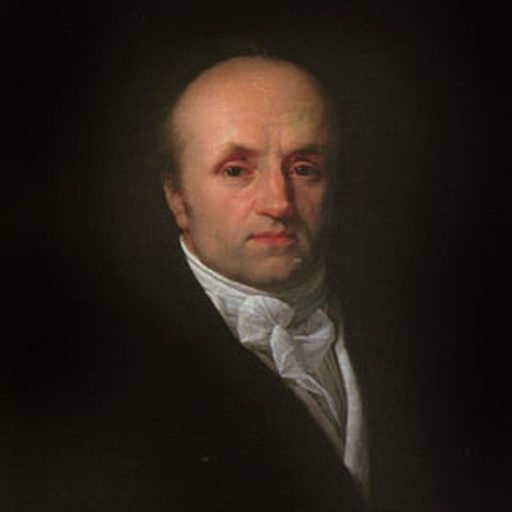
Abraham-Louis Breguet, a watchmaker born in Switzerland in 1747, settled in Paris and supplied Marie-Antoinette. To him we owe the tourbillon, patented in 1801: a mechanism that turns on itself to correct the effect of gravity on the running of a watch. He died in 1823. His name takes up one line among nineteen Breguets carved there, from the watchmaker to the aircraft builders.
The story
Set a watch on top of it: it winds itself and sets itself to the right time. That is an invention of Abraham-Louis Breguet, watchmaker — one of his so-called sympathique clocks. The man who imagined such a thing lies in Division 11, under a bronze bust that is neither signed nor dated.
Born at Neuchâtel on 10 January 1747 and apprenticed at Versailles from 1762, he set up on his own on the Île de la Cité in 1775. His list of inventions is a century of watchmaking: the Breguet balance spring, the pare-chute that shields the movement from shocks, the perpetual calendar, the sympathique clocks. He entered the Académie des sciences in 1816 and supplied Marie-Antoinette as well as the Queen of Naples.
He patented the tourbillon in 1801 — the escapement turns on itself to cancel the effects of gravity — and died in Paris in September 1823. His name is indeed on the stone, but drowned: the grave lines up five generations of Breguets, from the watchmaker to the aircraft builders. Two bronze plaques were placed there by the staff of the aviation works, and an earthenware planter carries, alone, the letter B.
The grave
A family stone where the watchmaker occupies one line among nineteen: “Abraham Louis BREGUET, membre de l'Institut, 10 janvier 1747 – 7 7bre 1823” — member of the Institut; “7bre” is the notarial abbreviation for September. Five generations appear there, from the inventor of the tourbillon to the aircraft builders, and two bronze plaques were placed there by the staff of the aviation workshops. An earthenware planter bears, alone, the letter B. The bronze bust that crowns the whole is neither signed nor dated; it is attributed to Mathieu Kessels and dated to 1818, perhaps 1815.
On site, do not miss
Look for his line among the others: “Abraham Louis BREGUET, membre de l'Institut, 10 janvier 1747 – 7 7bre 1823” — member of the Institut —, drowned among nineteen names of the family. The bronze bust, for its part, is neither signed nor dated.
Visitors' questions
Where is Breguet's grave?
In Division 11 of Père-Lachaise, chemin Méhul. You know it by the bronze bust and the long roll of Breguets carved below — nineteen names, his own on a single line.
Hans BellmerWhat is the Breguet tourbillon?
A mechanism patented in 1801: the escapement turns on itself to cancel the effect of gravity on the watch's rate. Two centuries later, the great watchmaking houses are still building it.
René-Just HaüyWhat is a sympathique clock?
An invention of Breguet's: a clock that winds and sets a watch placed on top of it. He also invented the Breguet overcoil, the pare-chute shock protection and the perpetual calendar, and entered the Academy of Sciences in 1816.
Claude ChappeWho wore his watches?
Marie-Antoinette and the Queen of Naples, among others. Apprenticed at Versailles from 1762 and in business on his own account on the Île de la Cité by 1775, he supplied the courts of Europe — and the house he founded is still going.
Zénobe GrammeAudio guide to Père Lachaise: the best unusual guided tour!
Discover the secrets of the most astonishing tombs
the audio guidefrom€6.99