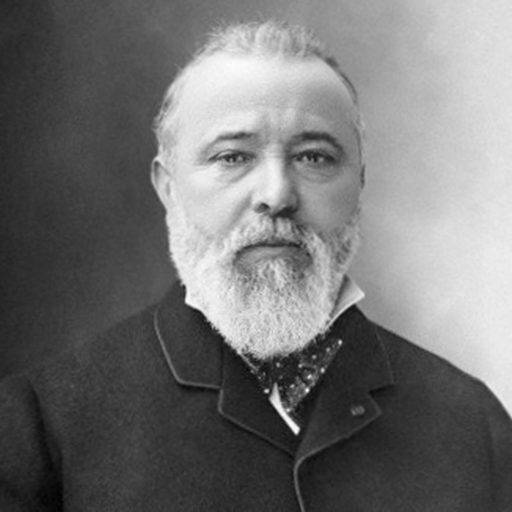
Zénobe Gramme was a working cabinetmaker, without the slightest scientific training, and it was by repairing electrical machines that he grasped their faults with his hands. His patent of 1870 delivers a steady, continuous current where earlier devices gave only a pulsed, unusable one. It was soon noticed that, fed with current, his machine ran as a motor.
The story
Zénobe Gramme was born in 1826 near Liège, in Belgium. A cabinetmaker and pattern-maker with no scientific training, he came up to Paris in 1856 and worked for makers of electrical machines, whose faults he understood through his hands.
In 1870 he filed a patent for a “magneto-electric machine producing continuous currents” — the Gramme machine. Where earlier devices delivered a pulsing current nobody could use, his gave a steady, continuous one.
In 1871, with Hippolyte Fontaine, he founded the Gramme magneto-electric machine company. A famous demonstration soon showed that the machine, fed with current, ran as a motor: the dynamo works both ways, and electricity became an industrial force.
The International Exhibition of Electricity of 1881 set the seal on the invention. In 1888 the Academy of Sciences gave him the Volta Prize and its fifty thousand francs; he had been an officer of the Legion of Honour since 1877.
He died at Bois-Colombes in 1901. His statue in Division 94 shows him seated with the dynamo in his hands — a workman with his object, on a scientist's grave.
The grave
A bronze statue by the sculptor Mathurin Moreau (1822-1912), cast by the Val d'Osne foundry: Gramme is seated in an armchair, a dynamo in his hands. The choice is rare at Père-Lachaise, where scientists usually appear in bust: here the man holds the object, and the object is a workshop machine. The inscription names him bluntly “inventor of the first industrial dynamo, 1826-1901”, followed by that of his widow, née Antonie Schentur, who died in 1923.
On site, do not miss
The dynamo held in the statue's hands, and the word engraved beneath: “inventor”.
Visitors' questions
Where is Zénobe Gramme's grave?
In Division 94, Avenue Transversale No. 3, first row, in the upper part of the cemetery — the Division of General Andranik's equestrian cenotaph. The bronze statue makes it recognisable from afar.
General AndranikWhat does the statue on his grave represent?
Gramme seated in an armchair, holding a dynamo in his hands. The work is by Mathurin Moreau, cast by the Val d'Osne foundry: a workman with his object, where scientists are usually shown as busts.
Joseph FourierWhat did Zénobe Gramme invent?
The direct-current dynamo, patented in 1870. Earlier machines produced only a pulsed current, of no practical use; his gave a steady one — and ran as a motor when fed with electricity.
Édouard BranlyDid he have any schooling?
No scientific training at all: he was a cabinetmaker and pattern-maker by trade, and came to understand electrical machines with his hands, working for the firms that built them. The Academy of Sciences awarded him the Volta Prize in 1888.
Claude ChappeAudio guide to Père Lachaise: the best unusual guided tour!
Discover the secrets of the most astonishing tombs
the audio guidefrom€6.99