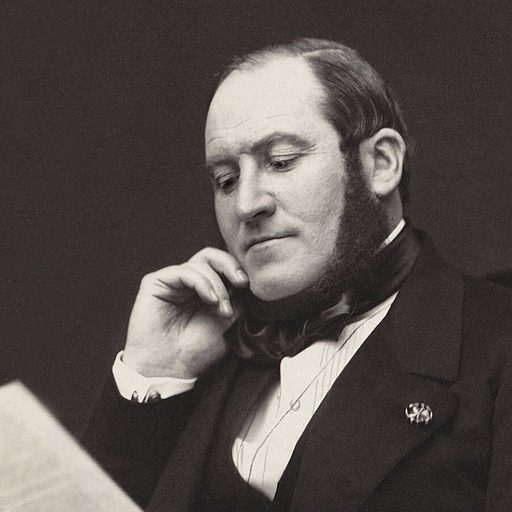
Haussmann was appointed Prefect of the Seine in June 1853, and seventeen years followed, out of which came the city of today. None of it was his work alone: Alphand designed the parks, Belgrand the water and the sewers, Baltard Les Halles, Davioud the street furniture. The bill for the new boulevards exceeded two billion francs of the day. The city before, it was said, turned into a cesspit as soon as it rained.
The story
Georges Eugène Haussmann was born in Paris on 27 March 1809, in the Beaujon quarter, to a father who was one of Napoleon's army commissaries. Napoleon III made him prefect of the Seine on 22 June 1853: there began seventeen years that made the city we live in.
He did not work alone. Alphand ran the works and laid out the parks with Barillet-Deschamps, Belgrand the water and the sewers, Davioud the street furniture and the style that would carry the prefect's name, Baltard the market halls, Hittorff the Cirque d'hiver.
The boulevards de Sébastopol, de Magenta and Saint-Germain, the avenues Kléber, Foch and George-V, the rues de Rivoli, Réaumur and des Écoles came out of those works, for two thousand one hundred and fifteen million francs. Before him Paris was described as a sewer on rainy days, a tangle of foul and ill-famed lanes.
The pick took down the tower of the Hospitallers of Saint-Jean-de-Latran, the church of Saint-Benoît, what was left of the Collège de Cluny, the Innocents market, dozens of churches and chapels — and the house in the Beaujon quarter where he had been born, which he had razed without a qualm.
The minister Émile Ollivier removed him in 1870, over a financial scandal and contested practices. Deputy for Corsica from 1877 to 1881, he never got the ministry he wanted, and died in Paris on 11 January 1891.
The grave
A family grave, that of the Haussmanns, with no monument to match the work. The prefect's inscription — “Georges Eugène, Baron Haussmann, Prefect of the Seine, 27 March 1809 – 11 January 1891” — sits beside that of his wife Louise Octavie de Laharpe, who died three weeks before him, and five other names going back to Catherine Thérèse Thiénot, widow of Nicolas Haussmann, born in Rouen in 1758. At the head, a reference stands in for an epitaph: “St Matth. XXV, 21” — “well done, good and faithful servant”. His dismissal in 1870 did not stop the family choosing this verse.
On site, do not miss
The biblical epitaph at the head of the stone — “Saint Matthew XXV, 21” — and, lower down, six generations of the prefect's family.
Visitors' questions
Where is Baron Haussmann's grave?
In Division 4, Avenue Principale, first row, a few minutes from the Boulevard de Ménilmontant entrance — the same alley as Paul Baudry's monument, Colette's grave and Albert Bartholomé's recumbent effigy.
ColetteWhat did Haussmann do to Paris?
Seventeen years of demolition and building, from 1853 to 1870: the boulevards de Sébastopol, de Magenta and Saint-Germain, the avenues Kléber, Foch and George-V, the rues de Rivoli and des Écoles, the sewers, the parks — for two thousand one hundred and fifteen million francs.
Adolphe AlphandWho worked with him?
Alphand for the works and the parks, Belgrand for water and sewers, Davioud for street furniture and the so-called Haussmannian style, Baltard for Les Halles, Barillet-Deschamps for the planting. Alphand rests in Division 66.
Théodore BalluWhy was he dismissed?
The minister Émile Ollivier removed him in 1870, over a financial scandal and contested methods of funding the works. He was later deputy for Corsica from 1877 to 1881, without ever obtaining the ministry he hoped for.
Casimir PérierAudio guide to Père Lachaise: the best unusual guided tour!
Discover the secrets of the most astonishing tombs
the audio guidefrom€6.99