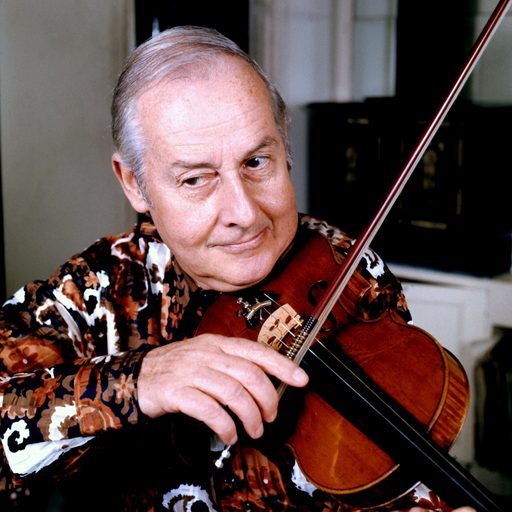
Stéphane Grappelli knew the orphanage and the street, played piano beneath silent films in neighbourhood cinemas, and entered the Conservatoire at twelve. With Django Reinhardt he formed in 1934 a quintet with no drums and no brass, all strings — an idea no American band had had. His second career, a late one, was immense, from Oscar Peterson to Yehudi Menuhin. He lies in the columbarium, in his father's niche.
The story
Stéphane Grappelli was born in Paris on 26 January 1908. His mother died when he was very small; his father, an Italian from Nettuno, sent him at six to Isadora Duncan's dance school, then had to place him in an orphanage. He learned the violin in the street, accompanied silent films at the piano, and entered the Conservatoire on 31 December 1920, at twelve.
In 1934 he founded, with the guitarist Django Reinhardt, the Quintette du Hot Club de France: three guitars — Django's for the solos, two more for rhythm — a double bass and a violin, with no drums and no brass. A jazz band made entirely of strings: no American had thought of it, and they listened.
The war separated them: Grappelli was in London in 1939 when it broke out, and he stayed. They met again in that same city in April 1946, after six years, and the first piece they recorded together was La Marseillaise — released under the title “Echoes of France”. Django died in 1953.
His second career was immense and late. He recorded more than a hundred titles with Oscar Peterson, Jean-Luc Ponty and Yehudi Menuhin, and cut in June 1995, at eighty-seven, Michel Petrucciani's “Flamingo”: released the following year, it sold over a hundred thousand copies in France — one of the rare gold records in jazz.
He played until he was eighty-eight and died of heart failure on 1 December 1997. His ashes were placed in the columbarium, niche 417, the one where his father had lain since 1939 — Georges Perec is on the same wall, niche 382.
The grave
A columbarium niche, number 417, closed with a black marble plaque in gilt lettering; the number is painted by hand on the stone above it. It carries three names: Ernest Grappelli, 1876-1939, his father, the Italian from Nettuno who raised him alone and had to put him in an orphanage; Stéphane Tanasesco, 1956-1991, dead at thirty-five, of whom nothing tells us who he was; and Stéphane Grappelli, 1908-1997, last of the three. Nothing on the plaque speaks of the violin or of jazz.
On site, do not miss
The plaque on niche 417 carries three names and two Stéphanes: his father Ernest, who died in 1939; Stéphane Tanasesco, who died at thirty-five in 1991; and himself. Georges Perec is on the same wall, niche 382. Isadora Duncan is further off in the building — it was to her school that Grappelli was sent, at six, to learn to dance.
Visitors' questions
Where is Stéphane Grappelli's grave?
In the Père-Lachaise columbarium, Division 87, niche 417 — these are his ashes, not a grave, and the plaque carries three names. Georges Perec is on the same wall, niche 382; Isadora Duncan, Max Ernst and Maria Callas's plaque are elsewhere in the building.
Mezz MezzrowWhat was the Quintette du Hot Club de France?
The group he founded in 1934 with Django Reinhardt: three guitars, a double bass and a violin, with no drums and no brass. A jazz band made entirely of strings — a formula the Americans had not tried, and came to hear.
Michel PetruccianiWho did he record with?
More than a hundred titles, with Oscar Peterson, Jean-Luc Ponty, Yehudi Menuhin, and with Michel Petrucciani the album “Flamingo”, recorded in June 1995 and released the following year, which sold over a hundred thousand copies in France — one of the rare gold records in jazz.
Manu DibangoHow old was he when he stopped playing?
He played until he was eighty-eight and died on 1 December 1997, at eighty-nine. His second career, after the war, lasted far longer than his years with Django Reinhardt: five years of the quintet before the war, half a century after it.
Max ErnstAudio guide to Père Lachaise: the best unusual guided tour!
Discover the secrets of the most astonishing tombs
the audio guidefrom€6.99