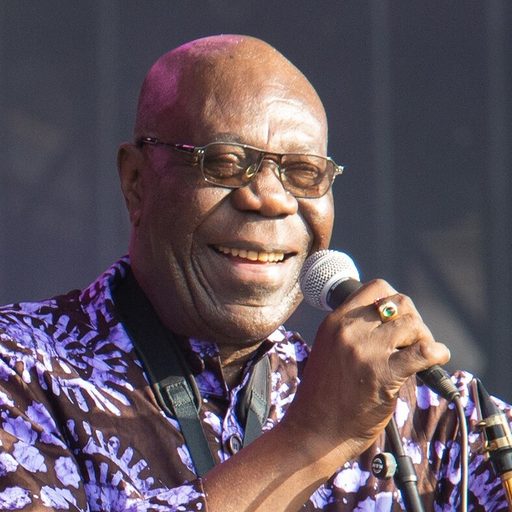
Manu Dibango arrived from Douala in Marseille in 1949 carrying three kilos of coffee that were to pay for his board, and discovered the saxophone in Reims. Soul Makossa, cut in 1972 as a B-side, became a worldwide hit and one of the very first disco tracks. Its riff was borrowed so often that it took a court case. A photograph of him is held between two sheets of glass.
The story
Manu Dibango was born in Douala, in Cameroon, on 12 December 1933. He landed at Marseille in 1949 with three kilos of coffee in his luggage to pay for his board, and came to the saxophone at Reims in 1956.
In 1957 he married Marie-Josée, known as Coco, a painter and model, and in 1961 toured the Congo with Le Grand Kallé — the Africa of the new independent states, and he became one of its musicians.
“Soul Makossa”, recorded in 1972, started life as a B-side and turned into a worldwide hit. It stands among the very first disco records, and its chant was lifted so often that the courts had to settle it: Michael Jackson, who borrowed it for “Wanna Be Startin' Somethin'”, paid a million francs to settle in 1986; in 2009 Dibango sued again, this time over Rihanna's “Don't Stop the Music”, with Sony, EMI and Warner named alongside her.
He backed Serge Gainsbourg through the 1980s, presented a programme on Africa Radio for twenty years, and became one of the most familiar figures in French music — Papagroove, Papa Manu.
He died in hospital at Melun on 24 March 2020, of Covid-19, in the first days of the first wave. The monument over his grave, in Division 44, is signed and dated that same year.
The grave
The monument is recent and catches the eye: a large photograph of the musician mounted between two sheets of glass, standing on the stone — a device rare in Père-Lachaise, where the portrait usually goes through bronze or marble. The whole is signed by the contractor Rebillon and dated 2020, the very year of his death. The inscription fits in two words and a date: “Manu Dibango, 2020”. Nothing of Cameroon, nothing of the saxophone, nothing of Soul Makossa: the image does all the work.
On site, do not miss
The photograph of the musician held between two sheets of glass — a device found almost nowhere else in the cemetery.
Visitors' questions
Where is Manu Dibango's grave?
In Division 44, Avenue Transversale No. 2, first row — the division of Yves Montand and Simone Signoret and of Yvette Chauviré. A large photograph of the musician is set between two panes of glass.
Yves Montand and Simone SignoretWhat is “Soul Makossa”?
A track recorded in 1972, first released as a B-side, that became a worldwide hit and one of the very first records in the history of disco. Michael Jackson took its hook for “Wanna Be Startin' Somethin'” and settled in 1986; in 2009 Dibango sued Rihanna over “Don't Stop the Music”.
Michel PetruccianiHow did he die?
Of Covid-19, on 24 March 2020, at the hospital in Melun: he was the first major French artist carried off by the epidemic, at the very start of the first wave. He was eighty-six, and still performing.
Alain BashungWho was Manu Dibango?
A Cameroonian saxophonist and singer who arrived in France in 1949 with three kilos of coffee and became one of the most familiar faces in French music — Papagroove. He played with Serge Gainsbourg and hosted a show on Africa Radio.
Gilbert BécaudAudio guide to Père Lachaise: the best unusual guided tour!
Discover the secrets of the most astonishing tombs
the audio guidefrom€6.99