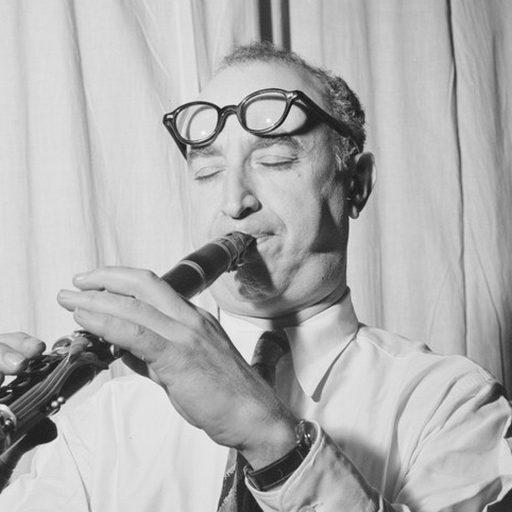
A white clarinettist from Chicago, he declared himself a “voluntary Negro”, organised mixed recording sessions as early as 1938 and gave Sidney Bechet work when no one else would employ him. Harlem's marijuana supplier, he obtained in prison to be registered as a Black inmate.
The story
Born in Chicago in 1899 into a Jewish family out of Eastern Europe, Milton Mezzrow found jazz where nobody goes looking for it: in a reformatory, played by Black inmates. He came out of it a clarinettist, and changed. The rest of his life would hang on a decision taken at that moment: never to go back to the side he was born on. He settled in the Black districts of Chicago and then of Harlem, married a Black woman, took up the language and the codes of the musicians, and declared himself a “voluntary Negro” — a phrase he would claim without irony until he died.
As a musician he was not the most gifted of his generation and never claimed to be; the critics reproached his playing enough. His importance lies elsewhere. In November 1938 he set up in New York the sessions the French critic Hugues Panassié had come to record, and brought back to them Sidney Bechet and the trumpeter Tommy Ladnier, whom the swing fashion had made old-fashioned and whom nobody would hire. Those records reopened Bechet's career and set off the New Orleans revival. Ladnier died six months later.
He was also Harlem's chief marijuana supplier, with a reputation for quality such that the product ended by taking his name: people asked for “a mezz”. Arrested in 1940 with sixty cigarettes on him, he demanded at the desk to be booked as a Black prisoner. The prison administration, embarrassed, gave in at last and moved him to the Black wing of Rikers Island. He served his sentence on the side he had chosen, and told the story without giving himself the good part.
In 1946 came Really the Blues, his autobiography written with Bernard Wolfe in the slang of the musicians — a book whose closing glossary remains a document on the speech of jazz. The beatniks read it before Kerouac published his own, and it became a classic of American counter-culture. Mezzrow ended his life in Paris, where Black American musicians found a welcome their own country refused them. He died there in 1972 and lies in the columbarium.
On site, do not miss
Division 87 is that of the columbarium — note that another clarinettist, Marcel Zanini, has lain there since 2023.
Visitors' questions
Where is Mezz Mezzrow's grave?
In Division 87 of Père-Lachaise, that of the columbarium — where Maria Callas, Georges Perec and Marcel Zanini, another clarinettist, also lie.
The crematorium and the columbariumWhy did he call himself a “voluntary Negro”?
Because he had chosen to live on the Black side of America: born white in Chicago, he moved into the Black neighbourhoods, married a Black woman, and claimed that belonging all his life — right into prison, where he had himself registered as a Black inmate.
Léon MiloWhat is Really the Blues?
His autobiography, published in 1946 with Bernard Wolfe and written in the slang of the musicians. It became a cult book of the American counter-culture: the beatniks were reading it before Kerouac.
Stéphane GrappelliWhat was his part in jazz?
Less that of a virtuoso than of a go-between: he set up mixed recording sessions at a time when Black and white musicians did not play together on record, and he found work for Sidney Bechet when nobody else would hire him.
Michel PetruccianiAudio guide to Père Lachaise: the best unusual guided tour!
Discover the secrets of the most astonishing tombs
the audio guidefrom€6.99