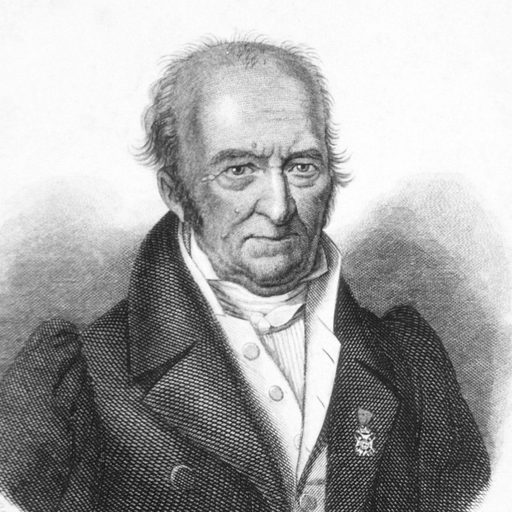
Imprisoned in Bordeaux as a non-juring priest and bound for French Guiana, he picked up an insect in his cell, identified it and sent it to a naturalist: he was released, and the ship he was to take was wrecked. In 1830 he received the chair of crustaceans, arachnids and insects, born of the division of Lamarck's chair at the Muséum.
The story
Born at Brive-la-Gaillarde on 29 November 1762, a priest in 1786, Pierre André Latreille refused the constitutional oath and found himself imprisoned at Bordeaux, awaiting embarkation for Guiana.
In his cell he picked up an insect, identified it and sent it to a naturalist: the prisoner's worth was recognised and he was set free. The ship he was to have boarded was wrecked. He gave up the priesthood and devoted himself to insects.
In 1796 his Précis des caractères génériques des insectes appeared; he entered the Muséum in 1798 and the Académie des sciences in 1814, in succession to Olivier.
His Familles naturelles du règne animal (1825) separated the amphibians from the reptiles — a boundary still in place today. In 1830 he received the chair of crustaceans, arachnids and insects, born of the division of Lamarck's chair. His classification of the arthropods is still in use.
He died in Paris on 6 February 1833 and rests in Division 39, on Avenue Transversale no. 1. His monument, raised by subscription, carries a bronze bust and the carved list of his books.
The grave
A bronze bust dated 1833 and signed Parfait Merlieux (1796-1855), on a stele carved with the titles of his works: “Précis des caractères des insectes 1797, Genera insectorum 1806, Règne animal crustacés, arachnides et insectes 1817-1820 etc.” The monument was raised by subscription, and the inscription says so in Latin: “Ex aere collato aedificaverunt” — they built it with money gathered together.
On site, do not miss
The bronze bust by Parfait Merlieux, dated 1833, and the stele on which the titles of his books are carved. At the bottom, four words of Latin say who paid: “Ex aere collato aedificaverunt”.
Visitors' questions
Where is Latreille's grave?
In Division 39, Avenue Transversale No. 1, first row, beneath a bronze bust dated 1833 and signed Parfait Merlieux. The stele carries the carved list of his publications; the monument was raised by public subscription.
Antoine ParmentierDid an insect save Latreille's life?
The episode has lasted: imprisoned in Bordeaux as a non-juring priest, he identified an insect found in his cell, which made his standing as a scholar known and secured his release. The ship that was to deport him to Guiana was wrecked.
Georges CuvierWhat did Latreille give to science?
The classification of arthropods, still in use today, and the separation of amphibians from reptiles, set out in his Familles naturelles du règne animal of 1825. He succeeded Lamarck in the chair of invertebrates in 1830.
Étienne Geoffroy Saint-HilaireWhat does the inscription on his monument say?
It carves his books — “Précis des caractères des insectes 1797, Genera insectorum 1806, Règne animal crustacés, arachnides et insectes 1817-1820” — then, in Latin, the origin of the monument: “Ex aere collato aedificaverunt”, they built it from money gathered together, raised by public subscription.
René-Just HaüyAudio guide to Père Lachaise: the best unusual guided tour!
Discover the secrets of the most astonishing tombs
the audio guidefrom€6.99