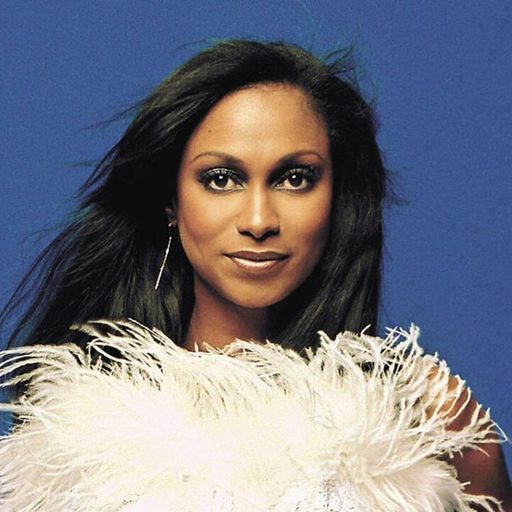
Born in Cayenne into a family from Martinique, she started as a backing singer in the studios where zouk was being invented, before her voice put her out front. In 1992, the SACEM named her best female performer for Mèci, an album that passed forty thousand copies. She died at thirty-nine.
The story
Born in Cayenne, in French Guiana, in 1963, to a father from Martinique and a mother from Guiana, Édith Lefel grew up in the Caribbean, came to France at fourteen and sang first as a backing vocalist, in the studios where zouk was being invented.
Her voice put her out in front. Nicknamed “la Petite Sirène”, the little mermaid, she became one of the great female singers of a music that in those years came out of the Caribbean and settled across France.
In 1992 SACEM, the French songwriters' society, named her best female performer for Mèci. The album passed forty thousand copies — a record for an Afro-Caribbean artist with no major label behind her.
The Olympia, the Paris hall that made careers, on 11 May 1996, and a duet with Jean-Jacques Goldman on a Malavoi album in 1998: the recognition reached beyond the Caribbean audience without her changing her language.
She died of a heart attack on 20 January 2003, at thirty-nine, and lies in Division 45, avenue Transversale n°1, first row, under an epitaph in Creole and French: “Sé lèspwa qua ba-w limiyé” — “C'est l'espoir qui donne la lumière”, it is hope that gives the light.
The grave
A slab on which the singer's portrait is engraved in the stone, and a bilingual epitaph that gives first place to Creole: “Sé lèspwa qua ba-w limiyé — It is hope that gives the light.” Père-Lachaise has few inscriptions in a language of France's overseas territories, and almost none where the French comes as a translation.
On site, do not miss
The portrait engraved in the slab, and the epitaph where Creole comes before French: “Sé lèspwa qua ba-w limiyé — It is hope that gives the light.”
Visitors' questions
Where is Édith Lefel's grave?
In Division 45, Avenue Transversale No. 1, first row: a slab with an engraved portrait and an inscription in Creole and in French. The Division is also that of Gilbert Bécaud and Ticky Holgado.
Gilbert BécaudWhat is the zouk she sang?
The genre born in the French West Indies in the early 1980s, which conquered the whole of France and then Africa. Édith Lefel was one of its great female voices, nicknamed “la Petite Sirène” — the Little Mermaid — for the clarity of her tone.
Manu DibangoWhat prizes did Édith Lefel receive?
The SACEM award for best female performer, in 1992, for Mèci — an album that sold more than forty thousand copies without the backing of a major record label.
Henri SalvadorWhat does the inscription on her grave say?
It is bilingual: “Sé lèspwa qua ba-w limiyé — C'est l'espoir qui donne la lumière” — hope is what gives the light. The Creole comes first, the French translates it. Few epitaphs at Père-Lachaise give pride of place to a language of France's overseas territories.
Ticky HolgadoAudio guide to Père Lachaise: the best unusual guided tour!
Discover the secrets of the most astonishing tombs
the audio guidefrom€6.99