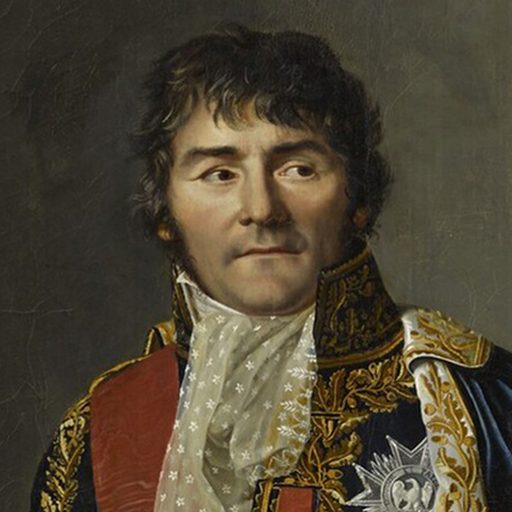
Lefebvre, son of an Alsatian miller, enlisted at eighteen and was still only a sergeant in 1789. The Revolution opened careers: general in 1793, marshal in 1804, then Duke of Danzig when the city was taken. To a courtier who envied his fortune, he is said to have offered his house in exchange for sixty musket shots taken: that was the price he had paid for it.
The story
The son of a miller from Rouffach, in Alsace, he was called Feber before he made the name French. A solicitor's clerk for want of anything better, he enlisted in the Gardes-françaises in 1773, at eighteen, and was still a sergeant in 1789.
The Revolution opened careers: brigadier general in December 1793, he served under Hoche, then backed Bonaparte on 18 Brumaire. He was made marshal in 1804, when the rank was created, and Duke of Danzig four days after the city capitulated, on 24 May 1807.
To a courtier who envied him his fortune he is said to have answered, pointing at his house: “I shall fire sixty rounds at you; if you live, it is yours — that is the price I paid for it.” The remark went round Europe.
In 1783 he had married an illiterate Alsatian laundress, Catherine Hubscher, who bore him fourteen children, twelve of them sons — not one outlived him to carry his name. Victorien Sardou would make her, in 1893, the Madame Sans-Gêne of the repertory.
He died on 14 September 1820, the day after Kellermann, and lies in Division 28: a few days before his death he had chosen his own place there, beside Masséna. Division 39 and its marshals' tombs — Murat, Suchet, Admiral Decrès — begin a few metres away, on the other side of the path.
The grave
A tomb of white marble in the antique form, raised to the designs of the architect Provost. The bas-relief on the front is by Pierre Jean David d'Angers: in the centre the marshal's medallion, on either side a winged Victory laying a branch of laurel on his brow, a garland of laurel and cypress falling as a support, and beneath it the naked sword. The epitaph, under the coat of arms and the medals, between trophies of arms: “Soldier, marshal, Duke of Danzig, peer of France. Fleurus, Wanegarde, Passage of the Rhine, Altenkirken, Dantzick, Montmirail.”
On site, do not miss
The two winged Victories of the bas-relief place a crown on the marshal's brow. Read the engraved list of battles — Fleurus, Dantzick, Montmirail — then the first word of the epitaph, which precedes them all: “Soldier”.
Visitors' questions
Where is Marshal Lefebvre's grave?
In Division 28 of Père-Lachaise, with his wife Catherine, the famous “Madame Sans-Gêne”. The marshal had chosen the spot himself a few days before he died, next to Masséna; the tombs of Division 39 begin a few metres away.
Madame Sans-GêneWhat can be seen on Marshal Lefebvre's tomb?
A white marble tomb in the antique style. On its front, a bas-relief by David d'Angers: the marshal's medallion, two winged Victories laying the laurel on his brow, a garland of laurel and cypress, and beneath it the naked sword.
David d’AngersWho was Madame Sans-Gêne?
Catherine Hubscher (1753-1835), an Alsatian laundress who became Duchess of Danzig by marrying Lefebvre. Her plain speaking at the imperial court inspired Victorien Sardou's play of 1893, which bears that nickname — created by Réjane and later taken up by Sarah Bernhardt.
Sarah BernhardtWhich other marshals of the Empire rest at Père-Lachaise?
Masséna, Davout, Ney, Murat, Kellermann, Grouchy and Suchet are buried here. Their graves are spread across Divisions 18, 28, 29 and 39, in the old upper part of the cemetery: it is the densest military walk in Paris.
André MassénaAudio guide to Père Lachaise: the best unusual guided tour!
Discover the secrets of the most astonishing tombs
the audio guidefrom€6.99