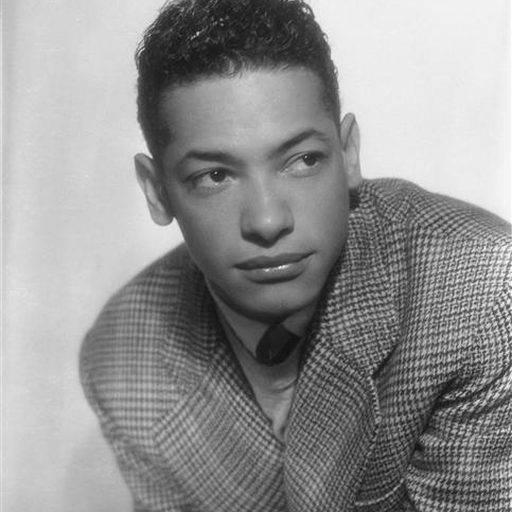
A guitarist before he was a singer, Henri Salvador was eighteen when Django Reinhardt took him on as an accompanist. In 1956, under the name Henry Cording, he cut rock and roll songs to words by Boris Vian that he took for a joke; “Jardin d'hiver” brought him a triumph at eighty-three. On his slab his name sits beside Jacqueline's, his first wife, who was also his agent for twenty-six years.
The story
Henri Salvador was born at Cayenne, in French Guiana, on 18 July 1917. A guitarist before he was a singer, he was playing at the Jimmy's Bar when Django Reinhardt noticed him and took him on as an accompanist: he was eighteen. He then left with Ray Ventura's orchestra for South America, where he spent the war, from 1941 to 1945.
Back in France he became one of the most popular singers in the country: “Syracuse”, “Maladie d'amour”, “Le Loup, la Biche et le Chevalier”, and comic songs — “Le Travail c'est la santé”, “Zorro est arrivé” — that would hide the musician for years.
In 1956, under the name Henry Cording, he cut some of the very first rock and roll records made in France, to words by Boris Vian and music by Michel Legrand: he would not put his own name to what he took for a joke.
With Sacha Distel he is one of only two variety singers to have an entry in the “Dictionnaire du jazz”. In 1964 he founded his own label, Rigolo, which would put out his records for twenty years. And it is his voice that speaks Sebastian the crab in the French version of “The Little Mermaid”.
“Jardin d'hiver”, written by Keren Ann and Benjamin Biolay, opens the album “Chambre avec vue” in December 2000: at eighty-three Salvador found in it a triumph he had stopped expecting, and the album won him several Victoires de la musique. He died of a ruptured aneurysm at his Paris home on 13 February 2008, at ninety, and lies in Division 97, beside Jacqueline.
The grave
A broad slab of white marble, signed by the firm Lecreux Frères, its edge carrying the two names side by side, cut and painted blue: “Henri Salvador, 1918-2008” and “Jacqueline Salvador, 1925-1976”. The first date is wrong — the singer was born on 18 July 1917 at Cayenne — and the one-year error was never put right. Jacqueline Garabédian was his first wife and his artistic agent; she died of cancer in 1976, at fifty, and he married again in 2001. At the head of the slab a sloping plaque carries her portrait in an oval medallion, with a dedication from his friends in Marseille. Nothing on the stone speaks of the guitar, of jazz or of Guiana.
On site, do not miss
The two names run side by side along the edge of the slab, in blue lettering: “Henri SALVADOR 1918 – 2008”, one year too many, and “Jacqueline SALVADOR 1925 – 1976”. Then look at the sloping plaque at the head of the grave: it carries her portrait, in an oval medallion.
Visitors' questions
Where is Henri Salvador's grave?
In Division 97, Avenue Transversale No. 3, first row, in the upper, eastern part of the cemetery — the Division of the communist plot, where Maurice Thorez, Paul Éluard and Henri Barbusse lie, the last under his stele of Ural stone. Look for a broad slab of white marble, nearly always with flowers on it.
Maurice ThorezIs there a mistake on his grave?
Yes, in the year of birth: the slab reads “1918”, whereas he was born on 18 July 1917 at Cayenne. The one-year error has never been corrected. It is not the only one at Père-Lachaise: Francis Poulenc's stele has him born in 1900 when he was born in 1899 — day and month right, year wrong, exactly the same mistake.
Francis PoulencWho was Henry Cording?
He was: the pseudonym under which, in 1956, he cut some of the very first rock and roll records made in France, to words by Boris Vian and music by Michel Legrand. He would not put his own name to what he took for a joke.
Stéphane GrappelliWas he really a jazz musician?
Django Reinhardt noticed him at the Jimmy's Bar and took him on as an accompanist in 1935, when he was eighteen; today he and Sacha Distel are the only two popular singers to appear in the “Dictionnaire du jazz”. His comic songs long hid the guitarist from view.
Manu DibangoAudio guide to Père Lachaise: the best unusual guided tour!
Discover the secrets of the most astonishing tombs
the audio guidefrom€6.99