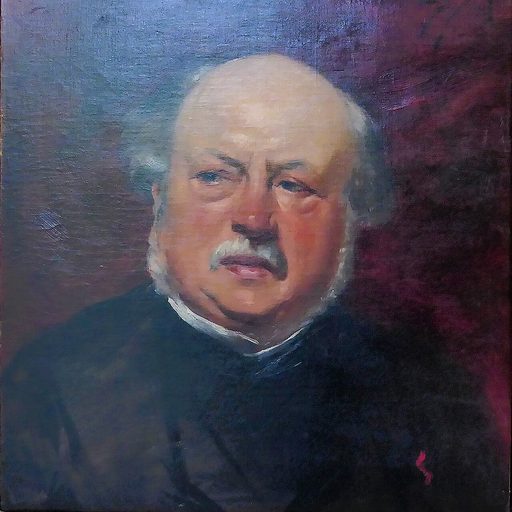
Préault, a Romantic sculptor born in 1809, exhibited in 1834 a bas-relief called Tuerie — Slaughter — where bodies scream, entangled, with neither hero nor story. The Salon jury rejected it and shut its door on him for fifteen years. It was in those years that he carved Le Silence, a head beneath a hood, the forefinger laid against the mouth, probably the most powerful image in the cemetery. He died in 1879.
The story
A pupil of the sculptor David d'Angers, Auguste Préault exhibited in 1834 a relief entitled Tuerie, Slaughter: a tangle of screaming bodies, with no story, no hero, of an unprecedented formal violence. The Salon jury rejected it and closed its doors to him for fifteen years, until 1849.
Through that spell in the wilderness he worked on private and funerary commissions. From them came Le Silence, a medallion carved around 1842 for the grave of the merchant Jacob Roblès, in Division 7: a hooded face, a finger to the lips, representing no one and illustrating nothing — one of the strongest images in the cemetery.
Rehabilitated after 1848, he gave the world Ophélie, now in the musée d'Orsay, the Christ of the church of Saint-Gervais, the Clémence Isaure in the Luxembourg gardens, and medallions of his contemporaries, Delacroix among them.
He died in 1879 and lies in Division 49, a few steps from Delacroix, whose portrait he had carved, and from the animal sculptor Antoine-Louis Barye.
On site, do not miss
His own grave is sober: the work to seek out in Père-Lachaise is elsewhere, in Division 7.
Visitors' questions
Where is Auguste Préault's grave?
In Division 49 of Père-Lachaise, one of the richest in the cemetery: Eugène Delacroix, whose medallion Préault sculpted, the animal sculptor Antoine-Louis Barye and the poet Gérard de Nerval all rest there too.
Eugène Delacroix, Division 49Where can you see Préault's Le Silence?
In Division 7 of Père-Lachaise, on the grave of the merchant Jacob Roblès: a hooded face, one finger laid across the lips. Carved around 1842, this bronze medallion is one of the most reproduced images in the cemetery.
The grave of Jacob RoblèsWhy was Préault barred from the Salon?
Because of Tuerie — slaughter — a bas-relief shown in 1834: a heap of screaming bodies, with no identifiable subject and a formal violence never seen before. The jury rejected it and shut the Salon against him for fifteen years, until 1849.
David d'Angers, his masterWhich other works by Préault can be seen?
Ophelia at the Musée d'Orsay, the Christ in the church of Saint-Gervais in Paris and the Clémence Isaure in the Luxembourg Gardens. He also left many medallions of his contemporaries, among them the one of Eugène Delacroix.
Antoine-Louis BaryeAudio guide to Père Lachaise: the best unusual guided tour!
Discover the secrets of the most astonishing tombs
the audio guidefrom€6.99