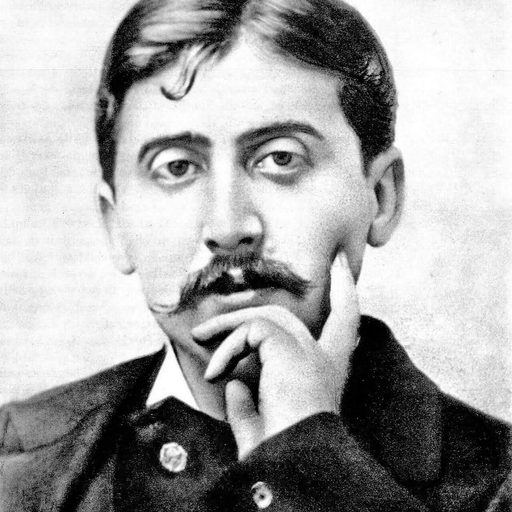
His first book passed unnoticed; his mother's death, in 1905, stopped him dead, and out of that collapse came the work of his life. The Goncourt Prize of 1919 was awarded to him by a divided jury. On the family slab, two professors of medicine flank him: he himself is entitled to nothing but his dates.
The story
In 1896, under the patronage of Anatole France, Proust published Les Plaisirs et les Jours. The book passed completely unnoticed. He was twenty-five, and nothing in that beginning announced what was coming.
In September 1905 his mother died. He stopped writing for months. It was out of that collapse that the work of his life would come, a few years later.
Du côté de chez Swann appeared in November 1913; the war held up the rest. In December 1919 the Prix Goncourt went to him for À l'ombre des jeunes filles en fleurs, by six votes to four against Dorgelès's Les Croix de bois — the jury was deeply split.
He died of pneumonia on 18 November 1922, in his flat in the rue Hamelin, at fifty-one. The work was finished but not fully revised: it was his brother Robert, a surgeon like their father, who saw the rest of it into print.
He is buried in the family vault. Visitors leave madeleines there, and notes, and sometimes a cup of tea. It is one of the few places in the cemetery where you see readers sitting on the ground, a book open on their knees.
The grave
A slab of dark marble, with neither sculptor nor ornament: sobriety is the notable fact here, for the writer who described things at greater length than any other. It bears only names, and they tell of a family of doctors — Adrien Proust, professor at the faculty of medicine; his wife, née Jeanne Weil; Robert Proust, professor at the faculty of medicine; and the latter's wife, who died in 1953. The novelist appears between the two generations, with his dates alone.
On site, do not miss
Read the titles engraved after the names: two professors of medicine flank the writer, who is entitled to nothing but his dates. Then look for what is missing — no quotation, no allegory, nothing of In Search of Lost Time.
Visitors' questions
Where is Marcel Proust's grave?
In Division 85, in the eastern part of the cemetery. The black marble slab is flat and plain, easy to walk past without a precise marker.
BeaumarchaisWhy do visitors leave madeleines on his grave?
In reference to the scene of the madeleine dipped in tea, near the start of In Search of Lost Time, which triggers involuntary memory — the most famous motif in his entire work.
Roger de BeauvoirWho rests with Marcel Proust?
His family: his father Adrien Proust, a professor of medicine, his mother Jeanne Weil, and his brother Robert. The black marble slab bears only their names, with no quotation.
Jean Anthelme Brillat-SavarinWhen did Marcel Proust die?
On 18 November 1922, of pneumonia, after fifteen years of seclusion devoted to his novel. The last three volumes of In Search of Lost Time were published after his death.
ColetteAudio guide to Père Lachaise: the best unusual guided tour!
Discover the secrets of the most astonishing tombs
the audio guidefrom€6.99