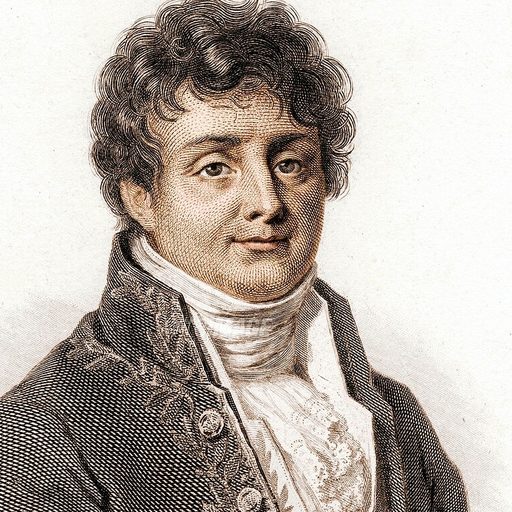
Fourier followed the Egyptian expedition as secretary of the Institut, then was prefect of the Isère, draining marshes while working on the propagation of heat. He established that a periodic function breaks down into a sum of sinusoids: from this descend medical imaging, signal processing, and the compression of our images and our sounds. Few pieces of mathematics had such a technical posterity.
The story
Joseph Fourier was born in Auxerre on 21 March 1768. From 1798 to 1801 he went with the Egyptian expedition as secretary of the Institut d'Égypte, alongside Vivant Denon and Bonaparte's scholars. His tomb still carries the mark of it.
Prefect of the Isère from 1802, he drained the marshes of Bourgoin while working on the movement of heat. His “Analytical Theory of Heat” established that any periodic function whatever can be broken down into a sum of sine waves.
That is the Fourier transform. It is everywhere now: image and sound compression, medical scanning, signal processing, quantum mechanics. Few results in mathematics left so large a technical progeny.
Elected to the Academy of Sciences in 1816, he went on to be its permanent secretary — Louis XVIII annulled the election first, and a second vote confirmed it in 1817. He entered the Académie française on 14 December 1826.
He died in Paris on 16 May 1830 and was embalmed by Doctor Gannal, by the method Gannal had just worked out. A lycée and the university of Grenoble carry his name; his tomb is in Division 18.
The grave
The monument is adorned with downturned torches — life extinguished — and an Egyptian-style decoration at the top, a memory of the Egyptian expedition. An alcove was provided for the bust, and its history is eventful: the one by Pierre Alphonse Fessard disappeared in the early 1990s; a bust of Chaussier long stood there by mistake, before being removed in 2021; a new bust was put back in early 2024, cast from the marble in the archives of the abbey of Saint-Germain d'Auxerre by François Gilles, on a base by Pierre Gamin, at the expense of the Société Joseph Fourier. The inscription, for its part, comes down to two words: “Joseph Fourier”.
On site, do not miss
The downturned torches, the Egyptian-style decoration at the top, and the new bust put back in its alcove in 2024.
Visitors' questions
Where is Joseph Fourier's grave?
In Division 18, Avenue des Acacias, first row — the same avenue as Count Belliard's grave, in Division 35. The monument is recognisable by its inverted torches and its Egyptian-style decoration.
Augustin-Daniel BelliardWhat is the Fourier transform?
The result whereby any periodic function can be broken down into a sum of sine waves, drawn from his “Théorie analytique de la chaleur” — the analytical theory of heat. It underlies image and sound compression, medical imaging and signal processing.
Louis Joseph Gay-LussacWhy Egyptian decoration on his grave?
Because he took part in the Egyptian expedition, from 1798 to 1801, as secretary of the Institut d'Égypte, alongside Vivant Denon. The top of the monument keeps the memory of it, forty years after the return.
Vivant DenonIs the bust on his grave the original?
No: the one by Pierre Alphonse Fessard disappeared in the early 1990s, and an unrelated bust stood there by mistake for years before being removed in 2021. A new bust, cast from the marble in Auxerre, was installed in early 2024.
Thomas CoutureAudio guide to Père Lachaise: the best unusual guided tour!
Discover the secrets of the most astonishing tombs
the audio guidefrom€6.99