The “Sibyl of the faubourg Saint-Germain”, she read the cards for Joséphine de Beauharnais, Barras and the painter David, and turned each of her spells in prison into publicity. She died in 1843 leaving a considerable fortune; a hundred mourners carrying candles followed her cortège.
The story
Born at Alençon on 27 May 1772, fatherless and raised by Benedictine nuns, she came to Paris at the end of the ancien régime and set up in the rue de Tournon. The “sibyl of the faubourg Saint-Germain” soon received everyone of consequence in the city.
The Terror gave her her legend: she is said to have foretold the scaffold for Saint-Just and Robespierre. Her attested clients were enough — Barras, who ruled France after Robespierre, the painter David, the actor Talma — and above all Joséphine de Beauharnais, who consulted her regularly.
Imprisoned several times, under the Terror and then under an Empire that mistrusted her influence, she turned every stretch in gaol into publicity. Her memoirs and her packs of cards sold across Europe; Balzac names her in Les Comédiens sans le savoir.
She crossed every regime that way, from Louis XVI to Louis-Philippe, living off the credulity of some and the curiosity of others, and died on 25 June 1843 leaving a considerable fortune.
Her funeral matched the woman: the nave hung with white, a hearse drawn by four horses, a hundred mourning women each carrying a taper. She lies in Division 3, avenue Principale, fourth row. Her five hundred thousand francs went to a nephew in the army, who burned every piece of her fortune-telling apparatus.
The grave
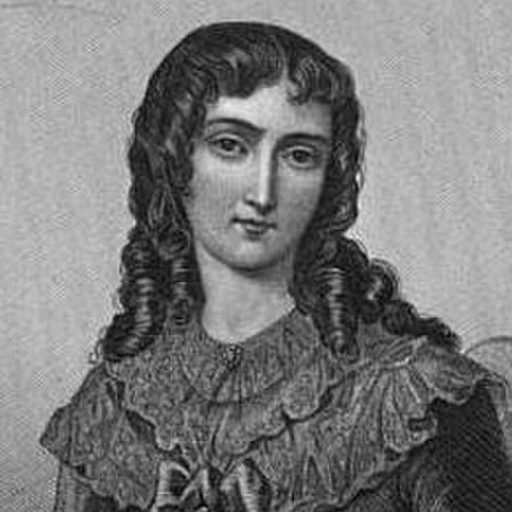
A plain slab, adorned with the photograph of an engraving that portrays the fortune-teller, and with a two-word inscription: “Mademoiselle, LE NORMAND”. The spelling on the stone is not the usual one — the database keeps Lenormand, in one word, like the reference works and the deck of cards. For a woman who staged her own legend right down to her funeral, the grave is surprisingly discreet.
On site, do not miss
The slab bears the photograph of an engraving that portrays her, and her name split into two words: “Mademoiselle, LE NORMAND”. Division 3 is one of the most crowded in the cemetery — the wealthiest fortune-teller of her century takes up no more room there than her neighbours.
Visitors' questions
Where is Marie-Anne Lenormand's grave?
In Division 3, avenue Principale, fourth row: one of the oldest Divisions, a few steps from the boulevard de Ménilmontant entrance. The fortune-teller (1772-1843) has rested there since June 1843.
Jules RomainsWho was Marie-Anne Lenormand?
The most famous fortune-teller of Revolutionary and Imperial Paris, established on rue de Tournon. She read the cards for the Empress Joséphine, received Barras, David and Talma, and died a millionaire in 1843, having lived through five regimes.
Étienne-Gaspard RobertsonDoes the Petit Lenormand deck come from her?
The deck bears her name, but it was published after her death, in Germany, to cash in on her fame. It remains one of the most widely used divination decks today, two centuries after the consultations on rue de Tournon.
Papus (Gérard Encausse)Which other figures of the occult rest at Père-Lachaise?
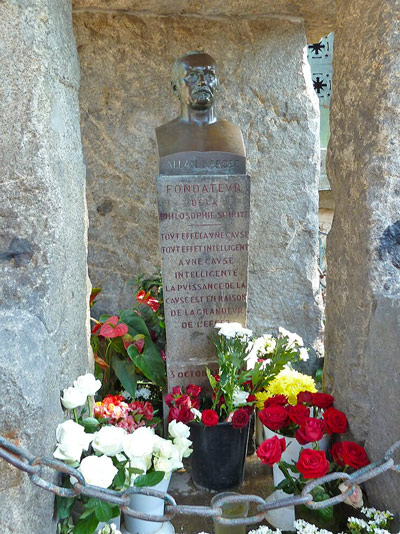
Allan Kardec, founder of Spiritism, in Division 44, and Papus, the occultist of the Belle Époque, make the cemetery a landmark in the history of the occult sciences in France. Kardec's grave is the most flower-laden in Père-Lachaise.
Allan KardecAudio guide to Père Lachaise: the best unusual guided tour!
Discover the secrets of the most astonishing tombs
the audio guidefrom€6.99