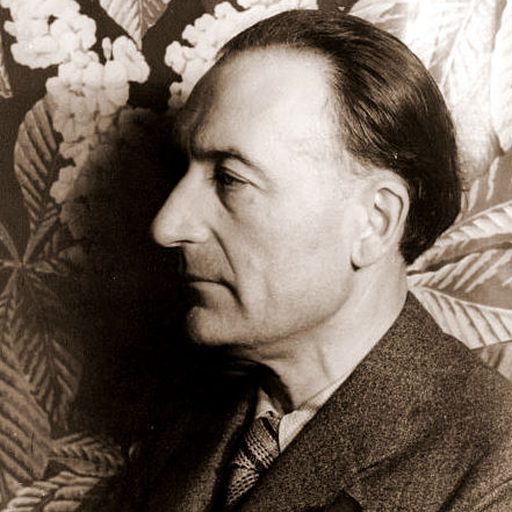
Jules Romains was born Louis Farigoule and was an agrégé in philosophy before inventing unanimism, the idea that a street, a regiment or a city form a body with a common soul. Knock, staged by Jouvet in 1923, raised him among the three most performed playwrights in the world. His Hommes de bonne volonté run to twenty-seven volumes and cover a quarter of a century of French society.
The story
Born at Saint-Julien-Chapteuil on 26 August 1885, Louis Farigoule took the agrégation in philosophy in 1909 and Jules Romains as his pen name.
He founded unanimism: the idea that a group — a street, a regiment, a city — has a collective soul. La Vie unanime (1908), Mort de quelqu'un (1911) and Les Copains (1913) came out of it.
Knock ou le Triomphe de la médecine (1923), premiered by Louis Jouvet, made him one of the three most performed playwrights in the world, alongside Pirandello and Shaw.
Les Hommes de bonne volonté — twenty-seven volumes, from 1932 to 1946 — tells the story of French society from 1908 to 1933: one of the vastest novel cycles in the language.
Exiled in Mexico and the United States during the war, he was elected to the Académie française on 4 April 1946, in his absence, to the seat of Abel Bonnard, stripped of it for collaboration. A columnist for L'Aurore until 1971, he died in Paris on 14 August 1972 and rests in Division 3.
The grave
A simple grave with two inscriptions: “Jules ROMAINS, 1885-1972” and “Lise JULES ROMAINS, 1909-1997”. The detail is worth noting: his wife is buried under her husband's pen name, and the civil name — Louis Farigoule — appears nowhere. Neither the Académie, nor Knock, nor the twenty-seven volumes of Les Hommes de bonne volonté.
On site, do not miss
A stone of two lines for twenty-seven volumes: “Jules ROMAINS, 1885-1972” and “Lise JULES ROMAINS, 1909-1997”. His real name, Farigoule, does not appear — his wife bears his pen name.
Visitors' questions
Where is Jules Romains's grave?
In Division 3, avenue du Bureau, first row, beneath a plain stone with two names: “Jules ROMAINS, 1885-1972” and his wife Lise, who died in 1997. His real name, Louis Farigoule, does not appear: his wife is buried under his pen name.
Marie-Anne LenormandWhat is unanimism?
His theory: a human group — a street, a regiment, a city — has a collective soul of its own, distinct from those of its members. La Vie unanime (1908) and Les Copains (1913) are its literary applications.
Jean-François LyotardWhat is Jules Romains's most performed work?
Knock ou le Triomphe de la médecine, staged by Louis Jouvet in 1923: the play made him one of the three most performed playwrights in the world, alongside Pirandello and Shaw. It is still performed, a century after Jouvet first staged it.
Gilles MargaritisHow was he elected to the Académie?
In his absence, on 4 April 1946: he was on his way back from exile in Mexico and the United States. The seat was that of Abel Bonnard, stripped of it for collaboration — the Académie was replacing a collaborator with an exile.
Alain DecauxAudio guide to Père Lachaise: the best unusual guided tour!
Discover the secrets of the most astonishing tombs
the audio guidefrom€6.99