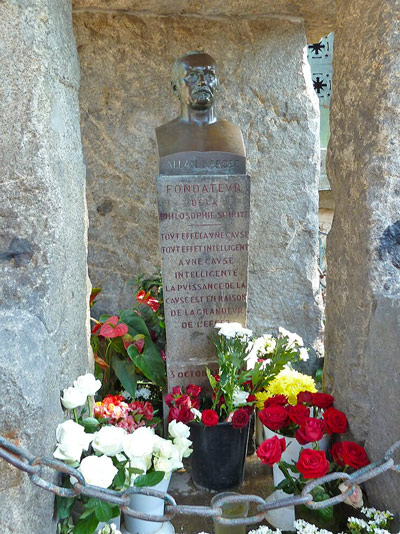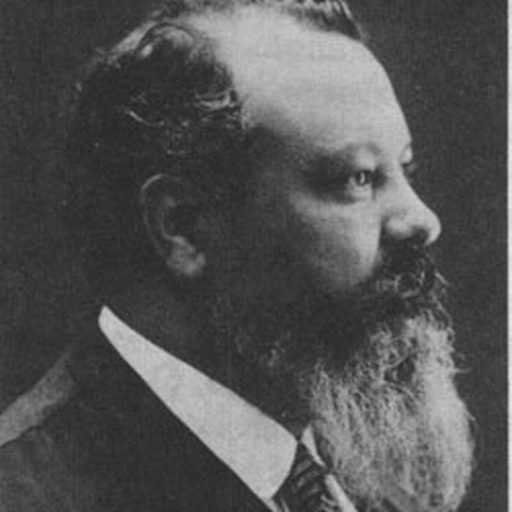
A physician, he was the central figure of Parisian occultism: founder of the Martinist Order in 1884, then spiritual adviser to Nicholas II, a few years before Rasputin. The inscription does not say he died but that he was “disincarnated” — and the engraved date is two days earlier than the one in the reference works.
The story
Gérard Encausse was born at A Coruña on 13 July 1865. A physician by training and by trade, he took the name Papus — that of a spirit of medicine in an ancient treatise — and became the central figure of Paris occultism in the Belle Époque.
In 1891 he founded, with Augustin Chaboseau, the Martinist Order, which exists to this day. He edited the review “L'Initiation” from 1888 to 1914 and published without pause: “Traité élémentaire de science occulte” in 1888, “Le Tarot des bohémiens” in 1889, “Traité méthodique de magie pratique” in 1898.
His reputation went well beyond the Paris circles. He made three journeys to St Petersburg as a consultant to the Russian imperial court, and became a spiritual adviser to Nicholas II and Alexandra — a few years before Rasputin.
The war caught up with him as a doctor. He served at the front, contracted tuberculosis there, and died in Paris on 25 October 1916.
A legend attaches to his funeral: at the exact moment the coffin passed under the porch of Notre-Dame-de-Lorette, a piece of an angel's hand is said to have come away from the façade. He lies in Division 93, under a grave that bears his son's name.
The grave
The grave bears the name of the son, Doctor Philippe Encausse (1906-1984), and that of a great-grandson reduced to two initials, “J. E.”. What sets it apart comes down to two plaques of esoteric quotations from Papus himself, and to one word: the inscription does not say he died, but “désincarné le 23 octobre 1916” — disincarnated on 23 October 1916. The vocabulary is that of his doctrine, for which death is only a change of state. The date, for its part, is two days earlier than the one given by the reference works, which have him dying on 25 October.
On site, do not miss
The word engraved in place of “deceased”: “désincarné”, disincarnated — and the date, two days before that of the registers.
Visitors' questions
Where is Papus's grave?
In Division 93, in the upper, eastern part of the cemetery — the Division of the painter Félix Ziem and the actress Silvia Monfort. The grave bears the name of his son, Doctor Philippe Encausse.
Félix ZiemWhat is carved on his grave?
Two plaques of esoteric quotations from his own hand, and an inscription that does not say he died but that he was “désincarné le 23 octobre 1916” — disincarnated on 23 October 1916 — two days before the date given by the biographical reference works.
Sadegh HedayatWas he really the Tsar's magician?
He made three journeys to Saint Petersburg as consultant to the imperial court and was a spiritual adviser to Nicholas II and Alexandra — a few years before Rasputin took that place.
The Countess of CastiglioneWhat is the Martinist Order?
The initiatory order he founded in 1891 with Augustin Chaboseau, and which still exists. He also edited the journal “L'Initiation” and published “Le Tarot des bohémiens” — “The Tarot of the Bohemians” — in 1889.
Étienne-Gaspard RobertsonAudio guide to Père Lachaise: the best unusual guided tour!
Discover the secrets of the most astonishing tombs
the audio guidefrom€6.99