Étienne-Gaspard ROBERTSON
See onthe map
Physicist and showman of phantasmagoria.
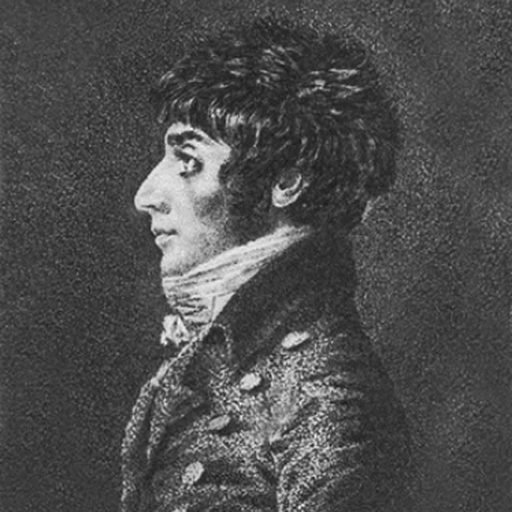
Étienne-Gaspard Robert, known as Robertson, a physicist from Liège born in 1763, perfected the fantascope, a magic lantern mounted on wheels. Hidden behind a screen of smoke, he drove the ghosts of the Revolution's dead out at his audience: spectators fainted. He led a second life in a balloon, from Hamburg to Saint Petersburg. On his tomb, two marble bas-reliefs show the two trades: a phantasmagoria séance on one side, a balloon ascent on the other.
The story
Étienne-Gaspard Robert was born in Liège in 1763. Physicist, painter and balloonist, he made Volta's experiments on electricity known in Paris and perfected the fantascope: a projector on wheels that threw moving images onto a screen of smoke or gauze and left them hanging in empty air.
Under the name Robertson the Phantasmagore, he opened his show in January 1798 at the pavillon de l'Échiquier, a hall off the Grands Boulevards, then moved it in 1799 into the disused chapel of the Capuchin convent, near the place Vendôme. There the audience watched the ghosts of Marat, Robespierre and Danton rise up, all three dead less than six years: people fainted, and all Paris wanted a seat.
He did not invent phantasmagoria: he saw Paul Philidor's séances in Paris in 1792 and improved on them. What he did invent was the projected-image show before a paying audience, a century before cinema. Total darkness, a projector on wheels, an invisible screen: every conjuror of the nineteenth century would take up the recipe.
His second life was in the air. He made balloon ascents at Hamburg, Vienna, Saint Petersburg, Riga and Copenhagen, and carried out his physics experiments at altitude. He was said to have been chosen to fly a balloon for the emperor of China, but nothing establishes that he joined the Russian embassy of 1805, which turned back in Mongolia.
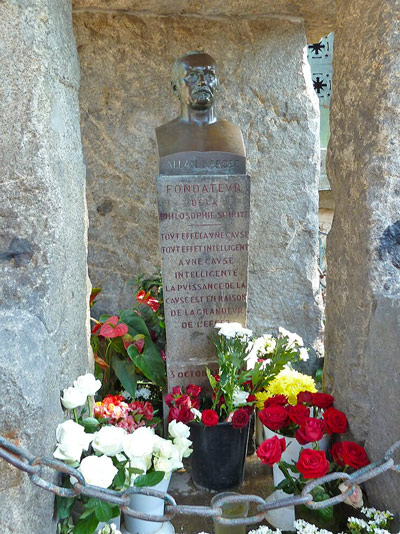
He died at Les Batignolles, then a village at the gates of Paris, on 2 July 1837. He lies in Division 8, under the tomb he had built for himself: two bas-reliefs show the man with the projector and the man with the balloon.
The grave
Robertson ordered this tomb in his own lifetime: four metres high in three parts, by the sculptor François Hardouin and the architect Guillard. The base is pierced by the door of the vault. The central block is the rare piece of the cemetery: two marble bas-reliefs, one showing a phantasmagoria session — projected skeletons, a panicking crowd, a mother hiding the sight from her child — the other a balloon ascent before a dumbfounded crowd of onlookers. At the top stands an antique-style sarcophagus beneath a canopy, framed by skeletal heads and owls. The inscription sums up his three trades in three words: “Physique, Fantasmagorie, Aérostats” — physics, phantasmagoria, balloons.
On site, do not miss
Look for the two bas-reliefs on the central block — the skeletons on one side, the balloon on the other — then raise your eyes to the owls at the top.
Visitors' questions
Where is Robertson's grave?
In Division 8, Avenue Casimir-Perier, first row, in the lower, older part of the cemetery — the division of Georges Cuvier and of Xavier Bichat, skirted by Chemin Chénier. The tomb stands four metres high.
Georges CuvierWhat was a phantasmagoria show?
A spectacle of images projected onto a screen of smoke or gauze, in total darkness, where the figures seem to float. Robertson used it to drive the ghosts of Marat, Robespierre and Danton out at the audience: spectators fainted.
Jehanne d'AlcyWhat do the bas-reliefs on his tomb show?
His two careers. On one, a phantasmagoria show: projected skeletons, a panicking crowd, a mother hiding the sight from her child. On the other, a balloon ascent, with onlookers gaping from the ground. Both are attributed to the sculptor François Hardouin.
Alexandre-Théodore BrongniartWas he a forerunner of cinema?
Of projection, yes: Robertson's fantascope produced moving images on a screen before a paying audience, a century before the Lumière brothers. Georges Méliès, who ran the Théâtre Robert-Houdin, is his direct heir.
Georges MélièsAudio guide to Père Lachaise: the best unusual guided tour!
Discover the secrets of the most astonishing tombs
the audio guidefrom€6.99