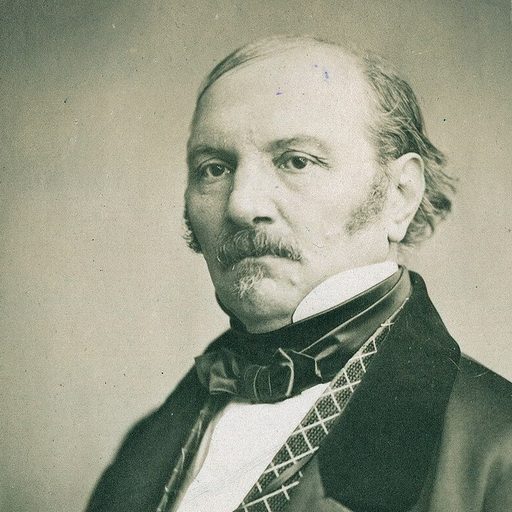
Allan Kardec was born Hippolyte Rivail and was a teacher for fifty years before anyone had heard of him. In 1855 Paris fell for table-turning; he began by distrusting it, then examined it like an experimenter. Out of that inquiry came, in 1857, The Spirits' Book, which founded Spiritism and gave him his pen name, borrowed from two former lives. He died in 1869.
The story
Hippolyte Léon Denizard Rivail was born in Lyon on 3 October 1804. A teacher trained in the Pestalozzi method, he translated, taught and published textbooks: nothing in the first fifty years of that life hints at what came next.
In 1855 the craze for table-turning reached the Paris salons. Rivail began by distrusting it, then watched the manifestations like an experimenter — and it was that stance, loudly claimed, that made his fortune. In 1857 came Le Livre des Esprits, signed Allan Kardec, two names the spirits were said to have revealed to him as his own in earlier lives.
Four more volumes followed within ten years: the Livre des médiums, L'Évangile selon le spiritisme, Le Ciel et l'enfer, La Genèse. This was no religion, he maintained, but a science of the dealings between the living and the dead. Victor Hugo, Théophile Gautier and Victorien Sardou took an interest; Georges Méliès set out to prove it a fraud.
He died in Paris on 31 March 1869 and lies with his wife, Amélie Boudet, an artist and teacher who died in 1883. Léon Denis and Gabriel Delanne would carry on his work.
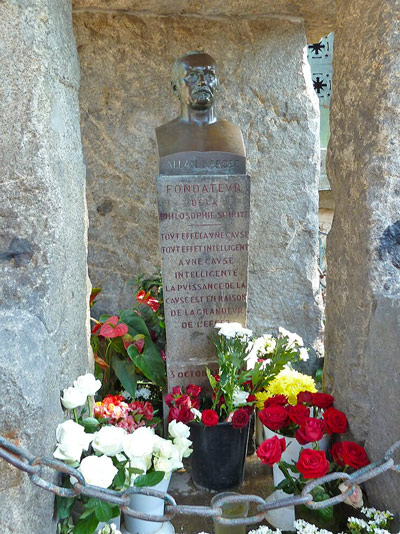
The success of Kardecism in Brazil, where it counts several million followers and where a stamp bore his likeness in 1957, explains the press of people around this dolmen. Custom has it that you lay a hand on the stone and make a wish. The Friends of the cemetery name it without hesitation the most flowered grave in Père-Lachaise.
The grave
A stone tomb in the form of a dolmen, sheltering a bronze bust signed Charles Romain Capellaro and dated 1870, mounted on a stone pedestal. The pediment bears the formula that sums up the doctrine: “To be born, to die, to be born again, and to progress without end, such is the law.” On the base, a chain of engraved propositions serves as a demonstration: “Every effect has a cause, every intelligent effect has an intelligent cause, the power of the cause is in proportion to the magnitude of the effect.” The bouquets are renewed there every day.
On site, do not miss
Stay a moment at a distance and count the visitors who lay a hand on the stone: the gesture passes on without anyone explaining it. The bouquets, for their part, change from one day to the next.
Visitors' questions
Why are there so many flowers on Allan Kardec's grave?
Because the Spiritism he codified counts several million followers, above all in Brazil. His grave is a place of pilgrimage where the flowers are renewed daily, left by visitors who travel from Rio, São Paulo or Manila.
Étienne-Gaspard RobertsonWhere is Allan Kardec's grave?
In Division 44, in the central part of the cemetery. It is a dolmen of rough-hewn stones, impossible to mistake for the chapels around it. The architect Roland Castro, who died in 2023, was buried a few metres away, on the edge of the same division.
Roland CastroWhat does tradition say about this grave?
Visitors place a hand on the stone, often on the bust or the dolmen itself, while making a wish or a thought for someone they have lost.
Papus (Gérard Encausse)Who was Allan Kardec, really?
Hippolyte Léon Denizard Rivail, an educator from Lyon and a disciple of Pestalozzi. He discovered table-turning in 1855 and published “The Spirits' Book” three years later, under a pen name he claimed spirits themselves had revealed to him.
Marie-Anne LenormandAudio guide to Père Lachaise: the best unusual guided tour!
Discover the secrets of the most astonishing tombs
the audio guidefrom€6.99