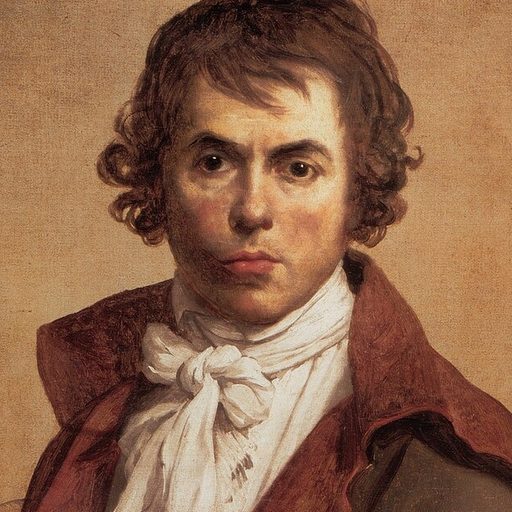
First Painter to the Empire, he had voted for the king's death at the Convention: the law of 1816 banning regicides from residing in France sent him to die in exile in Brussels. Paris refused his body, and his son Eugène brought back only the heart.
The story
Jacques-Louis David was born in Paris on 30 August 1748 and won the Prix de Rome in 1774, at his fourth attempt. The neoclassicism he imposed — “The Oath of the Horatii”, “The Intervention of the Sabine Women” — made him the most influential painter in Europe before the Revolution had even begun.
Elected to the Convention in 1792, he voted for the king's death, sat on the Committee of General Security and signed hundreds of arrest warrants. In 1793 he painted “The Death of Marat”, a political icon as much as a picture. Gaoled after Thermidor, he owed his release to his own pupils.
He met Bonaparte in 1797 and in 1804 became First Painter to the Emperor. “The Coronation of Napoleon” cost him three years' work; he finished “Leonidas at Thermopylae” in 1814.
The law of 12 January 1816 barred regicides from living in France: David left for Brussels. He went on painting there — “Mars Disarmed by Venus” in 1824, a canvas three metres high that nobody had ordered.
He died in the rue Léopold on 29 December 1825. Four thousand people followed the coffin through Brussels, but Paris refused the body. His son Eugène brought back the heart instead, laid in Division 56 beside his mother. Béranger summed the business up: “What! His coffin is turned away, and his glory inherited.”
The grave
This is not a grave but a heart-tomb: only the painter's heart was laid there, brought back from Brussels by his son Eugène. The inscription hides nothing: “To the memory of Jacques Louis David, French painter, died in exile on 29 Xbre 1825. His heart is laid in this vault, near the body of his wife, companion of his misfortunes.” A bronze medallion signed Charles Normand and dated 1829 accompanies it. The vault also holds his two sons, his daughter Laure Émilie and his son-in-law Lieutenant General Meunier. The body, for its part, stayed in Belgium: the funeral of 1825 gathered four thousand people in Brussels, and since 1882 his resting place is the cemetery of Evere.
On site, do not miss
The inscription on the heart-tomb, which says it all in three lines: the heart, the exile, and the wife, “companion of his misfortunes”.
Visitors' questions
Is Jacques-Louis David buried at Père-Lachaise?
Only his heart. He died in exile in Brussels in 1825 and his body stayed there — at the Evere cemetery since 1882 — as France refused its repatriation. His son Eugène brought back the heart, laid to rest in Division 56.
François-Adrien BoieldieuWhy did he die in exile?
Because, as a deputy to the Convention, he had voted for the death of Louis XVI. The law of 12 January 1816 barred regicides from residing in France: he left for Brussels, where he went on painting until his death.
CambacérèsWhat is engraved on his heart-tomb?
“À la mémoire de Jacques Louis David, peintre français, décédé en exil le 29 Xbre 1825. Son cœur est déposé dans ce caveau, près du corps de son épouse, compagne de ses malheurs.” — to the memory of Jacques Louis David, French painter, who died in exile on 29 December 1825; his heart is laid in this vault, near the body of his wife, companion of his misfortunes. The exile is named.
Vincenzo BelliniWhat are his best-known paintings?
“The Coronation of Napoleon” and “The Intervention of the Sabine Women”, in the Louvre, “The Death of Marat”, “The Oath of the Horatii”, “Madame Récamier” — and “Leonidas at Thermopylae”, completed in 1814, two years before his departure for Brussels.
Thomas CoutureAudio guide to Père Lachaise: the best unusual guided tour!
Discover the secrets of the most astonishing tombs
the audio guidefrom€6.99