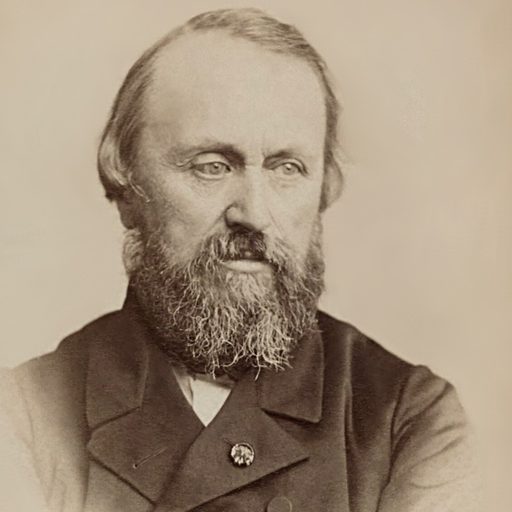
Hippolyte Flandrin entered the studio of Ingres and won the first Grand Prix de Rome in 1832. It was during his stay at the Villa Medici that he painted the naked young man, seated facing the sea, that the Louvre now holds. Having moved from history painting to religious painting, of which he is held to be the renewer, he covered Saint-Germain-des-Prés and Saint-Séverin with murals. Victor Baltard designed his monument.
The story
The architect of the Halles market designed Hippolyte Flandrin's tomb. Victor Baltard signed the monument in Division 57, set with a marble bust by Eugène André Oudiné — the same Baltard had designed the tomb of the organist Lefébure-Wély, in Division 4.
Born in Lyon on 23 March 1809, brother of the landscape painter Paul Flandrin who rests in the same Division, Hippolyte Flandrin entered Ingres's studio and took the first Prix de Rome in 1832. It was at the Villa Medici that he painted, in 1836, his most famous work: Young Male Nude Seated beside the Sea, now in the Louvre.
From history painting he moved to religious painting, of which he is held to be the reviver, and covered Saint-Séverin, Saint-Germain-des-Prés and Saint-Vincent-de-Paul with murals. Elected to the Académie des beaux-arts in 1853, he joined in 1856 the first council of the Œuvre des écoles d'Orient, founded to pay for Christian schools in the Levant.
He died of smallpox in Rome on 21 March 1864, two days before his fifty-fifth birthday. The inscription lists seven academies after the Institut de France — Bavaria, Antwerp, London, Belgium, the Netherlands, Rome, Lyon. For his widow, Aimée Caroline Ancelot, who died in 1882, it has only three words: “Priez pour elle” — pray for her.
The grave
A monument designed by Victor Baltard (1805-1874), the architect of the Paris Halles — the same man who conceived the tomb of Lefébure-Wély in Division 4 —, adorned with a marble bust by Eugène André Oudiné. The inscription, with its dates in Roman numerals, lists his honours like a cartouche: “Jean Hippolyte FLANDRIN Peintre d'histoire, membre de l'Institut de France, officier de la Légion d'honneur, ch. de plusieurs ordres étrangers, membre des académies de Bavière, d'Anvers, de Londres et de Belgique, des Pays-Bas, de Rome et de Lyon, né Lyon XXIII mars MDCCCIX, + le XXI mars MDCCCLXIV.” — history painter, member of the Institut de France, Officer of the Legion of Honour, Knight of several foreign orders, member of the academies of Bavaria, Antwerp, London and Belgium, the Netherlands, Rome and Lyon, born in Lyon on 23 March 1809, died on 21 March 1864. His widow, Aimée Caroline Ancelot, who died at Sèvres in 1882, is buried there beneath a prayer: “Priez pour elle” — pray for her.
On site, do not miss
A monument designed by Victor Baltard, the architect of Les Halles, with a marble bust by Eugène André Oudiné. The epitaph lists seven academies; for his widow, three words: “Priez pour elle” — pray for her.
Visitors' questions
Where is Hippolyte Flandrin's grave?
In Division 57, chemin Bourget, second row, beneath a monument designed by Victor Baltard, the architect of the Halles market, and set with a marble bust by Eugène André Oudiné. His brother Paul rests in the same Division.
Paul FlandrinWhat is his most famous work?
Young Male Nude Seated beside the Sea, painted in Rome in 1836 during his stay at the Villa Medici and now in the Louvre. He had taken the first Prix de Rome four years earlier, in 1832, out of Ingres's studio.
Jean-Auguste-Dominique IngresWhere can you see his murals in Paris?
In three churches: Saint-Séverin, Saint-Germain-des-Prés and Saint-Vincent-de-Paul. Held to be the man who renewed religious painting, he covered vast surfaces there with friezes and biblical scenes.
Lefébure-WélyWhat did Hippolyte Flandrin die of?
Of smallpox, in Rome, on 21 March 1864 — two days before his fifty-fifth birthday. He had been elected to the Académie des beaux-arts eleven years earlier and had co-founded the Œuvre des écoles d'Orient, a mission society for the Christian East, in 1856. His body was brought home and buried at Père-Lachaise.
Marc FumaroliAudio guide to Père Lachaise: the best unusual guided tour!
Discover the secrets of the most astonishing tombs
the audio guidefrom€6.99