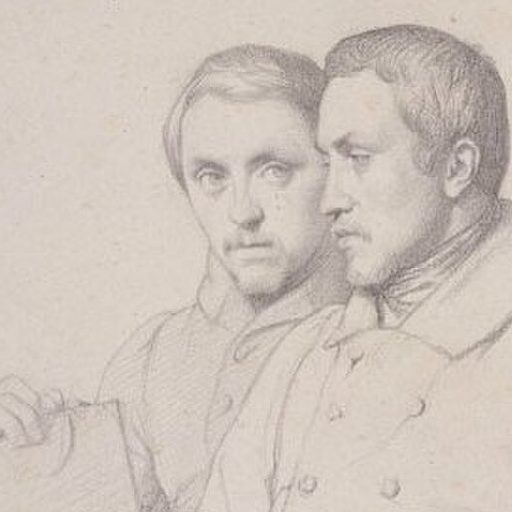
Flandrin came up to Paris with his brother Hippolyte, Ingres's favourite pupil, and worked in the same studio as he did. He painted religious pictures, portraits, and above all landscapes: their colour, franker than the school's, gradually set him apart from the history painting in which he had trained. He lived to ninety, saw Impressionism born and grow old, and never entered it.
The story
Born in Lyons on 28 May 1811, Paul Flandrin belonged to a family of painters: his brother Hippolyte, Ingres's favourite pupil, became one of the great church decorators of the century. The two boys went up to Paris together and worked in the same studio.
His painting stayed the painting of Ingres's studio until late in the century: a landscape drawn, ordered and idealised. Baudelaire accused him of wanting to “ingriser” nature — to make it Ingres-like.
He married the daughter of the landscape painter Alexandre Desgoffe (1805-1882), another regular of Ingres's studio. The two men would share a grave.
He died on 8 March 1902, at ninety, having watched Impressionism appear and grow old without ever entering it.
He lies in Division 57, chemin Bourget, fourth row, under a stone whose dates are cut in Roman numerals and which calls him a history painter — he who painted landscapes. His brother Hippolyte, who died in Rome, had wanted Saint-Germain-des-Prés, the church he had decorated: he is two rows away, in the same division.
The grave
A stone that bears two painters and gives all its dates in Roman numerals: “Paul FLANDRIN history painter, Knight of the Legion of Honour, born on XXVIII May MDCCCXI died on VIII March MCMII” — and “Alexandre DESGOFFE landscape painter, Knight of the Legion of Honour, born on II March MDCCCV died on XXX July MDCCCLXXXII”. The two men were father-in-law and son-in-law. The Legion of Honour the stone grants them does not appear in the Léonore database.
On site, do not miss
The dates in Roman numerals, which must be deciphered: “MDCCCXI” for 1811, “MCMII” for 1902. And two painters' names on the same stone: son-in-law and father-in-law.
Visitors' questions
Where is Paul Flandrin's grave?
In Division 57, chemin Bourget, fourth row. His brother, the painter Hippolyte Flandrin, rests in the same Division, and his father-in-law, the landscape painter Alexandre Desgoffe (1805-1882), in the same grave as him, beneath dates carved in Roman numerals.
Hippolyte FlandrinWhat was Paul Flandrin's connection with Ingres?
That of the studio. His brother Hippolyte was Ingres's favourite pupil, and Paul trained in the same circle, as did his father-in-law Alexandre Desgoffe. Three painters from one family, schooled by the same master — and two of them in the same grave.
Jean-Auguste-Dominique IngresWhy are the dates on the grave so hard to read?
Because they are in Roman numerals: “né le XXVIII mai MDCCCXI, décédé le VIII mars MCMII” — that is, 28 May 1811 and 8 March 1902. The practice is found elsewhere in the cemetery, notably on the grave of Marie d'Agoult.
Marie d’AgoultWhat did Paul Flandrin paint?
Religious compositions, portraits, and landscapes of a richer colour than his school allowed. Trained as a history painter, he remained a classicist until his death in 1902, never once following the Impressionists.
Jean TopartAudio guide to Père Lachaise: the best unusual guided tour!
Discover the secrets of the most astonishing tombs
the audio guidefrom€6.99