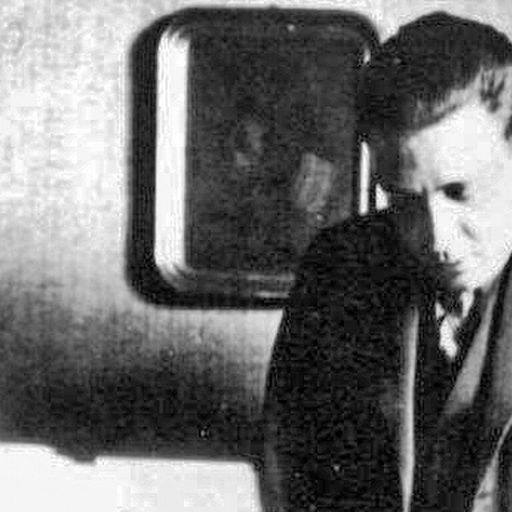
Francis Poulenc knew himself well: a critic had called him “monk and rascal”, and he gladly took up the phrase. Mass and music hall live side by side in his work, often on the same page, without either disarming the other. His Dialogues of the Carmelites, in 1957, send sixteen nuns to the scaffold on a hymn that dies out one voice after another. He died in 1963.
The story
Francis Poulenc was born in Paris on 7 January 1899. His “Mouvements perpétuels”, in 1918, made his name at nineteen, and he became one of the six composers the critics gathered under the label of Les Six.
A critic summed him up in a phrase he liked well enough to use himself: “half monk, half guttersnipe”. There is the Mass in him and the music hall, often in the same work, and neither disarms the other.
The sacred side gave the “Stabat Mater”, composed in 1950 in memory of Christian Bérard — Cocteau's stage designer, who lies in Division 16.
“Dialogues of the Carmelites”, in 1957, is his great opera: sixteen nuns climbing to the scaffold, on a chant that goes out one voice at a time. “The Human Voice”, in 1959, sets a Cocteau monologue for one woman and a telephone.
He died of a heart attack on 30 January 1963. His chapel in Division 5 carries an abstract stained-glass window — and a birth date that is wrong: “7 janvier 1900”.
The grave
A chapel adorned with an abstract stained-glass window — rare at Père-Lachaise, where funerary glass usually stays figurative or floral, like Caillebotte's in Division 70. The inscription is limited to three elements: “Francis Poulenc, 7 janvier 1900, 30 janvier 1963”. The first date is wrong: the composer was born on 7 January 1899. Day and month are right, only the year slipped, and nothing was corrected. Neither the Groupe des Six, nor the Carmelites, nor music appear on the stone.
On site, do not miss
The abstract stained glass of the chapel, and beneath it the wrong date: “7 janvier 1900”.
Visitors' questions
Where is Francis Poulenc's grave?
In Division 5, chemin Serré, first row, in the lower part of the cemetery — the same path as the grave of Pierre Bellemare. It is a chapel, adorned with an abstract stained-glass window, a rarity here.
Pierre BellemareIs there a mistake on his grave?
Yes, in the year of birth: the stele reads “7 janvier 1900” — 7 January 1900 — whereas he was born on 7 January 1899. The day and month are right, only the year has slipped — as on the slabs of Salvador and Dupuytren.
Henri SalvadorWhy was he called “moine et voyou”?
Monk and rascal — because his work holds both ends: the Mass and the music hall, the mysticism of “Dialogues of the Carmelites” and the lightness of his songs. The phrase came from a critic, and he liked it enough to adopt it himself.
Luigi CherubiniFor whom did he write his Stabat Mater?
In memory of Christian Bérard, the designer for Cocteau and Jouvet, who died suddenly in 1949 during rehearsals for “Les Fourberies de Scapin”. Bérard rests in Division 16 of the same cemetery.
Christian BérardAudio guide to Père Lachaise: the best unusual guided tour!
Discover the secrets of the most astonishing tombs
the audio guidefrom€6.99