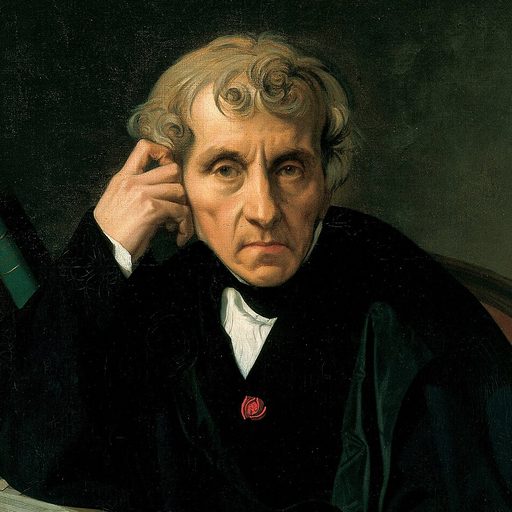
Beethoven held him to be the greatest living composer; Berlioz, who endured twenty years of his severity at the head of the Conservatoire, left ferocious pages about him. The composer of “Médée”, he died in 1842, five weeks after being made a commander of the Légion d'honneur: his Requiem was played at his own funeral.
The story
Luigi Cherubini was born in Florence on 14 September 1760 and gave his first opera, “Il Quinto Fabio”, at twenty. He settled in Paris in 1787 and stayed: co-director of the Théâtre de Monsieur from 1789 to 1792, inspector of teaching at the newborn Conservatoire.
“Médée”, in 1797, then “Les Deux Journées, ou le Porteur d'eau”, in 1800, imposed a dramatic manner that Germany would remember better than France. In Vienna, in 1805, he met Haydn and Beethoven, who would hold him the greatest living composer.
His “Messe à trois voix” in F major, written in 1808 for the Prince de Chimay, is held to be his greatest sacred work. He became director of the Paris Conservatoire in 1822 and reigned there for twenty years, feared for his severity — Berlioz left some ferocious pages about him.
His “Cours de contrepoint et de fugue”, brought out in 1835 by Jacques Halévy, extended that teaching authority. In 1841 Ingres made the portrait of him that is still famous, now in the Cincinnati Art Museum.
Made Commander of the Legion of Honour on 7 February 1842, he died in Paris on 15 March that same year. His “Requiem in D minor” was played at his funeral. The monument in Division 11 was set up in 1846, four years later.
The grave
The monument is a marble high relief signed Auguste Dumont and dated 1846: a woman crowns the composer's bust, set on a pedestal. The inscription is limited to the name, “CHERUBINI”, followed by the list of his works — Médée, Les Deux Journées, Elisa, the sacred music, the masses. The monument was put up four years after the funeral, the one at which his own Requiem in D minor had been played. Florence, his native city, raised a memorial to him in the church of Santa Croce.
On site, do not miss
The marble high relief — a woman crowning the bust — and the list of works engraved around it, from Médée to the masses.
Visitors' questions
Where is Luigi Cherubini's grave?
In Division 11, Chemin Denon, first row — the same alley as Michel Petrucciani, and the division of Chopin and Boieldieu. A marble high relief crowns it: a woman placing a crown on the composer's bust.
Michel PetruccianiWho sculpted his monument?
Auguste Dumont (1801-1884), who signed and dated it 1846, four years after the composer's death. The woman depicted lays a crown on the bust raised on its pedestal; the titles of his works are engraved around it.
François-Adrien BoieldieuWhat did Cherubini compose?
“Médée” in 1797, “Les Deux Journées” in 1800, a “Mass in A major for three voices” in 1808 regarded as his greatest sacred work, and a “Requiem in D minor” that was performed at his own funeral.
Marietta AlboniWhat was his role at the Conservatoire?
He was its inspector of studies from its foundation, then its director from 1822 for twenty years. His severity was feared — Berlioz, whom he had taken a dislike to, left some ferocious pages about him.
François BazinAudio guide to Père Lachaise: the best unusual guided tour!
Discover the secrets of the most astonishing tombs
the audio guidefrom€6.99