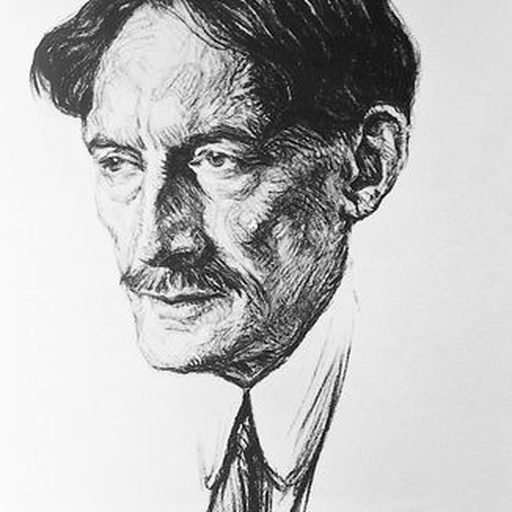
Henri Barbusse enlisted and drew from the trench Under Fire, the story of a squad, which won the Goncourt in 1916 and scandalised readers behind the lines whom nothing had prepared for the life of the Poilus. Won over to the Russian Revolution, he joined the Communist Party in 1923 and chaired the Amsterdam-Pleyel pacifist movement. He died in Moscow in 1935. An urn of earth brought back from the front accompanies him.
The story
Henri Barbusse was born at Asnières on 17 May 1873 and published a first naturalist novel, “L'Enfer”, in 1908. The war changed everything: he volunteered, and out of it came “Le Feu, journal d'une escouade”, which took the Prix Goncourt in 1916 and outraged a home front unprepared for what the men in the trenches were living through.
“Le Couteau entre les dents” marked his conversion to the Russian Revolution in 1921; he joined the Communist Party in 1923, ran the review Clarté, then, in the thirties, presided over the pacifist Amsterdam-Pleyel movement.
He died in Moscow on 30 August 1935, a few days after the Seventh Congress of the Communist International closed. His funeral was held at Père-Lachaise on 8 September, at the end of an immense procession, and he was buried in Division 89, in a plot he had bought long before.
His widow wanted a larger plot; there was no room. On 15 May 1936 the body was exhumed and moved to Division 97, facing the Communards' Wall: the address turned the novelist of the trenches into a monument of the labour movement.
The new monument was unveiled on 13 September 1936 before, the organisers said, fifty thousand Paris workers. The stele is cut from a stone of the Urals given by Soviet workers; a plaque in Russian and an urn of earth from the Chemin des Dames were added later.
The grave
The stele is cut from a stone from the Urals offered by “the Soviet workers”; a bronze palm by Jean Rabiant and a medallion by Naoum Aronson adorn it. The plaques have accumulated: that of the ARAC, “to the memory of our comrade, for our years of common struggle”; a long dedication in Russian to the “herald of the united front of workers against imperialist war and fascism”; a motto, “Bread, peace, freedom, such was his motto, it will always be ours”. An urn contains earth from Hill 1342, brought back from a pilgrimage to the Chemin des Dames in September 1949: the place he had described in “Under Fire”.
On site, do not miss
The urn of earth from the Chemin des Dames, the plaque in Russian from the workers of the Urals, and the engraved motto: “Bread, peace, freedom”.
Visitors' questions
Where is Henri Barbusse's grave?
In Division 97, Avenue Circulaire, first row, facing the Communards' Wall, in the upper, eastern part of the cemetery. It is not his original grave: he was first buried in Division 89, and moved here on 15 May 1936.
The Communards' WallWhy was his grave moved?
Because his widow wanted to enlarge the plot in Division 89 and there was no room. The transfer of 15 May 1936 placed him facing the Communards' Wall, a far more resonant location.
Charles AmourouxWhat is “Under Fire”?
The diary of a squad of French infantrymen, published in 1916 and awarded the Prix Goncourt. The book shocked the public back home by describing trench warfare with no heroism at all, which earned it as many protests as readers.
Georges AuclairWhat stone is his stele made of?
Ural stone, a gift from Soviet workers, with a bronze palm by Jean Rabiant and a medallion by Naoum Aronson. An urn holds earth from Hill 1342, on the Chemin des Dames, the very ground described in “Under Fire”.
Paul Vaillant-CouturierAudio guide to Père Lachaise: the best unusual guided tour!
Discover the secrets of the most astonishing tombs
the audio guidefrom€6.99