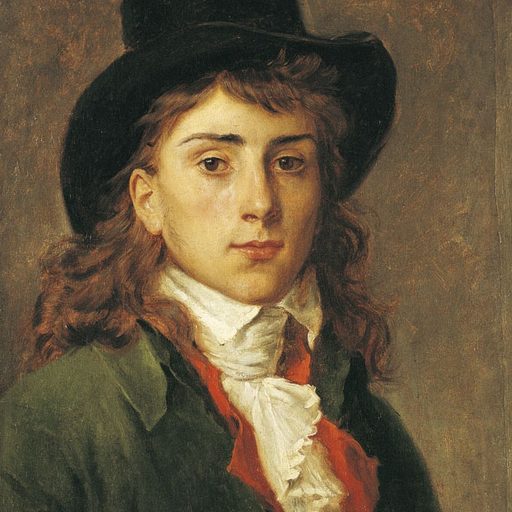
Antoine-Jean Gros, a pupil of David, met Bonaparte in Milan in 1796 and at once made himself the painter of his legend: it was he who fixed the image of the young general on the bridge at Arcole, flag in hand. Then came Jaffa, Eylau, the great military canvases of the Empire, then the dome of the Panthéon, for which the critics reproached him. His epitaph says he died in Paris in 1835. He had drowned himself in the Seine.
The story
Trained in the studio of Jacques-Louis David, Gros was presented to Bonaparte at Milan in 1796 by Joséphine, and became the appointed painter of a legend that was only beginning. “Bonaparte au pont d'Arcole” fixed for good the image of the young general, colours in his fist.
Under the Empire he turned out one great military machine after another: “Bonaparte visiting the plague victims of Jaffa” (1804), in which the general touches a sick man in defiance of contagion, and “The battlefield of Eylau” (1808), which spares the viewer nothing of the winter or the wounded. Napoleon made him a chevalier of the Légion d'honneur.
After 1815 he took over the studio of the exiled David. He spent thirteen years painting the dome of Sainte-Geneviève — the Panthéon returned to worship —, finished it in 1824, and Charles X came to see it: the king made him a baron and gave him fifty thousand francs.
The critics held it against him that he had left the breath of his battle pieces for an academic manner they found cold, just as Romanticism was taking hold and Ingres was reigning. The disfavour wore him down.
He drowned himself in the Seine at the Bas-Meudon on 26 June 1835, after his last painting failed at the Salon, leaving a note in which he called himself weary of life. He lies in Division 25, chemin Laplace, second row, under a marble bust signed Debay, a few steps from the sarcophagi of Molière and La Fontaine.
The grave
A marble bust by the sculptor Jean-Baptiste Debay tops the grave. The inscription has the brevity of a civil register: “GROS, Antoine Jean, born in Paris, on 16 March 1771, died in Paris, on 26 June 1835.” It mentions neither the title of baron, nor a single painting — and it moves the place of his death: the painter drowned himself in the Seine at Bas-Meudon, not in Paris.
On site, do not miss
The marble bust by Jean-Baptiste Debay, and the epitaph that says the painter “died in Paris”: he drowned himself in the Seine at Bas-Meudon, downstream from the city.
Visitors' questions
Where is Antoine-Jean Gros's grave?
In Division 25, chemin Laplace, second row, beneath a marble bust signed Jean-Baptiste Debay. The tombs of Molière and La Fontaine are a few steps away, in the same Division: it is one of the most walked sectors of the old cemetery.
MolièreWhat is Gros's most famous painting?
“Bonaparte Visiting the Plague-Stricken in Jaffa”, which shows the general touching a plague victim without fear of contagion. Hanging in the Louvre, it did much to build the Napoleonic legend, together with “The Battlefield of Eylau”.
Anne-Louis GirodetDid Gros work on the Panthéon?
Yes: he painted the dome of the Panthéon in 1824, the largest commission of his career. It was also the one that drew him the most reproach, the critics finding his return to classicism cold after the battle scenes of the Empire.
Edmond du Sommerard, Division 41How did Antoine-Jean Gros die?
Drowned in the Seine at Bas-Meudon, on 26 June 1835, eaten away by disgrace. His epitaph, for its part, has him “mort à Paris, le 26 juin 1835” — died in Paris: the stone corrected the geography, since it could not correct the ending.
Jacques-Louis DavidAudio guide to Père Lachaise: the best unusual guided tour!
Discover the secrets of the most astonishing tombs
the audio guidefrom€6.99