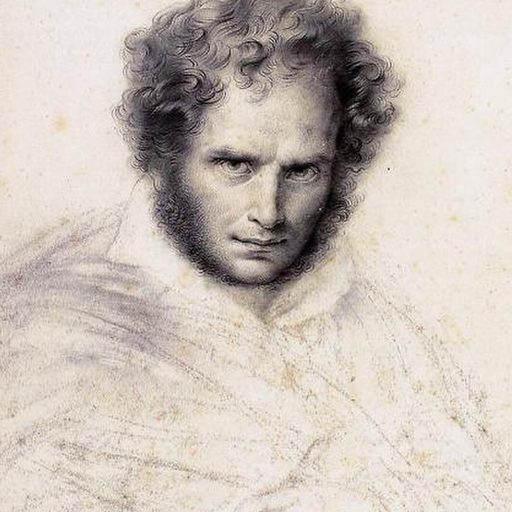
A pupil of David, he painted dream, night and the strange, and took the Prix de la Décennie from his master in 1810. His protector's inheritance made him rich: he almost stopped painting to write poems. His Latin epitaph closes on two words from Horace — “Pictoribus atque poetis”.
The story
Anne-Louis Girodet was born at Montargis on 5 January 1767. A pupil of Jacques-Louis David, he won the Prix de Rome in 1789 with “Joseph Recognised by His Brothers”, and delivered in 1791 “The Sleep of Endymion”: a green light, an abandoned body, something neoclassicism had not planned for.
His master did not follow him onto that ground. Girodet painted dream, night and strangeness — and in 1810 took the Prize of the Decade with “A Scene from the Flood”, ahead of David himself.
“The Funeral of Atala” in 1808, the portrait of Chateaubriand in 1809: he became the painter of a Romanticism still being born while claiming his classical training. The critics never knew where to file him.
In 1809 Doctor Trioson, his protector since childhood, adopted him; he took the name. The inheritance that came in 1812 made him rich, and he almost stopped painting in order to write poems about aesthetics.
A member of the Academy of Fine Arts in 1815, he died in Paris on 9 December 1824. His Latin epitaph in Division 28 ends on two words of Horace, “Pictoribus atque poetis” — to painters and to poets, which is what he wanted to be.
The grave
A bust of white marble signed Louis Desprez, and on the back a bas-relief that unites his two vocations: a palette, a lyre and a laurel wreath before a torch. Amphorae adorn the sides. The inscription is entirely in Latin: “Hic situs est, Anna Ludovicus Girodet Trioson… natus Montargis in januar MDCCLXVII, obiit Paris in decembre MDCCCXXIV” — then, to finish, two words from Horace: “Pictoribus atque poetis”, to painters and to poets. The painter who had taken to writing verse chose his own epitaph.
On site, do not miss
The bas-relief on the back — palette, lyre and laurel wreath before a torch — and the two Latin words that close the epitaph.
Visitors' questions
Where is Girodet's grave?
In Division 28, chemin Saint-Louis, second row, in the old, upper part of the cemetery — the Division of Beaumarchais, Barras and Redouté. A white marble bust stands on top.
Pierre-Joseph RedoutéWhat does “Pictoribus atque poetis” mean?
“To painters and poets” — a quotation from Horace, carved at the end of an epitaph that is itself entirely in Latin. It sums up his ambition: he had given up painting after 1812 to write poems on aesthetics.
Jacques-Louis DavidDid he beat his master David?
In 1810, at the Prix de la Décennie: Girodet's “La Scène du Déluge” — “The Deluge” — was preferred to the work of David, his own master. The pupil had taken a road the master would not follow — night, dreams, the uncanny.
Thomas CoutureWhy was he called Girodet-Trioson?
Because Doctor Trioson, his protector since childhood, adopted him in 1809: he took his name, then in 1812 inherited a considerable fortune that allowed him all but to give up painting.
Louis ViscontiAudio guide to Père Lachaise: the best unusual guided tour!
Discover the secrets of the most astonishing tombs
the audio guidefrom€6.99