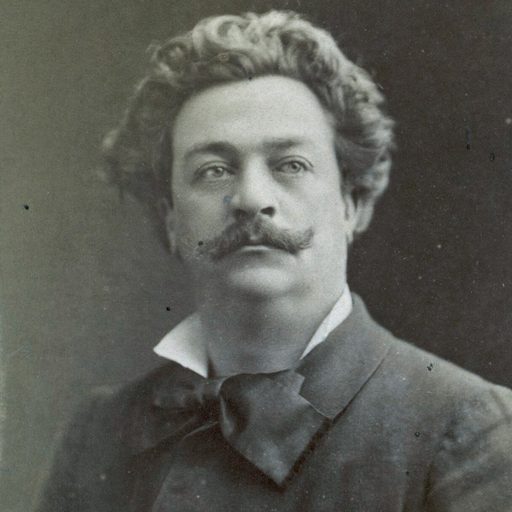
At La Lune and then L'Éclipse he invented the big-headed caricature portrait and was one of the most censored cartoonists of the Second Empire. The sign he painted on the rue des Saules, a rabbit leaping out of a saucepan, gave its name to the Lapin Agile. He died at forty-four in the asylum of Charenton.
The story
Born in 1840, the natural son of a count who never acknowledged him, Louis-Alexandre Gosset de Guines took the name André Gill in homage to Gillray, the English caricaturist. He made his mark in the 1860s at the paper La Lune, then at L'Éclipse, with his big-headed portrait-charges: a graphic invention that set the fashion across the press.
Under the Second Empire every issue was a trial of strength with the censor. La Lune was banned in 1868; Gill brought it back the following month under the title L'Éclipse. His drawings of Rochefort, Thiers, Hugo and Napoleon III are among the most widely circulated political images of the century.
In Montmartre he painted, for a cabaret in the rue des Saules, a sign showing a rabbit leaping out of a saucepan. People said “le lapin à Gill”, Gill's rabbit, and then the Lapin Agile: the name stayed with the cabaret, which is still there.
The mental crises began in 1881. Committed, released, committed again, he died in the asylum at Charenton on 1 May 1885, aged forty-four, and lies in Division 95, in the upper part of the cemetery.
On site, do not miss
A high and popular Division, that of the cabaret songwriters and the press cartoonists.
Visitors' questions
Where is André Gill's grave?
In Division 95 of Père-Lachaise, high up on the eastern side. The songwriter Eugène Pottier, who wrote The Internationale, and the singer Georges Moustaki rest in the same Division.
Georges Moustaki, Division 95Did André Gill create the Lapin Agile?
He created its sign, around 1875: a rabbit leaping out of a saucepan, painted for a tavern on the rue des Saules in Montmartre. People called it “le lapin à Gill”, Gill's rabbit, and the pun turned it into Lapin Agile — the nimble rabbit — the name the place still bears.
Honoré Daumier, caricaturistWhat is a portrait-charge?
A caricature that swells the sitter's head out of all proportion on a shrunken body. André Gill made it his signature at La Lune and then at L'Éclipse, from 1865 to 1876, and the device took over the whole French satirical press.
Tignous, Division 95How did André Gill die?
In the asylum at Charenton, on 1 May 1885, at forty-four. The illness had begun five years earlier; he was committed, came out, relapsed. His fellow draughtsmen held sales to support him through his last years.
Jean-Baptiste ClémentAudio guide to Père Lachaise: the best unusual guided tour!
Discover the secrets of the most astonishing tombs
the audio guidefrom€6.99