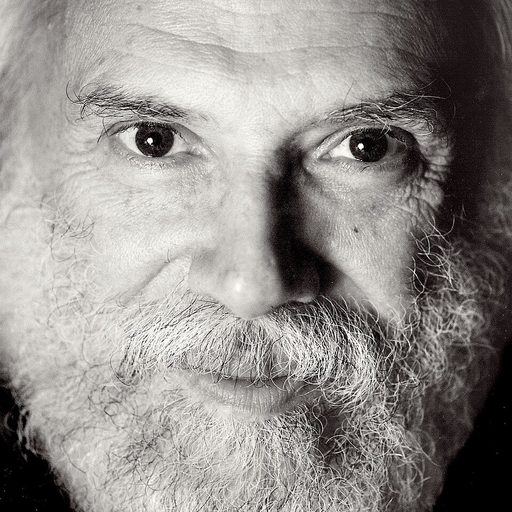
Georges Moustaki was born in Alexandria, to Greek Jewish parents from Corfu, and his name was Giuseppe Mustacchi. Arriving in the capital at seventeen, he borrowed his first name from Brassens, who taught him the trade; at twenty-five, he wrote Milord for Édith Piaf. Ten years would pass before he sang himself. Le Métèque, in 1968, turned an insult into a self-portrait.
The story
Giuseppe Mustacchi was born in Alexandria on 3 May 1934, to Greek Jewish parents from Corfu. He reached Paris at seventeen and took the first name Georges in homage to Brassens, who took him under his wing and taught him the trade.
In 1958 Brassens brought him into the Paris of song, and he met Édith Piaf. The following year he wrote “Milord” for her — he was twenty-five, and the song went round the world.
He wrote for Montand, Barbara and Serge Reggiani, and waited ten years before singing himself. “Le Métèque”, in 1969, turned a slur — the French word for an unwanted foreigner out of the south — into a self-portrait: with my foreigner's face, my wandering Jew's face, my Greek shepherd's face.
Then came “Ma solitude”, “Ma liberté”, “Joseph” — a voice more spoken than sung, one guitar, and an art of nonchalance that hides very tight writing.
He died at Nice on 23 May 2013, of emphysema, and lies in Division 95, a few paths away from the grave of Eugène Pottier.
The grave
A plain grave where the name is engraved alone — “Georges Moustaki” — and where the essential sits on a plaque: “Georges Moustaki, auteur – compositeur – interprète, Quand son âme l'a quitté, un rossignol quelque part a chanté. 03/05/1934 – 23/05/2013.” The three words of the trade, then a line — when his soul left him, somewhere a nightingale sang — that could be a verse of his own. It is one of the rare recent epitaphs in the cemetery to take this tone, halfway between the register office and the song.
On site, do not miss
The plaque and its line about the nightingale, beneath the three words of the trade: author, composer, performer.
Visitors' questions
Where is Georges Moustaki's grave?
In Division 95, Avenue Transversale No. 2, first row, in the upper, eastern part of the cemetery — the Division of the monument to Eugène Pottier, who wrote the words of The Internationale.
Eugène PottierWhat is carved on his grave?
His name, and on a plaque these words: “Georges Moustaki, auteur, compositeur, interprète. Quand son âme l'a quitté, un rossignol quelque part a chanté” — singer-songwriter; when his soul left him, somewhere a nightingale sang. Then his two dates, 1934 and 2013.
Jacques HigelinDid he write for Édith Piaf?
“Milord”, in 1959, at twenty-five: the song went round the world. It was Brassens who had brought him into the Paris song world the year before, and he also wrote for Montand, Barbara and Serge Reggiani.
Édith PiafWhy was he called Georges?
In homage to Georges Brassens, who had taken him on as a pupil: born Giuseppe Mustacchi in Alexandria, to Greek parents from Corfu, he arrived in Paris at seventeen and adopted the first name.
Henri SalvadorAudio guide to Père Lachaise: the best unusual guided tour!
Discover the secrets of the most astonishing tombs
the audio guidefrom€6.99