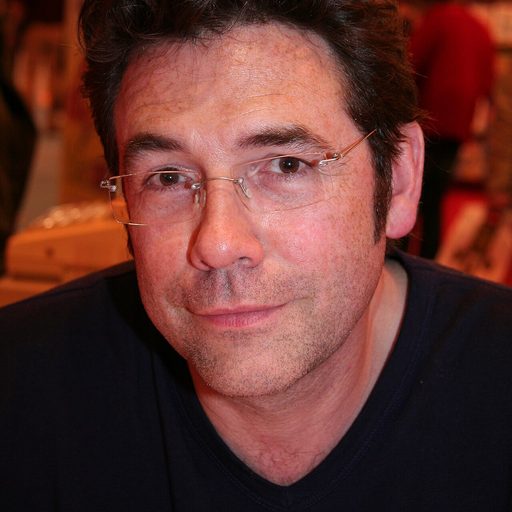
Bernard Verlhac had trained in furniture-making at the École Boulle before living by press cartoons, which he signed Tignous: thick line, gentle bite, talkative characters. In 1985 he illustrated a role-playing game that generations of players know by heart, a part of his work the satirical papers long overlooked. A father of four, he was murdered in January 2015; his family chose for him a line by Éluard.
The story
“Tu rêvais d'être libre, et je te continue” — you dreamed of being free, and I carry you on. The line is Paul Éluard's, and it was his family who chose it. The stone speaks of freedom and of carrying on; it says nothing of the attack.
Born in Paris on 21 August 1957, Bernard Verlhac trained at the École Boulle — the school of furniture and craft — before making press cartooning his trade under the name Tignous. A thick line, a gentle ferocity, characters who talk too much. He drew for Charlie Hebdo, Marianne and Fluide glacial, and in 1985 illustrated the role-playing game Rêve de dragon — a side of his work the satirical press long ignored and that a whole generation of players knows by heart.
The father of four children, he was murdered on 7 January 2015 in the editorial meeting of Charlie Hebdo. His funeral was held at the town hall of Montreuil, where Ibrahim Maalouf played.
The stone is cut “Bernard VERLHAC, dit TIGNOUS. 1957-2015”, and then the line by Éluard. In the same Division lies the caricaturist André Gill, who died in 1885: two press cartoonists a hundred and thirty years apart.
The grave
The inscription gives both names, the civil one then the signature: “Bernard VERLHAC, dit TIGNOUS. 1957-2015.” Then a line by Paul Éluard, chosen by his family: “Tu rêvais d'être libre, et je te continue.” — you dreamed of being free, and I carry you on. Nothing of 7 January, nothing of Charlie Hebdo: the stone speaks of freedom and continuation, not of the attack.
On site, do not miss
The epitaph is a line by Paul Éluard: “Tu rêvais d'être libre, et je te continue” — you dreamed of being free, and I carry you on. The first word on the stone, though, is his real name: Bernard Verlhac.
Visitors' questions
Where is Tignous's grave?
In Division 95, avenue Greffulhe, first row. The epitaph is a line by Paul Éluard. The Division is also that of the caricaturist André Gill, who died in 1885: two press cartoonists a hundred and thirty years apart.
André GillHow did Tignous die?
Murdered on 7 January 2015 in the editorial meeting of Charlie Hebdo, along with Cabu, Charb, Wolinski, Honoré and five other people. His funeral was held at Montreuil town hall, where Ibrahim Maalouf played.
Philippe HonoréWhat does Tignous's epitaph say?
“Tu rêvais d'être libre, et je te continue” — you dreamed of being free, and I carry you on — a line by Paul Éluard. Père-Lachaise has few epitaphs borrowed from poets: Daniel Cordier's, in Division 27, is by Rimbaud. On Tignous's stone, the line comes after his real name, Bernard Verlhac.
Daniel CordierWhich papers did Tignous draw for?
Charlie Hebdo, Marianne and Fluide glacial, among others. In 1985 he had also illustrated the role-playing game Rêve de dragon, a corner of his work the satirical press long ignored and that a whole generation of players knows by heart.
Honoré DaumierAudio guide to Père Lachaise: the best unusual guided tour!
Discover the secrets of the most astonishing tombs
the audio guidefrom€6.99