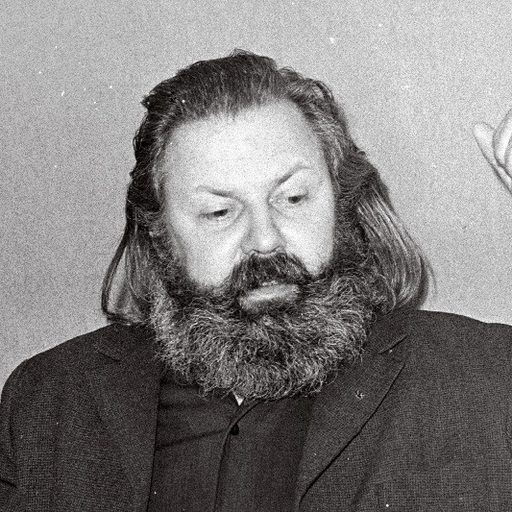
Vladimir Orgusaar studied history in Siberia, then cinema in Moscow: all his schooling thus came from the Soviets, he who would end up a refugee in France. An Estonian film-maker and journalist, he filmed what the regime would not allow, in a country that would not regain its independence until 1991. Three words designate him, one of which no one else had engraved here: subversive.
The story
“Cinéaste subversif, réfugié en France, combattant pour la liberté de l'Estonie.” The epitaph reads like a manifesto: three descriptions, two of them political positions and one an administrative status — “réfugié” stands there like a civil condition. The word “subversif,” claimed on a gravestone, is to be read on no other stone at Père-Lachaise.
Born in Tallinn on 14 December 1931, Vladimir Georg Orgusaar studied history at the University of Tomsk, in Siberia, from 1955 to 1958, then film at the VGIK in Moscow, the school of Soviet cinema, from which he graduated in 1965. Two entirely Soviet trainings, for a man who would end as a refugee.
A film-maker and a journalist, he made a cinema the regime would not allow. His country was then a Soviet republic; it would not become independent again until 1991.
He died on 27 January 2015, at eighty-three, and lies in Division 62. He outlived by twenty-four years the independence he had demanded — long enough to see it come.
The grave
An inscription that reads like a manifesto: “V.G. KARASJOV-ORGUSAAR, (1931-2015), cinéaste subversif, réfugié en France, combattant pour la liberté de l'Estonie.” — subversive film-maker, refugee in France, fighter for the freedom of Estonia. Three qualifications, two of which are political positions and one an administrative status — “réfugié”, refugee, appears there like a civil condition. The word “subversif”, claimed on a gravestone, is read on no other stone in the cemetery.
On site, do not miss
The epitaph is a political statement: “cinéaste subversif, réfugié en France, combattant pour la liberté de l'Estonie” — subversive film-maker, refugee in France, fighter for the freedom of Estonia. Few stones in the cemetery lay claim to subversion.
Visitors' questions
Where is his grave?
In Division 62 of Père-Lachaise, not far from the Kurdish film-maker Yilmaz Güney and the writer Joseph Joffo. His epitaph is one of the most political in the cemetery: “cinéaste subversif, réfugié en France” — a subversive film-maker, a refugee in France.
Yilmaz GüneyWhat does “cinéaste subversif” mean?
It is the term his own stone claims. Trained at the VGIK, the Moscow film school, he made films the Soviet regime would not have, and had to take refuge in France — subversion was his relation to the state that had trained him.
Léon MiloWhat was he fighting for?
For the freedom of Estonia, the country he was born in, then a Soviet republic. Independence did not come back until 1991 — he lived twenty-four years beyond it, long enough to see it happen.
Nestor MakhnoWhere had he studied?
History at the university of Tomsk first, in Siberia, from 1955 to 1958; then film at the VGIK in Moscow, where he took his diploma in 1965. Two entirely Soviet trainings, for a man who would end as a refugee.
Joseph JoffoAudio guide to Père Lachaise: the best unusual guided tour!
Discover the secrets of the most astonishing tombs
the audio guidefrom€6.99