Since 1896, a legend has promised the Demidoff fortune to anyone who keeps a year-long vigil over a Russian princess's glass coffin at Père-Lachaise. The mausoleum exists, in Division 19. So does the princess. But the glass coffin, the will and the fortune are a newspaper invention.
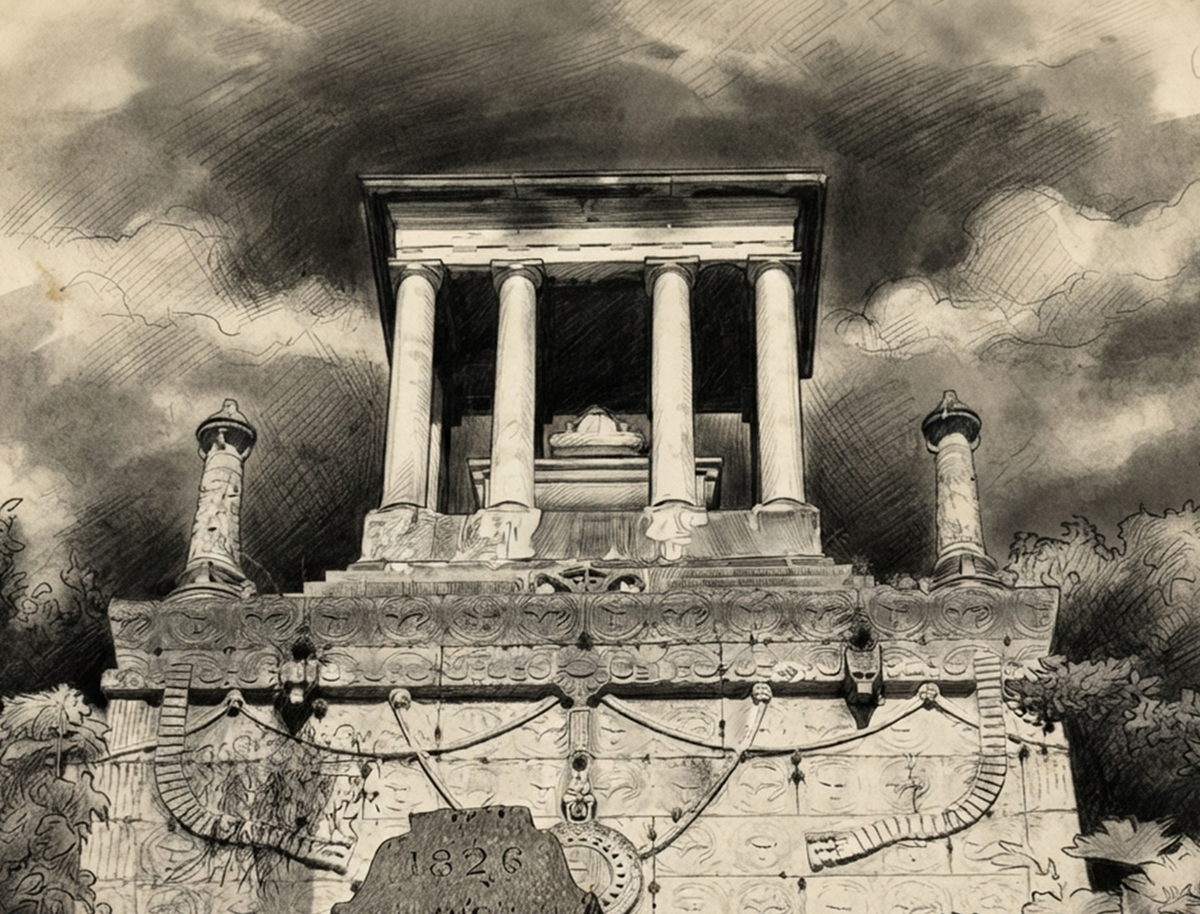
The Demidoff mausoleum, in Division 19 of Père-Lachaise, is one of the cemetery's most imposing monuments. Ten Doric columns of Carrara marble, a sarcophagus in the antique style, and a massive base decorated with gold-beater's hammers, sable pelts and wolves' heads — emblems of the family fortune, built on mining and the Central Asian fur trade. The monument sits atop the so-called *falaise de Charonne* (the “Charonne cliff”), on chemin du Dragon, visible from afar. And for more than a century, this mausoleum has been tied to one of the most persistent legends at Père-Lachaise: that of Countess Demidoff's glass coffin and fantastical will.
The woman who lies in the mausoleum is Baroness Elisabeth Alexandrovna Strogonoff, born on 5 February 1779. At sixteen, she married Nicolas Demidoff, a Russian diplomat and industrialist. The couple had four children. After years of separation, Elisabeth returned to live in Paris, where she died on 8 April 1818, at thirty-nine. She was buried at Père-Lachaise in an earlier monument, in Division 39. In 1851, Anatoly Demidoff, the younger son, Prince of San Donato and husband of Princess Mathilde — a cousin of Napoleon III — had the mausoleum taken apart stone by stone and rebuilt in Division 19, on a reinforced base designed by the architect Jean Charles Danjoy. More than thirty people — family, servants, relatives — would be buried in this tomb over the following decades. There is nothing mysterious in this story: a Russian aristocrat who died young, and a wealthy son honouring his mother's memory.
The curator of Père-Lachaise has received thousands of letters of application. The last is said to date from 1984. More than thirty people rest in the mausoleum: no easy thing, sharing it for even a year with a mysterious countess.
The legend was born in 1896 — seventy-eight years after Elisabeth's death. On 2 November 1896, the journalist Adolphe Brisson published an interview in *Le Temps* with the curator of Père-Lachaise, who recounted the story with amusement. The tale, the curator said, had originated “some years back, on page three of some boulevard newspaper”. The article described a great Muscovite lady, immensely wealthy, resting in a coffin of rock crystal beneath a polychrome dome. The princess, the article claimed, had lodged a will with a Paris notary: she left her entire fortune — some two million roubles — to whoever agreed to shut themselves in the vault for 365 days and 366 nights, without leaving the body for a single second. The princess had no objection to a companion feasting lavishly beside her, or reading amusing books. The tale, reprinted in the French, European and American press, set off a flood of applications.
According to the account published in *Le Temps*, the curator of Père-Lachaise received thousands of letters from would-be vigil-keepers — letters from France, from Europe, from America, all asking for details about the “fairy-tale princess” and the conditions for inheriting the fortune. The curator answered every one that there was no will, no glass coffin and no fortune to leave. But the legend, like all legends, resisted denial. The last letter of application is said to date from 1984 — nearly a century after the tale was first published. American journalists visiting Père-Lachaise in the 1880s and 1890s had found that the cemetery gave off a “mysterious air, lending itself to every legend”. The Demidoff mausoleum, with its marble columns and its dramatic position atop the cliff, provided the perfect setting.
The Demidoff mausoleum, in Division 19, still stands. The ten Doric columns of Carrara marble still frame the antique sarcophagus. The sable pelts and wolves' heads carved into the base by Danjoy have not moved. Roses are sometimes left at the foot of the monument. The glass-coffin legend appears in most Père-Lachaise guidebooks, told at times as fact, at times as a curiosity. No glass coffin lies in the mausoleum. No will was ever lodged with a Paris notary. More than thirty people rest in the tomb — which would make a year-long stay rather crowded. The legend of Countess Demidoff is one of the finest inventions of Père-Lachaise folklore: a nineteenth-century press hoax that the twenty-first century keeps retelling.
Is the story of the glass coffin at Père-Lachaise true?
No. The legend of Countess Demidoff's glass coffin is a nineteenth-century press hoax, born in a Paris newspaper before 1896. The Demidoff mausoleum in Division 19 is real, but the rock-crystal coffin and the two-million-rouble will are fiction.
Who is buried in the Demidoff mausoleum at Père-Lachaise?
The Demidoff mausoleum in Division 19 holds the remains of Élisabeth Alexandrovna Strogonoff (1779-1818), Nicolas Demidoff (1773-1851), Anatoly Demidoff, Prince of San Donato (1813-1870), and more than thirty other family members and relatives.
Père-Lachaise has inspired many legends: Countess Demidoff's glass coffin (Division 19), the fertility ritual at Victor Noir's recumbent effigy (Division 92), nocturnal occult rituals, and supposed direct passages to hell. Most are nineteenth-century inventions.
The Demidoff mausoleum stands in Division 19 at Père-Lachaise, on Chemin du Dragon, at the top of the “Charonne cliff”. The Carrara-marble monument, with its ten Doric columns, is visible from afar and ranks among the cemetery's unmissable monuments.
 Mysteries