A Hundred and Twenty-Six Names and a Cinematograph
On 4 May 1897, the fire at the Bazar de la Charité, on the Rue Jean-Goujon, killed a hundred and twenty-six people — mostly women of the Parisian aristocracy. A monument to the unidentified victims stands in Division 92 of Père-Lachaise, and the disaster gave rise to forensic odontology.
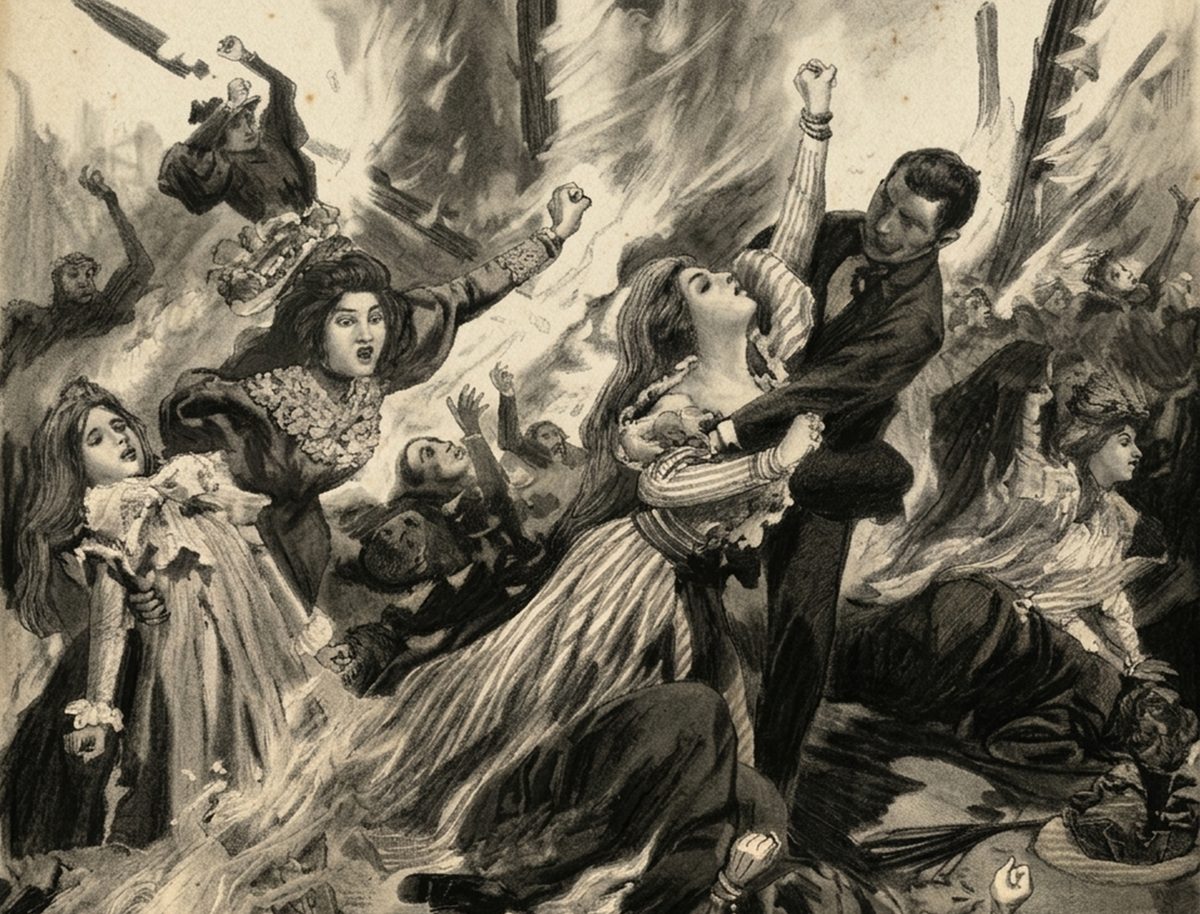
On the afternoon of 4 May 1897, some 1,200 people crowded into a large wooden shed on rue Jean-Goujon, in the 8th arrondissement, for the annual charity sale of the Bazar de la Charité. The crowd was made up largely of women from Parisian high society, there to buy goods in aid of Catholic charities. The shed, dressed up as a “reconstructed medieval street” with papier-mâché and paper scenery, housed a new attraction: the cinematograph. The projectionist, working in too cramped a space, used an ether lamp to power the projector. While changing a reel, in the half-dark, an assistant struck a match near the open ether can. The ether caught fire and spread to the film and the scenery. Within minutes, the shed was an inferno. 126 people died — among them the Duchess of Alençon, sister of Empress Sisi of Austria.
The speed of the fire gave no one a chance. The papier-mâché and canvas scenery went up instantly. The shed's canvas ceiling collapsed within seconds. Panic was total. The press of the day condemned the “cowardice” and “spinelessness” of the society men present, mockingly dubbed *chevaliers de la pétoche* and *marquis d'Escampette* (roughly, “knights of funk” and “lords of the bolt”): some accounts claim men struck with their canes at the women and children trying to get out. Rescuers arriving from outside could only watch the disaster helplessly. The next day, between 120 and 150 charred bodies were pulled from the rubble. The Duchess of Alençon, Sophie Charlotte in Bavaria, who had been presiding over a sales counter, was identified by her dentist from gold fillings — the first documented case of identification by forensic odontology.
The projectionist, struggling in the dark, struck a match beside the ether can feeding the cinematograph lamp. The ether ignited. Within minutes, the wood-and-papier-mâché hall was an inferno.
Identifying the bodies was a nightmare. The victims were burned beyond recognition. Families filed through the Palais de l'Industrie, turned into a makeshift morgue, trying to recognise a piece of jewellery, a garment, a set of teeth. The identification of the Duchess of Alençon by Dr Davenport, an American dentist based in Paris, marks the birth of forensic odontology: specialists date the founding act of the discipline to 4 May 1897. The state funeral was held on 8 May at Notre-Dame, attended by President Félix Faure. The Duc d'Aumale, a son of Louis-Philippe, died of a heart attack on 7 May 1897, after finishing some twenty letters of condolence to the families of the victims. Several bodies were never identified.
The Bazar de la Charité fire had considerable technical and social consequences. The cinematograph, blamed for causing the disaster, suffered an immediate loss of standing that slowed the popularity of the new medium. Technical improvements were mandated: take-up reels became compulsory, projection booths had to be fireproofed, and ether was banned as a fuel. Safety standards in places of public entertainment were tightened. Socially, the disaster struck at the heart of the Parisian Catholic aristocracy: some of its oldest families — Maillé, d'Uzès, Bonneval, du Plessis — counted victims among them. The chapel of Notre-Dame-de-Consolation, built in 1900 by Albert Guilbert on the site of the disaster, on rue Jean-Goujon, houses a permanent memorial.
At Père-Lachaise, a monument stands in Division 92, raised by the City of Paris on a free perpetual plot granted by a prefectoral order of 28 February 1899. The inscription is plain: *Aux victimes non reconnues de l'incendie du Bazar de la Charité, 4 mai 1897. La ville de Paris.* (“To the unidentified victims of the Bazar de la Charité fire, 4 May 1897. The City of Paris.”) The monument holds the remains of victims whose identity could never be established. Other, identified victims lie in family graves scattered across the cemetery. The Duchess of Alençon herself is buried in Dreux, in the royal chapel. Of the event, what remains at Père-Lachaise is this plain monument in Division 92, the chapel of Notre-Dame-de-Consolation on rue Jean-Goujon — and the invention of a scientific discipline, forensic odontology, born of the need to name the dead when their faces were gone.
The Bazar de la Charité fire, on 4 May 1897, destroyed a wooden hall on Rue Jean-Goujon in Paris's 8th arrondissement during a charity sale. The blaze, sparked by the ether used in a cinematograph projector, killed 126 people, mostly women from the Parisian aristocracy.
Is there a monument to the Bazar de la Charité at Père-Lachaise?
Yes. A monument to the unidentified victims of the Bazar de la Charité fire stands in Division 92 at Père-Lachaise, raised by the City of Paris in 1899. Identified victims rest in family graves scattered across the cemetery.
On 4 May 1897, the Duchess of Alençon, burned beyond recognition in the Bazar de la Charité fire, was identified by her gold dental fillings, examined by the dentist Davenport. Specialists date the birth of forensic odontology to this identification.
Is the Duchess of Alençon buried at Père-Lachaise?
No. The Duchess of Alençon, Sophie Charlotte in Bavaria, who died in the Bazar de la Charité fire on 4 May 1897, is buried at Dreux, in the royal chapel. At Père-Lachaise, the Division 92 monument holds the remains of the unidentified victims.
 History