In the nineteenth century, the fear of being buried alive haunted Parisian families. Dozens of safety coffins were patented, fitted with bells, breathing tubes and cords tied to the corpse's fingers — an anxiety that left its mark on the history of Père-Lachaise.
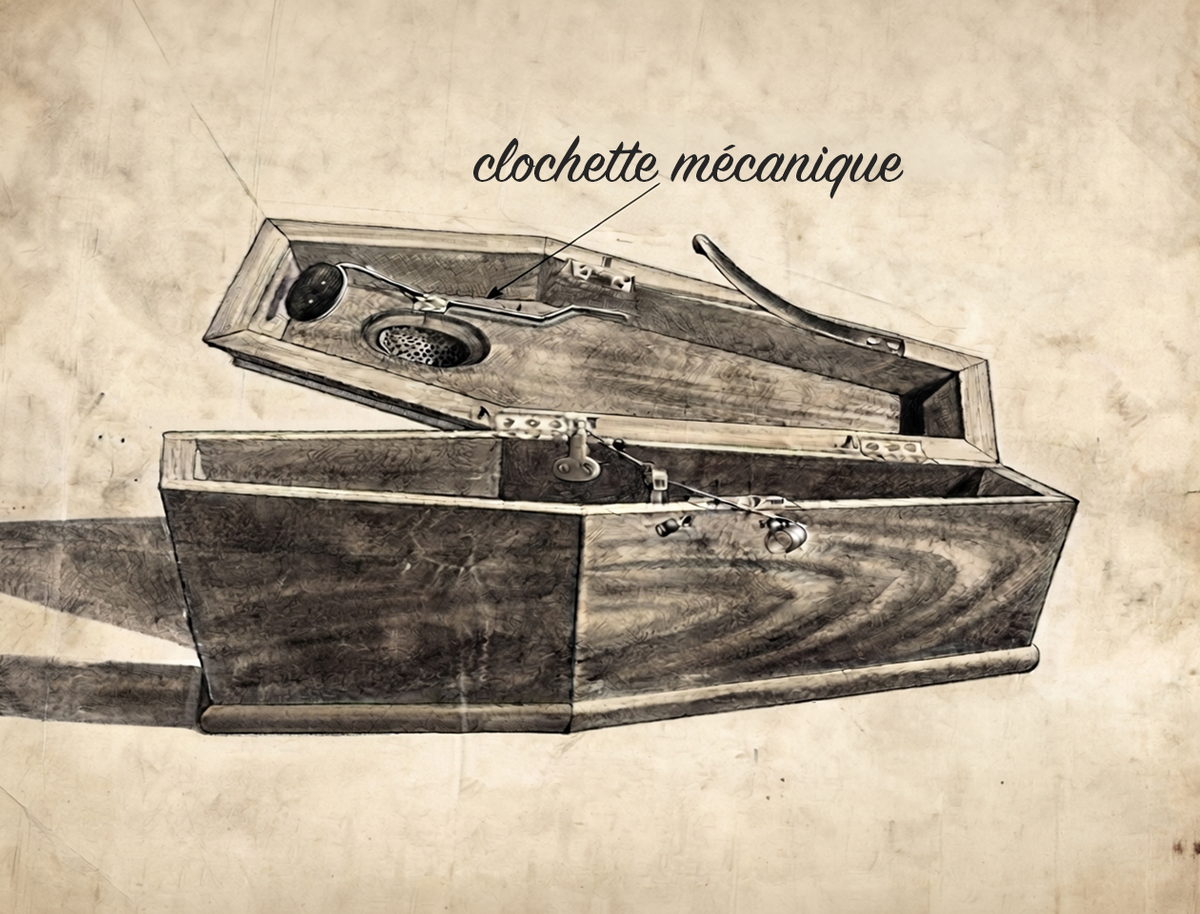
In 1903, an English inventor named Jephson filed a patent for a safety coffin. The device included a tube running to the surface to supply fresh air, an electric bell the supposedly dead person could ring from inside, and a flag that would rise above the grave at the slightest movement. Jephson's patent was no isolated curiosity: between 1830 and 1910, dozens of safety-coffin patents were filed in France, Germany, England and the United States. All answered the same terror: being buried while still alive. This fear, which seems irrational today, was an ordinary anxiety in the nineteenth century — one that touched rich families as much as poor ones, doctors as much as patients, and one that left its traces in the vaults of Père-Lachaise.
The fear of premature burial rested on a real medical fact: in the nineteenth century, the diagnosis of death was uncertain. Catalepsy — a state in which the body stiffens, the pulse becomes imperceptible and breathing undetectable — could last several hours, sometimes several days. Lethargy, prolonged fainting and certain forms of coma made diagnosis impossible without the tools of modern medicine. Newspapers of the day regularly reported cases of people buried alive — real or supposed — that fed popular terror. The cholera epidemic of 1832, which sent thousands of bodies to Père-Lachaise within a few weeks, made the panic worse: the dead were so numerous that doctors had no time to check each death. Stories circulated claiming that coffins opened afterwards showed scratch marks on the inside of the lid. Edgar Allan Poe published *The Premature Burial* in 1844 — proof that the obsession crossed the Atlantic as readily as the Channel.
A cord was tied to the dead person's finger. It ran through the coffin lid, up a tube to the surface, and rang a bell. If the dead person was not actually dead, all they had to do was move a finger.
The nineteenth century's answer to this terror was technical. In Germany, municipal mortuary halls — the Leichenhäuser — were built in major cities from the 1790s. Bodies were laid out there for three to five days, watched over by an attendant. Cords tied to the corpses' fingers led to a system of bells: at the slightest movement, the bell rang and the attendant came running. In France, the legal twenty-four-hour delay between death and burial, set by the imperial decree of 23 Prairial Year XII — the same decree that created Père-Lachaise — was meant precisely to prevent premature burials. But twenty-four hours was not enough to reassure families. Inventors kept filing patents: double-bottomed coffins with an air reserve, coffins with a window to observe the dead person's face, coffins fitted with bells, whistles, or light signals. Dr Karnice-Karnicki's safety coffin, presented at the Sorbonne in 1897, had a tube, a metal box placed on the grave, a bell and a flag.
The fear of premature burial faded gradually at the turn of the twentieth century. The stethoscope, the electrocardiogram, and then the medical definition of brain death made the diagnosis of death reliable. The German mortuary halls closed one after another. Safety-coffin patents stopped being filed. Newspapers no longer printed stories of people buried alive. In France, the introduction of the compulsory death certificate, signed by a doctor, finally reassured families. The terror that had haunted an entire century vanished within a generation — so quickly that the twenty-first century finds it hard to believe it ever existed.
At Père-Lachaise, nothing signals this fear. No inscription mentions a safety coffin, no tube emerges from a grave, no little bell juts from a vault. But the fear is there, invisible, written into the twenty-four regulatory hours that still separate death from burial today — a delay the nineteenth century imposed because it was afraid its dead might not be dead. It is there in the vaults of bourgeois families in the older divisions, who paid to have the body watched over for as long as possible before burial. It is there in the practice of embalming, which guaranteed — among other things — that a body treated by the Gannal method was truly a corpse. Père-Lachaise was born of this anxiety as much as of the imperial decree: the modern cemetery, with its individual plots, its sealed vaults and its legal delays, is the answer of a society that feared confusing sleep with death.
No documented case of premature burial is recorded at Père-Lachaise. But the fear of premature burial haunted the nineteenth century and prompted the legal 24-hour delay between death and burial, established by the 1804 imperial decree that created the cemetery.
What was a safety coffin in the nineteenth century?
A safety coffin was a coffin fitted with devices allowing a person buried alive to signal that they had survived — a bell wired to the fingers, an air tube, a light signal or a flag. Dozens of patents were filed in Europe and the United States between 1830 and 1910.
Why was there a wait before burying the dead in the nineteenth century?
In the nineteenth century, the diagnosis of death was uncertain: catalepsy, lethargy and prolonged fainting could all mimic death. The imperial decree of 1804 imposed a 24-hour delay between death and burial to prevent premature interment.
What link is there between the 1832 cholera epidemic and the fear of being buried alive?
The 1832 cholera epidemic in Paris amplified the terror of premature burial. The dead were so numerous that doctors lacked time to verify each death, and stories of people buried alive circulated in the press of the day.
 Society