Jim Morrison died in Paris on 3 July 1971 and was buried in Division 6 of Père-Lachaise five days later, before five people. The Doors singer's grave has become the cemetery's most visited place of pilgrimage — and its administration's most stubborn problem.
On 7 July 1971, five people attended Jim Morrison's burial in Division 6 of Père-Lachaise: Pamela Courson, his partner; Agnès Varda, the filmmaker and neighbour from the building on rue Beautreillis; Alain Ronay, a French friend; Robin Wertle, the Doors' European manager; and Bill Siddons, the band's manager. No religious ceremony, no speeches, no press. Morrison had died four days earlier, on 3 July, in the bathtub of his flat at 17 rue Beautreillis, in the Marais. The exact cause of death has never been established with certainty: no autopsy was performed. Pamela Courson chose Père-Lachaise because Morrison loved the cemetery and admired the poets buried there — Balzac, Molière, La Fontaine. The plot, at first temporary, was a small patch of ground with no monument, marked by a plain plaque.
Jim Morrison's grave stayed unremarkable for about ten years. Then the pilgrimage began, driven by the myth of the “27 Club” — musicians who died at twenty-seven —, by the release of Oliver Stone's film in 1991, and by the lasting fascination with the Doors. Fans came from all over the world. They left flowers, letters, whiskey bottles, joints. They wrote messages on neighbouring graves, scratched graffiti onto steles, left litter behind. The adjoining plots were vandalised, and the families involved filed complaints. By the 1990s, Morrison's grave had become a public-order problem. The cemetery put up metal barriers around the plot, then security cameras. A guard was permanently assigned to the area. Graffiti was cleaned off, litter picked up, and unruly fans escorted to the exit.
Five people at the funeral in 1971. Three million visitors a year half a century later. No grave at Père-Lachaise has had a trajectory as dramatic as Jim Morrison's.
In 1990, a bronze bust of Morrison, commissioned by the Courson family and made by the Croatian sculptor Mladen Mikulin, was placed on the grave. The bust was stolen a few months later — never recovered. The grave returned to its plainness: a flat slab, a bronze plate bearing the Greek inscription “KATA TON DAIMONA EAYTOY” — “faithful to his own demon” —, the name, the dates, and nothing else. A nearby tree is covered in chewing gum stuck on by visitors. The surrounding graves are marked with graffiti, arrows and “Jim →” signs to guide pilgrims. Division 6, one of the oldest at Père-Lachaise, with its neoclassical steles and First Empire monuments, has become a tourist corridor.
Jim Morrison's grave transformed Père-Lachaise. Before the 1980s, the cemetery drew a public made up chiefly of families, genealogists and strollers. Morrison's grave brought in a new crowd — young, international, noisy — that changed the atmosphere of the place. The cemetery administration had to adapt its rules: more prohibition signs, tighter surveillance, dedicated visitor routes to manage the flow. Paradoxically, the pilgrimage around Morrison also introduced Père-Lachaise to millions of people who would otherwise never have come. Many visitors arrive for Morrison and leave having discovered Chopin, Wilde, Proust and Balzac. The cemetery's most troublesome grave is also its best advertisement.
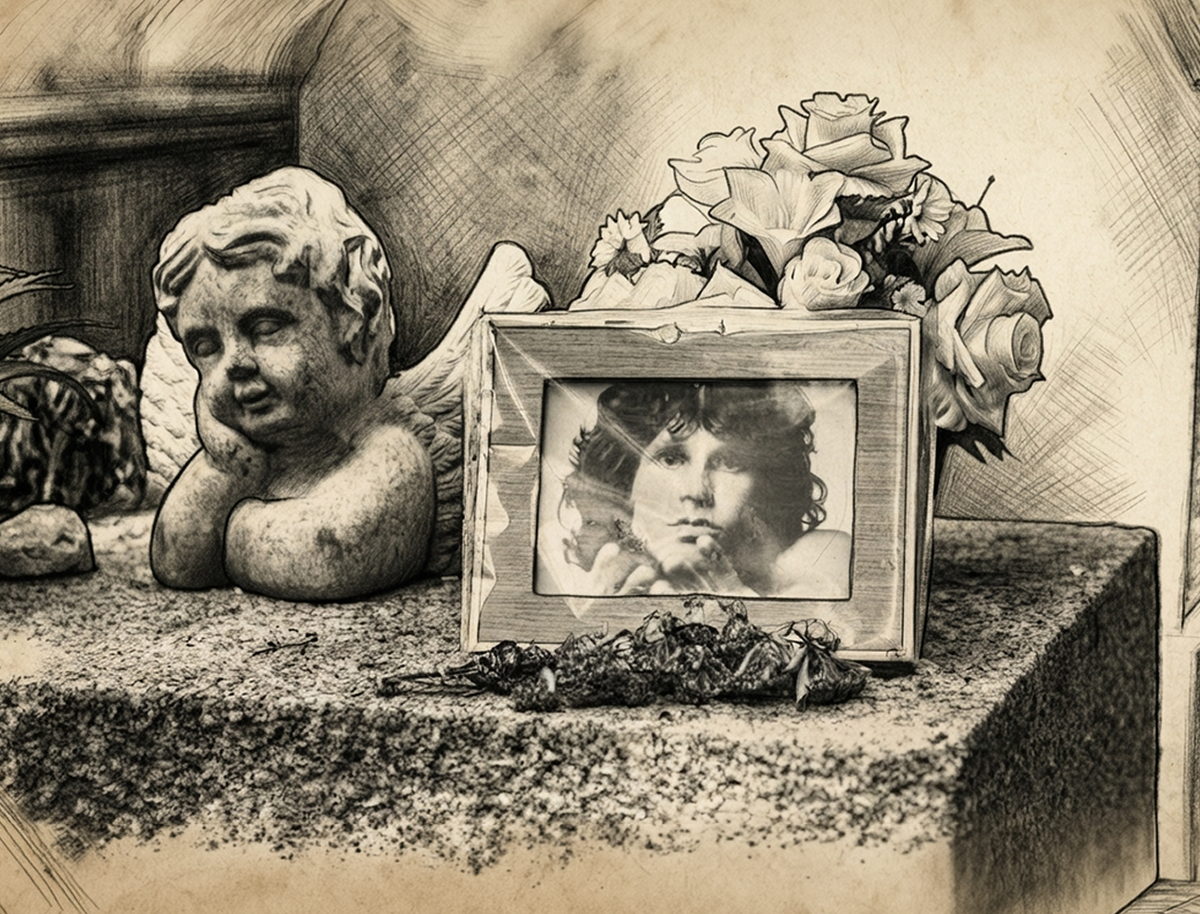
Jim Morrison's grave, in Division 6, remains the most visited at Père-Lachaise. The metal barriers are still in place. A guard watches over the area. The plain, flat granite slab still bears the Greek inscription and the bronze plate. No more bust, no more graffiti on the grave itself — though the neighbouring steles still carry its traces. Fresh flowers are laid there every day. The contrast between the modesty of the grave and the intensity of the devotion it inspires sums up Morrison's paradox at Père-Lachaise: a twenty-seven-year-old American rock singer, buried without ceremony in a nineteenth-century Parisian cemetery, who in half a century became the most famous resident of a place that holds Molière, Chopin and Proust.
Jim Morrison's grave lies in Division 6 at Père-Lachaise, one of the cemetery's oldest Divisions. The grave is a flat granite slab bearing a bronze plaque inscribed, in Greek, “KATA TON DAIMONA EAYTOY” (true to his own spirit).
Pamela Courson, Jim Morrison's partner, chose Père-Lachaise because the singer loved the cemetery and admired the writers resting there — Balzac, Molière, La Fontaine. Morrison died in Paris on 3 July 1971, in his flat in the Marais.
Is Jim Morrison's grave the most visited at Père-Lachaise?
Yes. Jim Morrison's grave in Division 6 is the most visited grave at Père-Lachaise, ahead of Oscar Wilde's (Division 89) and Frédéric Chopin's (Division 11). Barriers and a permanent guard have protected the area since the 1990s.
Jim Morrison died on 3 July 1971 in the bathtub of his flat at 17 Rue Beautreillis, in the Marais, aged 27. The exact cause of death was never established with certainty, since no autopsy was performed.
 Figures